
Vandaag of morgen in huis

Kwaliteit gegarandeerd

Welkomstaanbiedingen ontgrendelen: GRATIS bezorging | Tot 80% korting | Gratis 30 dagen JoyPlus-proefperiode
Download de app
Loose papers on your desk, post piling up and folders constantly being moved around: an A4 wall-mounted document holder can save a lot of space. But not every A4 wall holder is suitable for everyday use. A shallow pocket, unclear dimensions or poor mounting can cause documents to curl, fall out or be difficult to reach.
Use the points below to compare a metal wall holder, wall-mounted document holder and wall-mounted file holder based on practical features rather than marketing claims.
A wall holder with lots of pockets may seem useful, but check the height of each pocket and the total amount of wall space it will take up. A model with ten tiers, for example, can be over 81 cm tall. It won’t necessarily fit above every desk or beside every door.
Think about how you want to organise your documents beforehand:
A holder for standard A4 paper isn’t always suitable for thick ring binders or several full files. Check the internal width and pocket height. Some models have an internal width of 31,5 cm, while a landscape model is around 35 cm wide and 21,5 cm high.
A wall-mounted letter holder for loose envelopes has different requirements from an office file holder for filled folders. So choose based on what you actually want to store.
A wall-mounted file holder often comes with screws, but the right wall plugs depend on the surface. Concrete, brick, plasterboard and a wooden panel don’t always need the same fixings.
Before installation, check:
The product descriptions recommend fixing the holder securely, using suitable wall anchors and not exceeding the recommended load capacity.
A metal wall holder is generally a good choice if you’re looking for a permanent organiser for everyday use. The Senhoglb models are made of metal with a powder-coated finish. According to the manufacturer’s product description, this finish is designed to help prevent oxidation and rust. This is a product specification, not a guarantee that the product will remain rust-free in all conditions.
For a longer service life, these details are particularly relevant:
A landscape model gives you easy access to A4 documents, magazines, post and forms. An upright model uses more vertical space instead. Measure not only the wall but also the space in front of the holder. A document organiser that sticks out too far can get in the way in a narrow hallway or beside an office chair.
Check:
A six-tier model lets you organise documents into several categories. A single pocket makes more sense if you only want to collect post, papers for a current project or magazines. A ten-pocket model may be more practical for an office with lots of invoices and files, provided there’s enough wall space.
An integrated label plate helps you see the categories at a glance. Check whether the labels are easy to replace if your filing system changes.
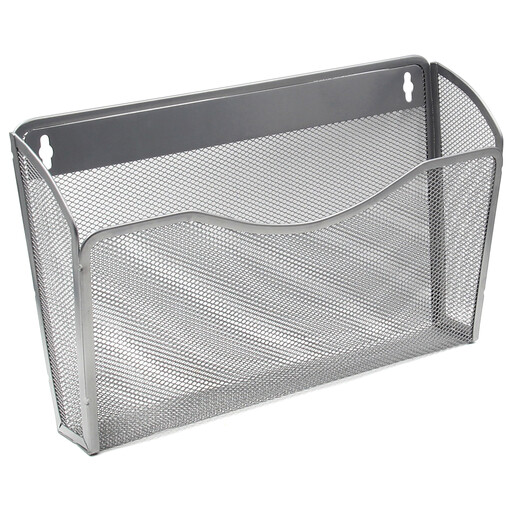
Why it suits this user: A single pocket is ideal if you want to create one dedicated spot for post, forms or papers for a current project without taking up much wall space.
You don’t pay for pockets you won’t use, and you can easily compare its dimensions of 35 x 9 x 21,5 cm with the wall space available.
Lightweight model at around 0,42 kg, metal construction, suitable for standard A4 paper and supplied with mounting screws.
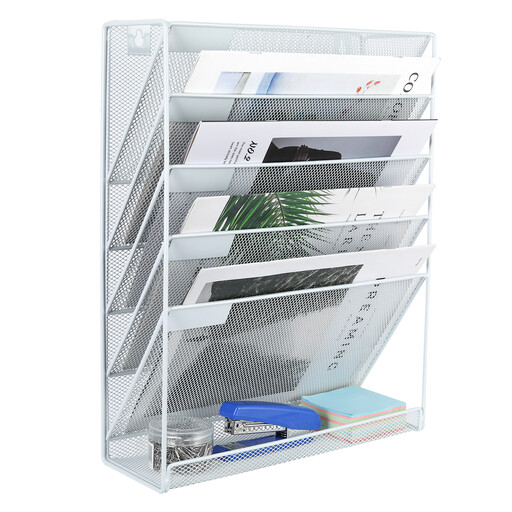
Why it suits this user: The six pockets and label plates are a good fit for a home workspace or office where documents are sorted by topic every day.
The specifications list both the overall dimensions of 32,5 x 10,5 x 40,5 cm and an internal width of 31,5 cm, making it easy to check whether you have enough space.
Six tiers, integrated label plates, a bottom storage tray and the option to use it as a wall-mounted or desk organiser.
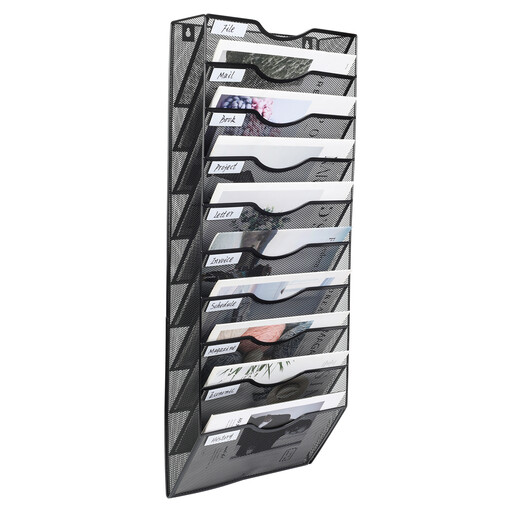
Why it suits this user: Ten pockets are designed for people dealing with lots of daily post, invoices, files, magazines or school documents.
Each pocket has a stated height of 7,5 cm, and the overall height is 81,5 cm. This helps you check in advance whether the extra capacity will make the pockets harder to reach.
Ten A4 pockets, label plates, curved access for easy paper retrieval and a metal body with a powder-coated finish, according to the product description.
We’ve put together a complete, up-to-date list of products that meet these strict selection criteria and current European safety regulations.
Mark the drill holes first and use a spirit level to check that the holder will hang straight. For a plasterboard wall, use suitable wall plugs and, if possible, attach a heavily loaded model to a sturdy part of the wall. The supplied screws are intended for installation, but always check that they’re suitable for your wall surface.
Clean the metal surfaces with a soft, dry cloth. For stubborn marks, you can use a slightly damp cloth. Avoid prolonged exposure to moisture, especially in an unheated storage room or near an open window.
Yes, a landscape model often works well as an A4 magazine holder, post holder or pocket for invoices. Check the internal dimensions if you want to store thicker magazines, folders or several bundles at once.
Use fixings that are suitable for your wall type. Mark the holes, drill with the right drill bit if needed, then check that the holder is firmly and straightly fixed in place. If it will be carrying a heavy load, using a suitable wall plug is more important than simply relying on the supplied screw.
Its lifespan depends on how it’s installed, how much weight it carries, how often it’s used and how much moisture it’s exposed to. A powder-coated metal model is easy to clean, but don’t exceed the recommended load and check the screws from time to time. This helps prevent wobbling, tilting and falls.
