
Vandaag of morgen in huis

Kwaliteit gegarandeerd

Welkomstaanbiedingen ontgrendelen: GRATIS bezorging | Tot 80% korting | Gratis 30 dagen JoyPlus-proefperiode
Download de app
Loose invoices, post, study papers and work documents can quickly take over a desk. An A4 wall file organiser with 6 compartments can help you sort papers vertically and keep them within easy reach. However, not all organisers are equally practical. The wrong dimensions, unsuitable wall fixings or an unclear layout can mean the holder soon goes unused.
This buying guide helps homeworkers, students, office workers and small businesses compare their options. We look at verifiable features such as dimensions, material, fixings and flexibility of use.
Six compartments sounds organised, but the height and depth of each compartment determine how easily documents can be taken in and out. So check not only the number of compartments, but also the internal width and compartment height. A holder designed for A4 paper may be too narrow for thick folders or documents in plastic sleeves.
A metal wall organiser gets heavier once it holds several files, magazines or piles of paper. Plasterboard, brick and concrete don’t always need the same wall plugs. Only use the supplied screws if they’re suitable for the wall surface. For other types of wall, you’ll need suitable wall anchors.
A mesh wall organiser may look tidy, but sharp edges, compartments that are hard to see or missing labels can make sorting more difficult. Look for rounded or neatly finished edges, a sturdy construction and clear labelling options. Positioning matters too: a holder above a desk is handy for post, while a model by the entrance can be useful for keys and incoming documents.
A4 paper measures 21 × 29,7 cm. For an A4 document holder, the internal width is particularly important. According to the product information, the Senhoglb 6 Tier A4 Mesh Wall File Holder has external dimensions of 32,5 × 10,5 × 40,5 cm and an internal width of 31,5 cm. Its six compartments are arranged vertically and designed for A4 documents.
Also check how much wall space you have available. A vertical wall organiser for papers saves desk space, but needs enough clear height. Measure the space in front of the holder too, so you can remove files without them hitting a shelf or cupboard.
Metal is generally more resistant to bending than thin plastic, but the finish also affects how easy the product is to clean. According to Senhoglb’s product description, the holder is made of metal with a powder-coated finish. The manufacturer says this coating helps prevent oxidation and rust; this is a product claim, not a guarantee for every environment.
For everyday use, the following features are practical:
It’s best not to leave a metal holder in a damp environment for long periods. Check the fixing points regularly, especially if you use the organiser frequently.
A wall-mounted file organiser frees up vertical space. A freestanding desk organiser, on the other hand, is handy if you’re not allowed to drill holes, such as in a rented home or student room. According to the product information, the Senhoglb 6 Tier mentioned here is suitable for both uses: wall-mounted or freestanding on a flat desk.
This dual-purpose design means you can change your setup later. Screws are included for wall mounting. The holder must be securely fixed and shouldn’t be loaded beyond what’s safe for its construction and the chosen wall fixings.
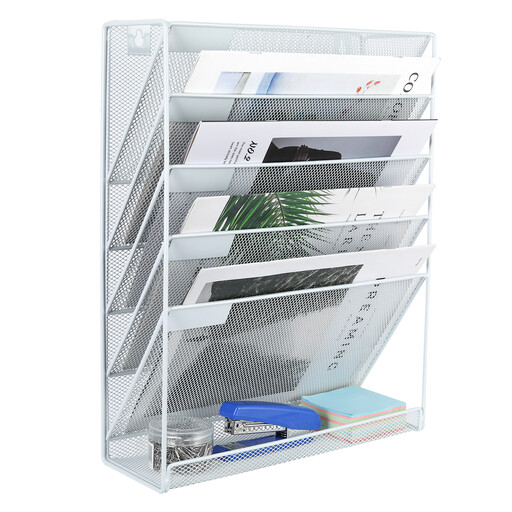
Why it suits this profile: The six compartments provide a clear basic layout for post, invoices, ongoing tasks and study or work papers. The holder can be used on the wall or freestanding on a desk.
The specifications list the internal width, external dimensions and number of compartments. This lets you check in advance whether the layout suits your documents.
Six compartments, integrated label plates, a bottom catch tray and a powder-coated metal construction.
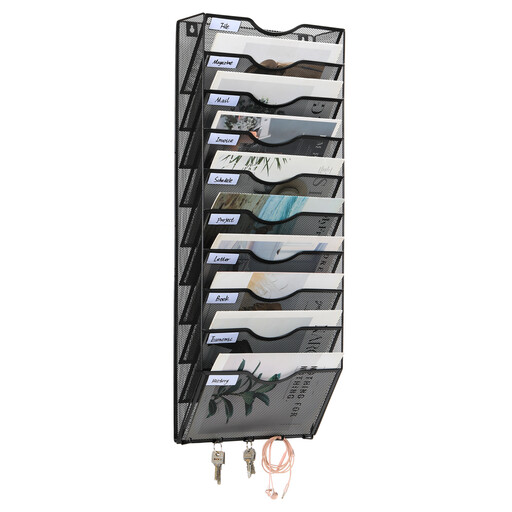
Why it suits this profile: If you manage several projects, files or streams of post at once, the ten compartments give you more vertical storage. The five hooks are also handy for keys, small tools or an umbrella.
The extra capacity helps prevent documents from piling up in one overcrowded compartment. However, check in advance that the height of 81,5 cm will fit on your chosen wall.
Ten A4 compartments, label plates, a curved access opening and five hooks at the bottom.
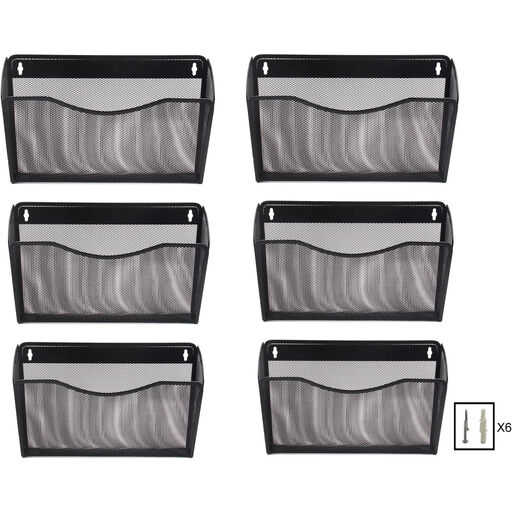
Why it suits this profile: This model is suited to people who want to store A4 documents horizontally, such as forms, magazines, clipboards or incoming post in different places.
According to the product information, the individual wall pockets can be mounted separately or together. This lets you adapt the layout to the wall space available.
Six landscape compartments, which can be mounted as separate units or as a group, plus a powder-coated metal mesh design.
We’ve put together a complete, up-to-date list of products that meet these strict selection criteria and the applicable European safety regulations.
Don’t use the label plates only for general terms such as “paper”. A layout like this is often clearer:
A document organiser works better when you regularly clear out old papers. For example, set aside a regular time each week to empty the compartments.
That depends on the weight, wall surface and fixing materials. According to the product information, the models mentioned are designed to be mounted with screws. Self-adhesive strips aren’t automatically suitable for a metal holder filled with documents. Always check the load-bearing capacity of the wall and the fixing system you choose.
Not always. Check the internal width, compartment height and opening shape. A4 paper may fit, while a thick folder, clipboard or document sleeve may be too large. So check the product specifications before ordering.
Remove dust with a soft, dry cloth. For marks, the product information says you can use a slightly damp cloth; dry the surface thoroughly afterwards. Avoid abrasive cleaners and check occasionally that the screws and wall anchors are still secure.
