
Vandaag of morgen in huis

Kwaliteit gegarandeerd

Welkomstaanbiedingen ontgrendelen: GRATIS bezorging | Tot 80% korting | Gratis 30 dagen JoyPlus-proefperiode
Download de app
Loose invoices, school papers and incoming post can quickly take over your desk. An A4 wall file holder keeps documents visible and within easy reach, without taking up floor space with an extra cupboard or drawer. However, wall-mounted holders vary considerably in size, layout and fixing method. A low price doesn’t necessarily mean a product will be practical.
So focus on the construction, the space available and how you plan to use the holder. Below, you’ll find the main pitfalls to avoid, key technical details and some suitable models for different needs.
A wall holder may be suitable for A4 paper, but that doesn’t necessarily mean thick ring binders or full files will fit comfortably. Check not only the external dimensions, but also the internal width and pocket height. A compact pocket is often enough for loose letters and slim documents. Ongoing projects need more room.
A metal wall file holder may be sturdy, but the fixings determine whether the whole unit stays secure. A concrete wall needs different wall plugs from plasterboard or a wooden wall. Use suitable wall anchors and check that the screws can support the weight. The load can increase quickly when several pockets are full.
A model with lots of pockets isn’t always practical. If it has more levels than you use every day, documents can disappear from view or pile up. On the other hand, one pocket may not be enough for an office handling several projects. Before you buy, consider how many categories you really need, for example:
The models listed are made from powder-coated metal. According to the manufacturers’ product information, this finish is designed to help protect the surface from oxidation and rust. It isn’t a guarantee for every environment: prolonged exposure to moisture is still best avoided.
Check the edges and welds too. The product descriptions state that the metal components are finished to reduce sharp burrs. Even so, inspect the holder carefully when it arrives, especially if children or students will be handling the documents regularly.
A4 paper measures 21 by 29.7 centimetres. An A4 wall document holder therefore needs enough internal width for you to insert and remove paper easily. Depending on the model, the holders in this selection have an internal width of around 31.5 centimetres or a pocket width of approximately 35 centimetres.
Also check the overall height. A 10-tier file holder is an efficient way to store documents vertically, but it needs more than 80 centimetres of clear wall space. Measure the area before you order. A 6-tier model is more compact and can also be used as a freestanding organiser.
Check which parts are included. The models described come with mounting screws, but some walls may need additional plugs or anchors. Ideally, install a metal wall document holder on a stable, flat surface.
The product information doesn’t specify a universal maximum load. So don’t put heavy books, sharp objects or overfilled folders in the pockets. Distribute documents evenly and check the fixings periodically.
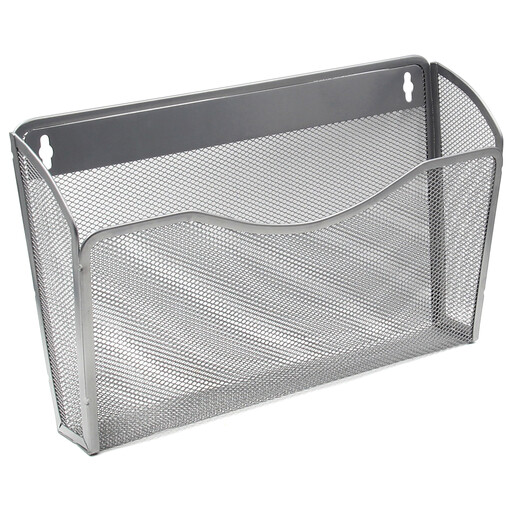
Why it suits this type of user: A single pocket is ideal if you want to clear incoming post, current documents or an ongoing project off your desk. You can hang this model on its own or add other pockets later.
The simple layout means you won’t pay for extra capacity that goes unused. The dimensions for landscape A4 are clearly stated.
One metal pocket, approximately 35 × 9 × 21,5 cm, with mounting screws included and a powder-coated finish according to the product description.
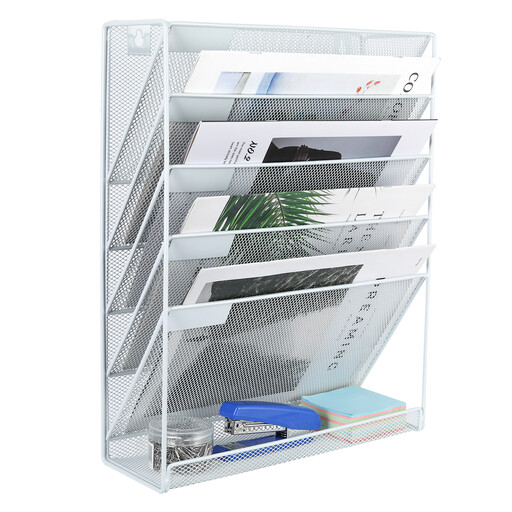
Why it suits this type of user: This model is a good fit for a home office or workplace where you need to keep several document categories neatly organised without taking up the wall height required by a 10-tier version.
The six separate pockets stop post, paperwork and ongoing files from disappearing into one deep pile. According to the product information, you can also use the model freestanding.
Six pockets, label plates, a lower tray for small items and dimensions of approximately 32,5 × 10,5 × 40,5 cm.
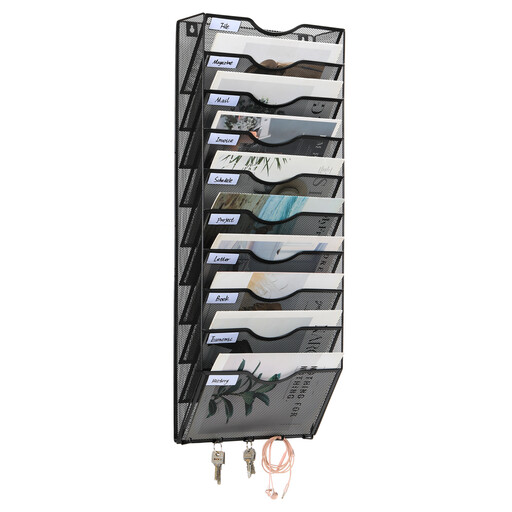
Why it suits this type of user: For an office, school or household with a steady flow of paperwork, the vertical layout provides space for ten categories. The five hooks are handy for keys, small tools or an umbrella.
The label plates make the layout easy to see, so you won’t need to rummage through one pile as often. Secure installation is especially important, though, as the holder is 81,5 cm tall.
Ten A4 pockets, five hooks, an internal width of approximately 31,5 cm, and labels and mounting screws included.
We’ve put together a complete, up-to-date list of products that meet these strict selection criteria and current European safety regulations.
A mesh wall file holder is especially useful when you want to see what’s inside at a glance. Separate pockets are often enough for magazines, post and slim files. If you have lots of categories, choose a 6- or 10-tier file holder.
Use plugs designed specifically for plasterboard and take the total weight of the filled holder into account. For a tall or frequently used organiser, it’s better to fix it to a stud or supporting structure behind the wall, if possible.
Its lifespan depends on the installation, load and moisture levels. According to the product information, the models listed have a metal construction with a powder-coated finish. Don’t place them in a persistently damp environment, avoid overloading them, and check the screws and wall anchors regularly.
Usually, wiping it with a soft, dry cloth is enough. For stubborn marks, you can use a slightly damp cloth. Avoid harsh cleaning products and dry the surface afterwards to keep the finish in good condition.
