
Vandaag of morgen in huis

Kwaliteit gegarandeerd

Welkomstaanbiedingen ontgrendelen: GRATIS bezorging | Tot 80% korting | Gratis 30 dagen JoyPlus-proefperiode
Download de app
A desk covered in invoices, study materials and post can make finding what you need unnecessarily difficult. An A4 wall-mounted document holder makes use of vertical space and keeps documents visible and within easy reach. It’s a practical choice for home workers, offices, schools, students and households.
However, not every A4 wall file holder is suitable for everyday use. Pay particular attention to the layout, the fixings and the actual dimensions. Below, we cover the main pitfalls and product specifications to consider before buying a wall-mounted document holder.
A wall file organiser with lots of compartments may seem practical, but a tall model can be difficult to reach if it’s mounted above eye level. So check the overall height. A model with ten tiers, for example, is 81,5 cm tall. That gives you plenty of vertical storage, but you’ll also need a suitable place to mount it.
For a desk or school table, a model with three or six compartments may be easier to keep organised. Think about which documents you use every day and which you only need to store temporarily.
An A4 document measures 21 by 29,7 cm. So a holder shouldn’t just be described as “suitable for A4”; the internal width and compartment height are just as important. For example, a mesh wall holder that is 32,5 cm wide has an internal width of 31,5 cm. This leaves room for loose papers and thin folders.
Also consider the orientation. A landscape A4 wall holder has a horizontal opening approximately 35 cm wide and 21,5 cm high. This is handy for post, magazines and documents you want to store flat, but less suitable for ring binders that you use upright.
A metal wall organiser can weigh over a kilogram on its own, even before you add any documents. The screws supplied aren’t necessarily suitable for every type of wall. Plasterboard, concrete, brick and timber walls all need different plugs or fixings.
Before installation, check:
For an outdoor model, such as a lockable wall-mounted letter box, choose a sheltered spot. The product information recommends installing it under a canopy, for example, to limit exposure to rain.
Many of the models discussed are made from powder-coated metal. According to the product descriptions, this finish is designed to help limit oxidation and rust. This is a product specification, not a guarantee that the material will remain rust-free in all conditions.
For an office organiser or indoor A4 document holder, a metal frame is worth considering if you’re looking for a sturdy design with an open mesh finish. Check the edges and welds. A carefully finished edge reduces the risk of sharp parts causing problems during everyday use.
Choose the number of compartments to suit your workflow:
In a six-tier model, the compartments are approximately 5,5 cm high. The ten-tier version has openings of around 7,5 cm. These measurements determine how much paper or how thick a thin folder can be on each tier. A wall-mounted organiser isn’t automatically suitable for heavy, fully loaded ring binders.
Label holders are useful when several people share the same A4 wall file holder. You can label compartments with names, projects or statuses. A model with five hooks also provides space for keys, an umbrella or small tools.
A lock and viewing windows are mainly features of an outdoor wall-mounted letter holder. They aren’t essential for an office solution, but can help keep post out of sight and make it easy to see whether anything has been delivered.
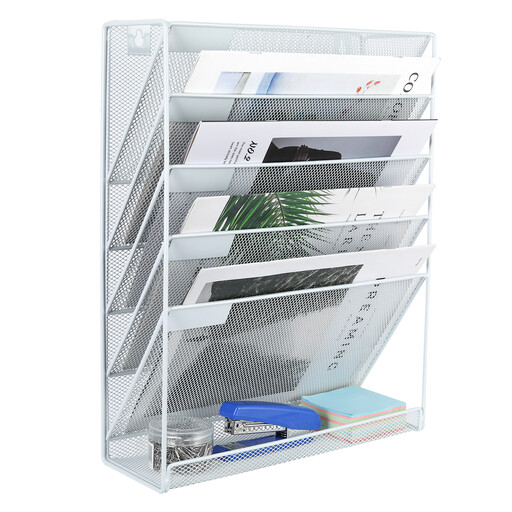
Why it suits this user: Six compartments provide a straightforward way to organise paperwork, study materials or documents for working from home. The holder can also stand freely on a desk.
The dimensions are clearly stated: 32,5 × 10,5 × 40,5 cm. This lets you check in advance whether the six compartments and the installation spot will work for you.
Powder-coated metal frame with six label plates and a bottom tray for small accessories. Suitable for wall mounting or freestanding use.
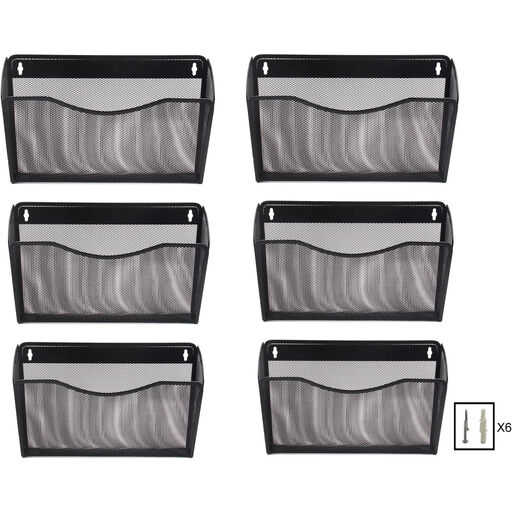
Why it suits this user: This set of six horizontal compartments is ideal if you want to organise several locations or workflows, such as an office, classroom or home workspace.
The individual pockets can be mounted together or separately. This means you don’t have to install a tall organiser if a horizontal arrangement is easier to reach.
Set of six metal A4 compartments, each approximately 35 × 9 × 21,5 cm. Includes mounting screws and is suitable for documents, magazines and post.
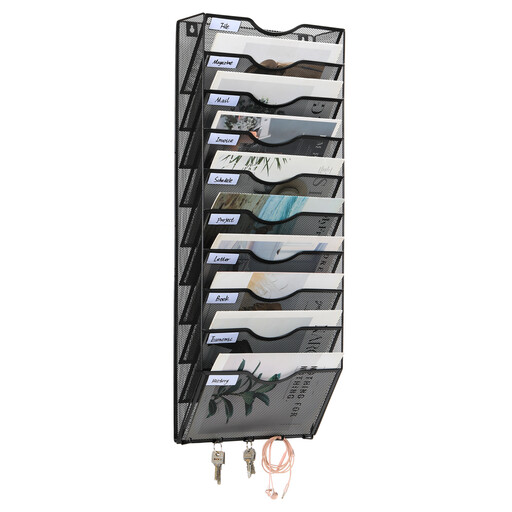
Why it suits this user: Ten tiers are designed for large volumes of documents, such as invoices, files, study materials and ongoing projects. The five hooks provide extra storage in an entrance or shared workspace.
The compartment height of approximately 7,5 cm and internal width of 31,5 cm can be checked in advance. This helps you work out which folders and papers will fit comfortably.
Ten labelled compartments, a powder-coated metal construction and five hooks. Overall dimensions are approximately 32,5 × 10,5 × 81,5 cm.
We’ve put together a complete, up-to-date list of products that meet these strict selection criteria and the applicable European safety regulations.
Use wall plugs designed for plasterboard and check the maximum load capacity. For a heavy metal organiser holding lots of paper, it’s often better to fix it to a stud or a reinforced wall. Follow the product’s installation instructions and check that the holder is securely mounted once installed.
Its lifespan depends on the load, how it’s mounted and exposure to moisture. According to the product description, a powder-coated finish can help prevent oxidation and rust, but prolonged exposure to moisture may damage the finish. Wipe it with a dry cloth to maintain it, and tighten any loose fixings promptly.
It depends on the number of compartments and the capacity you need. A wall holder takes up less floor space and is practical for documents you need regularly. For long-term storage of large quantities of paper, a closed cabinet or filing system is still more suitable. So first check how many documents you really want to keep within easy reach every day.
