
Vandaag of morgen in huis

Kwaliteit gegarandeerd

Welkomstaanbiedingen ontgrendelen: GRATIS bezorging | Tot 80% korting | Gratis 30 dagen JoyPlus-proefperiode
Download de app
Loose invoices on the dining table, post piling up beside the printer and important letters disappearing beneath magazines: an A4 wall document holder can prevent a great deal of everyday clutter. However, choosing the right one depends on more than just the number of compartments or its appearance.
A wall-mounted document organiser needs to suit the available space, the type of paperwork and how you intend to attach it. Below, you’ll find the common pitfalls that are often overlooked, the specifications that matter and the models suited to different uses.
A 5-tier wall document holder may seem appealing if you have a lot of documents. However, a model with several compartments can be impractical if you mainly want to sort incoming post quickly. For a home office with categories such as “to pay”, “file” and “action”, a 3-tier wall document holder may be easier to manage.
So think about your filing system first. An extra compartment is only useful if you use it consistently.
An A4 document measures 21 × 29,7 cm. Check whether the stated dimensions refer to the entire product or to the internal compartment. With a landscape metal wall file holder, the width is often more than sufficient for A4 paper, but a thick folder or ring binder may still protrude.
Also pay attention to the depth of approximately 9 to 11 cm found in various mesh wall document holders. This is suitable for loose papers, post, magazines and thin folders, but not automatically for heavily filled lever-arch files.
A wall holder for post is often installed on a wall or door. The screws supplied are convenient, but not every wall has the same load-bearing capacity. Plasterboard, concrete, brick and a wooden door each require a suitable wall plug or mounting method.
Check the following before installation:
The product descriptions for several models recommend using suitable wall anchors and not exceeding the recommended load capacity. A specific maximum load is not provided for every model. Therefore, do not place heavy items in the holder without checking this beforehand.
Many models in this selection are made from powder-coated metal. According to Senhoglb’s own product descriptions, this finish is intended to help prevent oxidation and rust formation. This is a product specification, not a guarantee that the product will remain rust-free in all conditions.
A metal construction is practical for everyday use in an office, hallway or home office. However, avoid prolonged exposure to moisture and direct water spray. A mesh design leaves the contents partially visible, allowing you to identify the paperwork in each compartment more quickly.
A landscape A4 wall holder is suitable for documents stored horizontally. The individual compartments of Senhoglb are approximately 35 cm wide, 9 cm deep and 21,5 cm high. This provides room for A4 paper, post, magazines and thin documents.
For upright storage, models with several vertical compartments are more logical. If you use filing pockets, check that the pocket width fits inside the compartment. A wall-mounted document organiser is particularly practical when you need frequent access to its contents.
A 3-tier model may be sufficient for a simple filing system. A 5-tier or 6-tier wall file organiser offers more categories, but also takes up more vertical space. The 5-tier models are approximately 42 cm high, while the 6-tier version is approximately 40,5 cm high.
Label plates or stickers are useful for fixed categories. Consider:
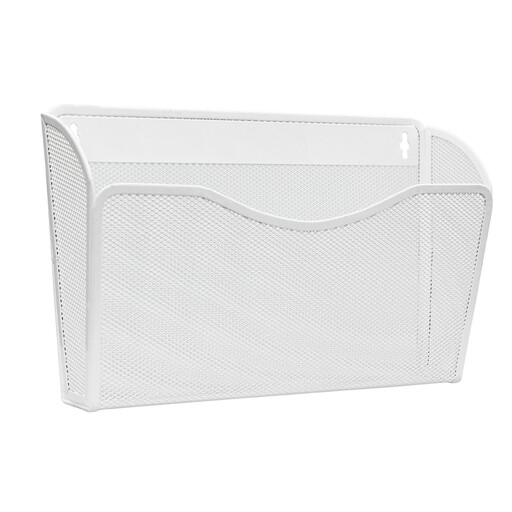
Why it suits this profile: A single compartment is ideal if you’re looking for a simple place to store daily post, current documents or magazines.
You don’t pay for compartments you won’t use. The dimensions and landscape A4 format are clearly stated in the product information.
Metal construction, powder coating and supplied mounting screws; can be used individually or together with other units.
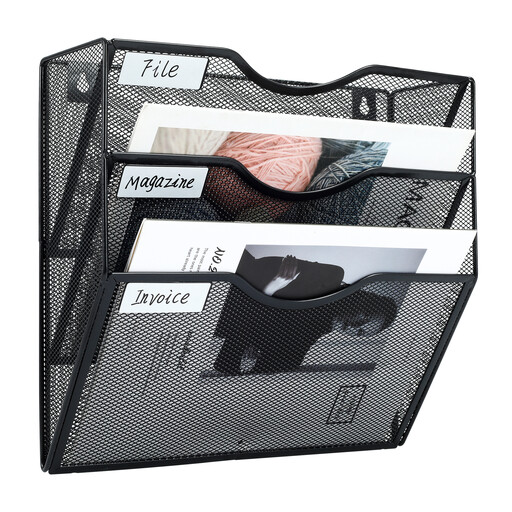
Why it suits this profile: The three compartments and integrated label panels are ideal for a home office or workplace where documents are sorted by category.
The layout is straightforward: three separate A4 compartments instead of one large, unsorted compartment.
Three tiers, label panels, powder-coated metal and a design suitable for wall or door mounting.
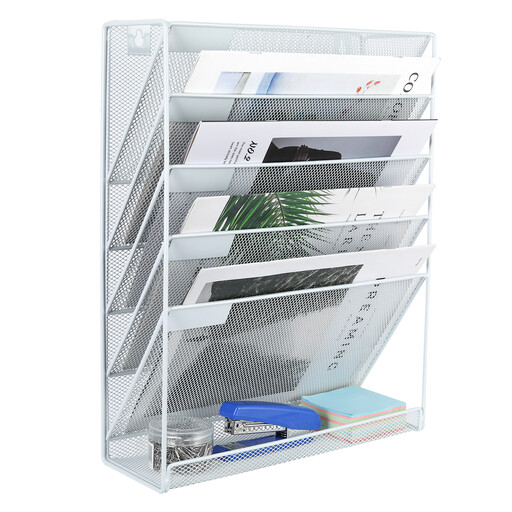
Why it suits this profile: Six compartments are useful for multiple projects, family administration or a high volume of post in a small office.
The six labelled compartments reduce the risk of incoming and processed documents getting mixed up.
Six compartments, label plates, a lower storage tray and the option to use it as a wall-mounted or freestanding organiser, according to the product description.
We’ve put together a complete, up-to-date list of products that fully meet these strict selection criteria and the applicable European safety regulations.
Position the document organiser on the wall at a height that allows you to reach the contents without bending or stretching. When mounting it on a door, leave sufficient space between the holder and the door frame. Ideally, use separate compartments for incoming and outgoing post so that documents do not get left behind.
Empty the compartments regularly. A wall file organiser only works if old invoices, letters and magazines are not allowed to pile up indefinitely. Clean it with a soft, dry cloth; for stubborn marks, use a slightly damp cloth and dry the metal thoroughly afterwards.
Use wall plugs suitable for plasterboard and, where possible, check for the studs behind it. The screws supplied are not automatically suitable for every wall. Take into account the weight of both the holder and the documents.
A single compartment may be enough for one document stream. Three compartments are practical for basic sorting. Choose five or six compartments when you want to keep multiple projects, family members, customers or post categories separate.
The product descriptions for several models mention a powder coating which, according to the manufacturer, is intended to help prevent oxidation and rust. Nevertheless, prolonged exposure to moisture is not recommended. For a bathroom, unheated shed or other damp space, assess the installation location and maintenance requirements particularly carefully.
