
Vandaag of morgen in huis

Kwaliteit gegarandeerd

Welkomstaanbiedingen ontgrendelen: GRATIS bezorging | Tot 80% korting | Gratis 30 dagen JoyPlus-proefperiode
Download de app
Loose invoices, teaching materials and files quickly disappear under a pile of paper. An A4 mesh document tray can help you organise documents by project, priority or department. However, not every tray looks the same in practice as it does in the product photo. A tray that is too shallow, a wobbly construction or awkward stacking can actually make daily use frustrating.
This guide helps home workers, students, teachers and office staff to compare effectively. We look at the dimensions, the material, the number of tiers and the way the tray is used on the desk.
A model with multiple tiers automatically seems more spacious, but the total height is important. A 5-tier document tray can be approximately 37.5 cm high, for example. That will not fit under every shelf or wall cabinet. So measure the available space on your desk first.
Also look at the internal space. A4 paper is 21 × 29.7 cm, but folders and ring binders often need extra width and height. A tray that is only suitable for loose documents can be less practical for thick files.
A metal document tray is generally sturdier than a lightweight plastic model, but material alone does not tell you everything. Pay attention to the weight, the feet and the shape of the frame. A low tray weighing around 1 kg can sit stably on a desk, whereas a tall model with heavy files can tip over more easily if the contents are unevenly distributed.
According to the product descriptions of the models mentioned, the construction is made of metal with a powder coating. The supplier describes this finish as resistant to oxidation and rust. That is no guarantee that the product will remain rust-free in all conditions. Therefore, place the organiser in a dry spot and preferably clean it with a dry cloth.
A stackable document tray saves space by making use of height. However, check that the trays are properly aligned and that the surface is level. With models that have a locking or hooking system, the parts must be fully in place. Place heavy folders at the bottom and lighter papers on top.
In addition to the external measurements, also check:
An A4 desk organiser with two tiers is usually suitable for daily paperwork with a limited number of documents. Three to five tiers are better suited to multiple projects, subjects or administrative categories. A tall organiser does require more attention to weight distribution.
Mesh has an open structure. This means the documents are more visible from the outside than in a closed drawer. That can be handy when you frequently switch between folders or letters. However, the openings do not keep out dust completely.
A powder coating can protect the metal surface and gives the tray an even finish. Damage to the coating can make the metal more sensitive to moisture. Therefore, do not use aggressive cleaning products and dry any damp cloth afterwards.
A fixed tray is simple and has few parts that can jam. A pull-out drawer gives quicker access to documents that are lower down in the organiser. With a model that has sliding drawers, check that the drawers run smoothly and that the construction has enough space around it.
Rubber feet are useful on a varnished, wooden or glass desk. They can help prevent scratches, but they must stay clean and intact. With products that require assembly, it is important to tighten all screws properly before you add documents.
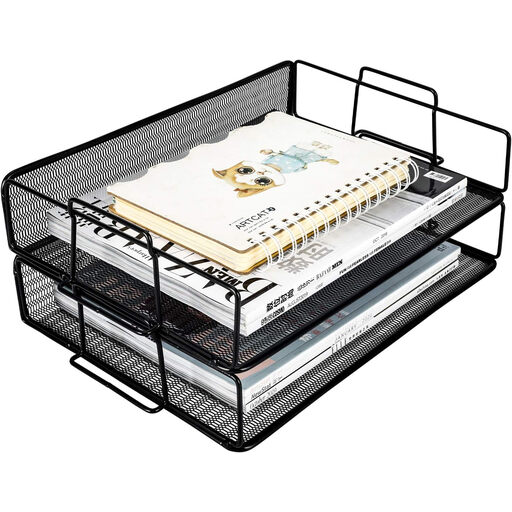
Why it suits this profile: The two tiers offer a clear starting point for home working, study papers or post without taking up much desk space.
The product description states A4 compatibility, a metal mesh construction and a stackable design. If you buy multiple units, check the alignment and weight distribution yourself.
Two tiers, handle, stackable design and dimensions of approximately 34 × 24.5 × 13.5 cm.

Why it suits this profile: Four levels and a separate holder on top suit a workspace where documents and small stationery items are separated daily.
The organiser uses vertical space instead of just extra desk width. Place heavy documents at the bottom to keep the taller construction stable.
Four tiers, integrated pen holder, hook-on stacking and dimensions of approximately 25 × 33.5 × 30.7 cm.

Why it suits this profile: The five pull-out tiers are designed for a high volume of paper, such as administration, teaching materials or multiple ongoing files.
The pull-out trays make different categories accessible. The height of approximately 37.5 cm should be compared with the free space on your desk beforehand.
Five levels, pull-out trays, rubber feet and a metal frame of approximately 35.5 × 29.5 × 37.5 cm.
We have put together a complete, up-to-date list of products that fully meet these strict selection criteria and the applicable European safety regulations.
Use fixed categories that suit your workflow. Think of ‘to do’, ‘in progress’ and ‘completed’. For students, subjects or projects may be more logical. A removable document tray works better when each drawer has one clear function.
Have a regular tidy-up session. A paper organiser only helps when old documents do not stay there indefinitely. Place frequently used papers at the front and check that the tray is not overloaded. Only use the handle for moving and do not lift an overfull tray by the handle.
That varies by model. The product descriptions mention A4 files, folders and ring binders as possible uses, but the available space depends on the thickness. Compare the external dimensions with your ring binders and allow extra room for removing documents.
Generally, use a soft, dry cloth. For stubborn marks, a slightly damp cloth can be used, after which you dry the surface thoroughly. Avoid prolonged contact with moisture, especially if the powder coating is damaged.
The lifespan depends on the load, frequency of use, assembly and the conditions in your workplace. A metal construction and powder coating can be suitable for daily office work, but overloading, uneven stacking and moisture can accelerate wear. Check the screws, feet and connections regularly.
