
Vandaag of morgen in huis

Kwaliteit gegarandeerd

Welkomstaanbiedingen ontgrendelen: GRATIS bezorging | Tot 80% korting | Gratis 30 dagen JoyPlus-proefperiode
Download de app
Loose invoices, school papers and post can quickly pile up if they don’t have a set place. An A4 document organiser can help you sort documents by project, priority or action required. However, a metal document tray can often look roomier and sturdier in a product photo than it is in practice.
So don’t focus on price or appearance alone. Home workers, students, office workers and self-employed people are particularly likely to come across three common pitfalls.
An A4 document measures 21 by 29.7 centimetres. An organiser also needs to leave room for plastic sleeves, ring binders and curled-up papers. So check both the external dimensions and the internal width. A narrow A4 file holder may be suitable for loose sheets, but less practical for bulky folders.
A stackable document tray saves desk space, but several full trays can become unstable. Check the construction, the product’s weight and any load capacity warnings. Place a stack on a flat surface and keep the heaviest documents at the bottom.
A wall-mounted model frees up workspace, but the wall and fixings need to support the weight of the holder and its documents. Check that the wall plugs are suitable for your wall type, such as concrete, brick or plasterboard. Don’t install a wall-mounted document holder above an area where falling items could cause damage.
First, decide what you want to sort:
An open compartment gives you quick access. A closed office organiser protects its contents better from dust, but makes daily sorting less straightforward.
A metal document tray usually has a sturdy frame, while its mesh structure lets you see some of the contents. The models mentioned are described as having a powder-coated metal finish. According to the manufacturer’s product information, this finish is designed to help prevent oxidation and rust. It doesn’t guarantee that the product will remain rust-free in all conditions, so avoid prolonged contact with moisture.
Also look for finished edges, rubber feet and a handle. These features are useful if you regularly move your desk organiser or place it on a delicate desktop.
A desk organiser that requires no assembly is handy for a rented home, student room or flexible workspace. A wall-mounted model takes more preparation, but keeps your desk clear. For each product, check:
Never use an organiser as a step stool. Keep it out of reach of young children if it has sharp edges or screws, or contains heavy documents.
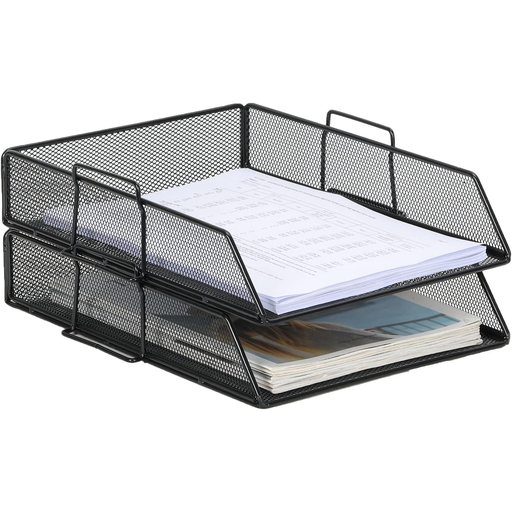
Why it suits this profile: This compact model measures 25 × 33.5 × 13.5 cm and has two tiers for post, loose A4 documents and folders. The handle is handy for a home workspace or student room.
The dimensions and two-tier layout are clearly specified, so you can check in advance whether it will fit on your desk and hold the documents you need to store.
Metal construction, stackable design, a handle and space for A4 paper, letters, magazines and office supplies.
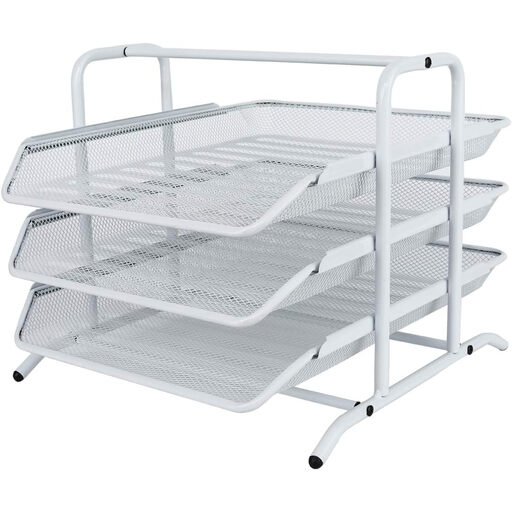
Why it suits this profile: The three pull-out tiers are ideal if you handle different types of documents every day, such as incoming post, ongoing files and archive documents.
These aren’t just open compartments: the trays pull out for easy access. The stated dimensions of 35.5 × 29.5 × 26 cm also make it easy to check how much desk space you’ll need.
Three tiers, a metal frame, rubber feet and space for A4 documents, ring binders, letters and magazines.
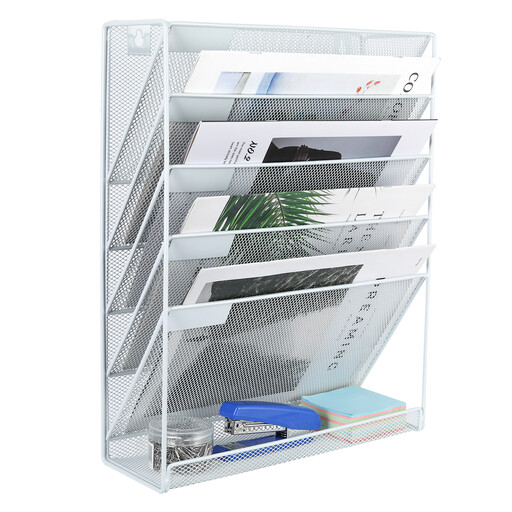
Why it suits this profile: With six compartments and a height of 40.5 cm, this model is designed for offices, shared workspaces and home offices with several regular document categories.
The six separate compartments and label plates help keep files organised. If you wall-mount it, make sure the fixings are suitable for both the wall and the load.
Six A4 compartments, integrated labels, a lower tray for small items, and the option to wall-mount it or use it freestanding.
We’ve put together a complete, up-to-date list of products that meet these strict selection criteria and the applicable European safety regulations.
An organiser works best when you use set categories. Try to do, in progress, to file and personal. Use the label plates on a wall-mounted holder for these categories. For a desk organiser, you can use coloured folders or simple labels.
It’s also worth setting aside a short time each week to tidy up. Remove completed documents from your desk organiser and check whether you still need every compartment. This helps prevent an extra office organiser from simply creating more storage space for papers you no longer need.
Not always. A4 paper measures 21 × 29.7 cm, but folders and document sleeves need extra room. Check the stated width and depth, as well as any internal dimensions. An organiser with an open mesh design can be practical, but that doesn’t automatically mean it has room for bulky lever arch files.
That depends on its construction and how much weight you put in it. Product information often describes powder-coated metal models as suitable for everyday office use. According to the manufacturer’s own product information, the coating is designed to help prevent oxidation and rust. Keep the tray dry, don’t exceed the recommended load and regularly check that stacked trays are stable.
The price mainly depends on the number of compartments, the material, how it’s mounted and any extra features, such as labels, a handle or a pen holder. Don’t compare the purchase price alone; consider how many organisers you’ll need too. In some situations, one six-compartment wall holder may be more practical than several separate trays on a small desk.
