
Vandaag of morgen in huis

Kwaliteit gegarandeerd

Welkomstaanbiedingen ontgrendelen: GRATIS bezorging | Tot 80% korting | Gratis 30 dagen JoyPlus-proefperiode
Download de app
Loose invoices, teaching materials and post can pile up quickly. An A4 document organiser can help, but only if its layout matches what you use every day. A metal file holder that is too shallow, a wall-mounted model without proper fixings, or a desk organiser with too few compartments will soon lead to clutter again.
This guide helps office workers, homeworkers, students, teachers and households compare dimensions, mounting options and capacity before making a purchase.
Ten compartments might seem handy, but they also take up more height on the wall. A 10-tier wall-mounted model, for example, is approximately 81.5 cm high. So measure your available space first. For a desk, a stackable document tray with two or three tiers may be more practical.
A4 paper measures 21 × 29.7 cm, but documents are often in plastic sleeves, ring binders or folders. So don't just check whether a holder supports "A4" – also check the internal width, depth and compartment height. A wall-mounted document holder with an internal width of around 31.5 cm offers more leeway than a narrow document tray.
A metal file holder fixed to the wall bears the weight of the holder itself plus its contents. The screws supplied are not automatically suitable for every type of wall. With plasterboard, a hollow wall or a brick wall, different wall plugs may be needed. Also check regularly that the fixings are still secure, and distribute heavy folders across several compartments.
A mesh document organiser gives you quick visibility of the contents, but it does not protect documents from dust, moisture or long-term storage like a closed archive box does. Use open compartments mainly for documents you need frequently, such as incoming post, invoices or ongoing projects.
Pay attention to these measurements:
An A4 paper holder with horizontal compartments is good for quick access. A vertical file holder with label plates works better when you want to separate categories such as "to pay", "school" and "keep".
Many models in this category are made from metal with a powder coating. According to the product descriptions, this finish is intended to help limit oxidation and rust formation under normal use. That does not mean every model is suitable for a damp room. So do not place a metal holder in direct contact with water, and dry any damp spot immediately.
Also check for:
A freestanding desk organiser is usually easy to place and move. A wall-mounted model saves desk space, but requires a suitable surface and accurate installation. A stackable document tray is a middle ground: you start with two tiers and can expand later, as long as the construction remains stable and the manufacturer allows stacking.
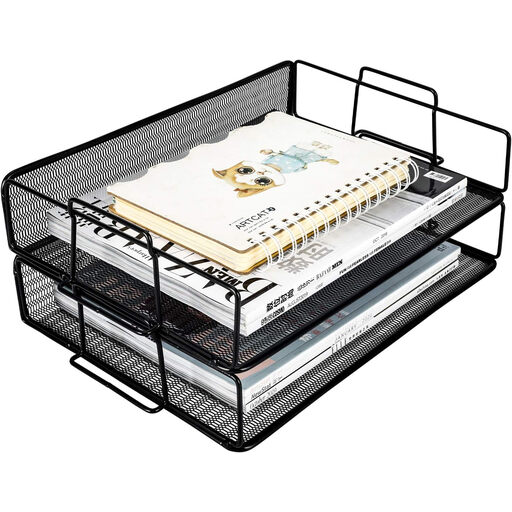
Why this fits the profile: This freestanding model offers two A4 compartments without any mounting required, and has a compact size of 34 × 24.5 × 13.5 cm. Handy for a first sorting system on a desk or in a home office.
The number of compartments and the dimensions are clearly specified. This means you won't buy a large system when you only have a small daily paper flow.
Two tiers, stackable design, handles and a metal mesh construction.
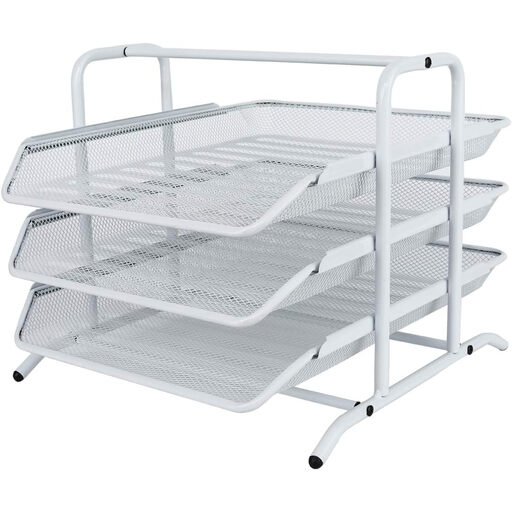
Why this fits the profile: The three pull-out A4 trays are ideal for workstations where documents are consulted several times a day. The dimensions are 35.5 × 29.5 × 26 cm.
The pull-out trays prevent you from having to search through one deep pile. Rubber feet help protect the desk surface.
Three A4 tiers, pull-out trays, metal finish and easy assembly with screws.
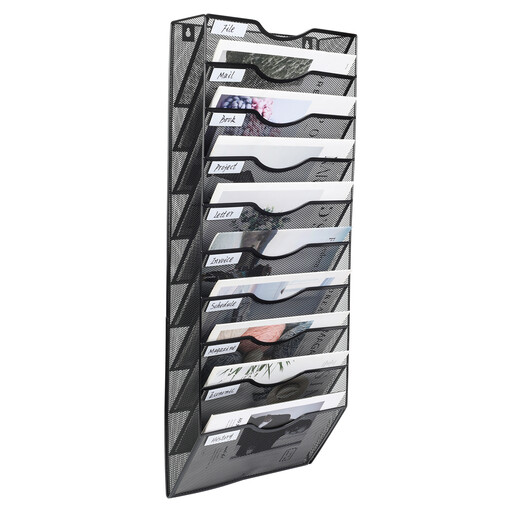
Why this fits the profile: With ten vertical compartments approximately 7.5 cm high, you can keep incoming post, invoices, projects and forms separate. The model measures 32.5 × 10.5 × 81.5 cm.
The label plates make the layout easy to manage and reduce the chance of all post ending up in one messy compartment. Check the available wall height and fixings before mounting.
Ten A4 compartments, label plates, powder coating and supplied mounting screws.
We have compiled a full, up-to-date list of products that fully meet these strict selection criteria and comply with current European safety regulations.
Place a desk organiser on a flat surface and distribute heavy folders evenly. For a wall-mounted document holder:
Use label plates for fixed categories and plan a regular tidy-up session. An A4 paper holder only works well when outdated documents are also removed or archived.
That depends on the internal dimensions. Loose A4 paper is narrower than a folder or ring binder. So check the stated internal width and compartment height. A model designed for A4 documents is not automatically suitable for thick lever-arch files.
Many wall-mounted models are designed for fixing to a wall, and some can also be attached to a door. Check the product information, the weight and the suitability of the surface. When in doubt, use appropriate wall anchors and do not exceed the recommended load.
Dust can usually be removed with a dry, soft cloth. For stubborn marks, you can use a slightly damp cloth and then dry the metal afterwards. Avoid abrasive cleaners and prolonged exposure to moisture, as these can damage the coating.
