
Vandaag of morgen in huis

Kwaliteit gegarandeerd

Welkomstaanbiedingen ontgrendelen: GRATIS bezorging | Tot 80% korting | Gratis 30 dagen JoyPlus-proefperiode
Download de app
Loose bills, school papers, magazines and incoming post can quickly pile up. An A4 document organiser can help, but not every holder suits every workspace. A wall-mounted model saves desk space, while a desk organiser offers more flexibility for everyday use. Pay particular attention to the dimensions, number of compartments and mounting method.
Not every wall-mounted document holder is suitable for standard A4 paper. Don’t just check whether “A4” appears in the title: look at the internal width and compartment height too. A folder, ring binder or magazine takes up more space than a single sheet of paper.
A 10-tier wall organiser for documents sounds practical, but it can become confusing if the compartments aren’t labelled or you only use a few categories. For post and a handful of ongoing projects, one or three compartments may make more sense. Decide in advance how you want to organise everything: for example, “incoming”, “to pay”, “school” and “archive”.
A metal wall organiser gets heavier once it’s filled. Plasterboard, brick and a cupboard door may not all need the same wall plugs or screws. Check the surface, use suitable wall anchors and fit a heavy model to a stable wall. Supplied screws are useful, but they won’t necessarily suit every type of wall.
A4 paper measures 21 × 29,7 cm. A landscape holder is practical for loose documents, post and magazines. For example, the Senhoglb models with one compartment measure approximately 35 cm wide, 9 cm deep and 21,5 cm high. That leaves room for A4 paper in landscape orientation, but check that your folders or ring binders will fit too.
A vertical, multi-tier document organiser makes efficient use of wall space. The 10-tier model is approximately 32,5 cm wide, 10,5 cm deep and 81,5 cm high. Measure the available wall height beforehand, especially above a desk or beside a door.
A metal wall organiser is generally suitable for everyday use and holds its shape better than thin plastic when documents are taken out regularly. According to the product description, the mesh models mentioned are made of metal with a powder-coated finish. This finish is designed to protect the surface from oxidation and rust, but it’s best not to leave the holder in a damp environment for long periods.
Pay attention to the edges too. The openings and finish on a mesh document holder shouldn’t have any sharp parts. Even so, check the edges when it arrives and tighten any loose parts before using the holder.
Choose the number of compartments to suit your daily routine:
Label plates make an office file holder easier to keep organised. An open front gives you quick access to documents, but offers less protection from dust than a closed cabinet.
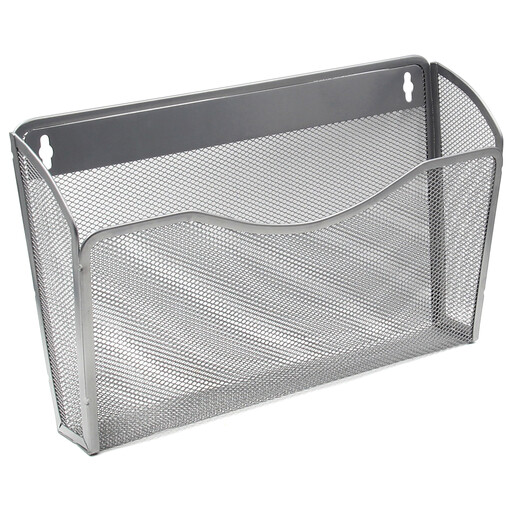
Why it suits this profile: One compartment keeps things simple if you’re new to wall storage and only want to organise post, papers you’re currently working on or a single project.
The model has one easily accessible compartment, so you won’t pay for tiers you don’t use. The stated dimensions are 35 × 9 × 21,5 cm.
Metal mesh construction, powder-coated finish and mounting screws included, according to the product description.
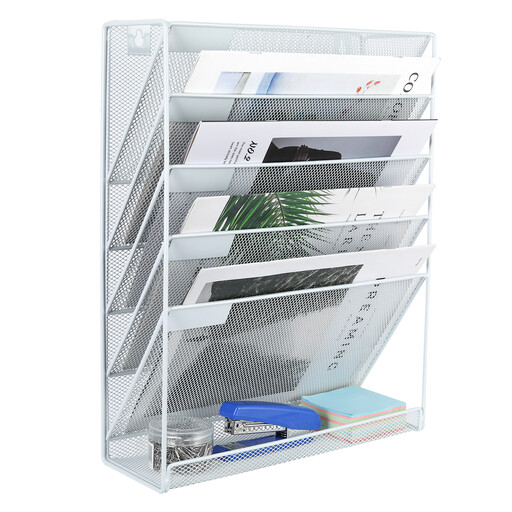
Why it suits this profile: This model combines six compartments with the option to mount it on a wall or use it on a desk.
The six built-in label plates help keep categories clearly marked. According to the description, the holder can also be used freestanding.
Measures 32,5 × 10,5 × 40,5 cm, with six compartments and a bottom drawer for small office supplies.
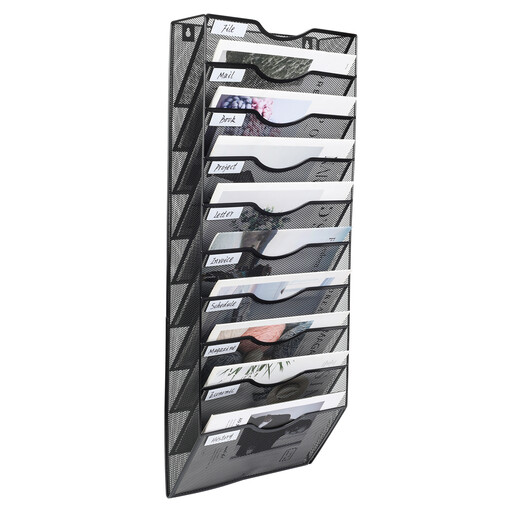
Why it suits this profile: Ideal for offices, schools and households with lots of separate document types and limited desk space.
The ten tiers have label plates to help you keep lots of categories easy to identify. Make sure you have 81,5 cm of clear wall height available.
Ten compartments, a powder-coated metal construction, labels and mounting screws, according to the product specifications.
We’ve put together a complete, up-to-date list of products that meet these strict selection criteria and the applicable European safety requirements.
It depends on the depth and opening of the compartment. An A4 holder is often designed for loose sheets, post or thin folders. So check the internal dimensions, not just the A4 label. A ring binder may be wider and thicker than the available space.
It can be, but use suitable wall plugs or cavity wall anchors, and secure the holder at several points if the model allows it. A sturdy surface is important for a heavy, multi-tier model. After installation, check regularly that the fixings are still secure.
First remove the documents and wipe the surface with a soft, dry cloth. For stubborn dirt, you can use a slightly damp cloth. Dry the metal afterwards, and don’t leave the holder in a damp room for long periods.
