
Vandaag of morgen in huis

Kwaliteit gegarandeerd

Welkomstaanbiedingen ontgrendelen: GRATIS bezorging | Tot 80% korting | Gratis 30 dagen JoyPlus-proefperiode
Download de app
A pile of invoices, post and files on your desk can quickly turn into an unruly mountain of paper. An A4 document organiser can help, but not every model suits every workspace. A low document tray is practical for daily use, while a wall-mounted document holder frees up more desk space.
When choosing, don’t just focus on the number of compartments or the metallic look. Load capacity, dimensions and installation are what really determine whether an organiser remains a pleasure to use after several months.
A 10-tier wall holder might seem appealing when you have a lot of paper. However, a tall model isn’t always convenient. Check beforehand whether you have enough free wall height and whether the compartments are suitable for the amount of paper you want to store. An overfilled document rack can become unstable or put strain on the fixings.
For a home office or student room, a 2-tier stackable document tray may be sufficient. An admin department dealing with incoming and outgoing post would be better served by a 6-tier or 10-tier wall holder.
A4 paper measures 21 × 29.7 cm. So a holder must not only accommodate A4 documents, but also leave room for folders, plastic sleeves or slightly curled paper. Pay attention to the internal width and compartment height. An A4 document holder with a tight opening can be awkward in practice, especially with files that have dividers.
A wall-mounted document holder needs to be securely fixed to the wall or door. The screws supplied aren’t automatically suitable for every surface. Check whether wall plugs or other fixings are needed for, say, plasterboard, concrete or wood.
With a metal desk organiser, other points come into play. Rubber or EVA feet help prevent scratches, while a level surface is important to minimise tipping.
Many models in this category are made from metal mesh with a powder coating. According to the product descriptions, this finish is intended to prevent oxidation and rust. That’s a product specification, not a guarantee that the item will remain rust-free in all conditions. So don’t place a metal organiser in prolonged direct contact with water or in a very damp room.
Mesh has two practical advantages: you can partly see the contents, and the material keeps the weight relatively low. Also check whether the edges are finished. The descriptions of several models state that the edges are ground or deburred.
Measure before you buy:
A 3-tier document holder measuring roughly 35.5 × 29.5 × 26 cm is suitable for a desk with enough depth. A 6-tier wall holder uses about 40.5 cm of vertical space, while a 10-tier model is approximately 81.5 cm high according to the supplied specifications.
An A4 paper tray with pull-out drawers is handy when you need documents often. A wall holder with labels works better for fixed categories, such as “to process”, “invoices” and “archive”.
Also check whether stacking is advised as safe. With a stackable document tray, the trays must be aligned straight and the contents must not overload the structure. A top compartment for pens, staplers or paperclips can be useful if you’re also looking for a desk organiser for small essentials.
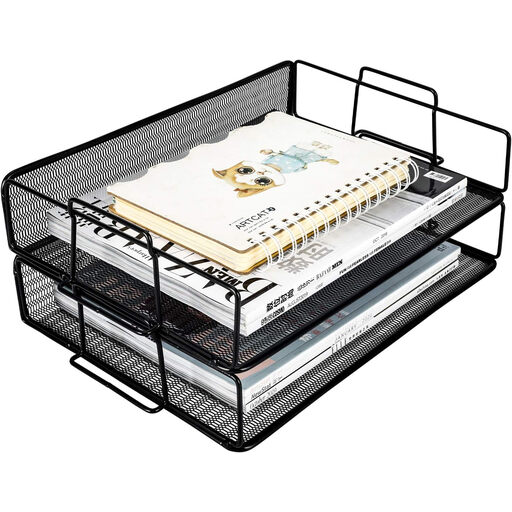
Why this fits the profile: Two compartments offer a simple starting point for home workers, students or a small home office. The organiser sits freely on the desk and, according to the product description, requires no assembly.
You’re not paying for unused tiers. The dimensions of roughly 34 × 24.5 × 13.5 cm keep the layout clear without taking up much desk space.
Metal mesh, two A4 compartments, handle and stackable design according to the product specifications.
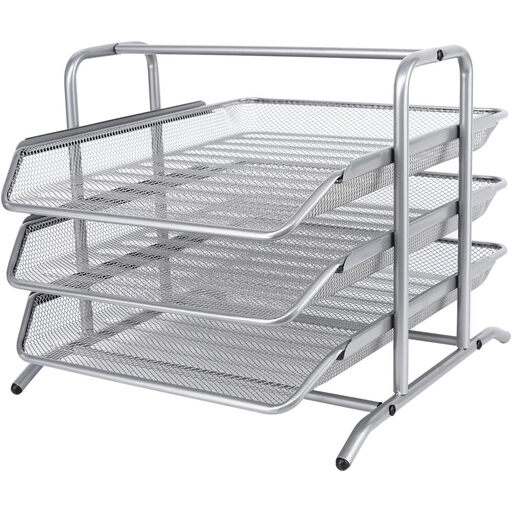
Why this fits the profile: This metal desk organiser suits a tidy workspace where documents are regularly separated by project, status or priority.
The three separate pull-out drawers prevent all documents from ending up in one deep tray. Rubber feet are described as being intended to protect the work surface.
Three A4 drawers, metal construction, pull-out function and multiple colour options according to the product information.
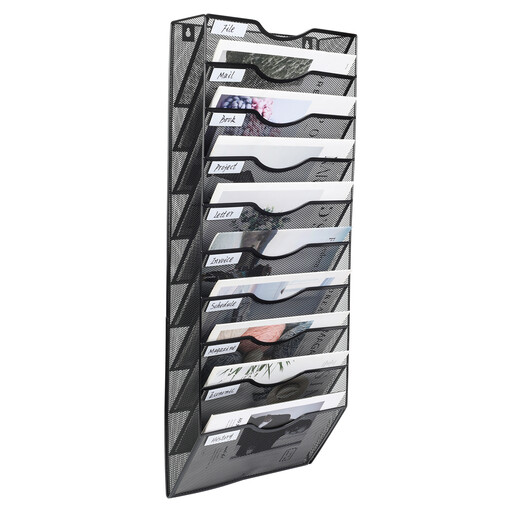
Why this fits the profile: An admin area with lots of post, invoices or files can divide categories across compartments. The wall mounting keeps the desk clear, provided the wall and fixings are suitable.
The compartments are spread across the height rather than in one stack. Labels on each level help you identify the contents, but check beforehand whether 81.5 cm of wall space is available.
Ten A4 compartments, label plates, powder-coated metal and supplied mounting screws according to the product description.
We’ve put together a full, up-to-date list of products that fully meet these strict selection criteria and comply with current European safety regulations.
An organiser works better when each compartment has a fixed function. You could use a layout like this, for example:
With a wall holder, use labels that clearly describe the contents. Sort regularly; a full document organiser isn’t automatically an organised system.
That depends on the internal width and compartment height. A loose stack of A4 paper usually fits more easily than a wide ring binder. So check the product specifications and measure your binder before you order.
A metal model can be practical for daily use, but its lifespan depends on load, installation and maintenance. Place a desk organiser on a level surface, avoid overloading it and clean the powder coating with a soft cloth. Avoid prolonged exposure to moisture to limit rust formation.
Choose fixing materials that suit the wall or door. Only use the supplied screws when they are suitable for the surface. After installation, check that the wall holder for post doesn’t move and inspect the fixing points periodically. Also take into account the weight of the documents in all compartments.
