
Vandaag of morgen in huis

Kwaliteit gegarandeerd

Welkomstaanbiedingen ontgrendelen: GRATIS bezorging | Tot 80% korting | Gratis 30 dagen JoyPlus-proefperiode
Download de app
Loose invoices, return slips and meeting papers pile up quickly. An A4 document organiser can bring order to that paperwork, but only if the layout and mounting suit your daily use. A tray that is too shallow, a wobbly wall fixing or too few compartments will only mean documents end up back on your desk.
In this buying guide, you will learn what to look for in an A4 document holder, desk organiser or wall-mounted A4 storage unit. After that, we share some practical recommendations for different user profiles.
More compartments do not automatically mean more usable space. Always check the internal width and compartment height. An A4 document measures 21 × 29.7 cm, but folders, ring binders and magazines are thicker and take up extra room. A compartment with an internal width of around 31.5 cm offers more leeway than a holder that is precisely tailored to paper size.
A metal document organiser may come with screws included, but the right wall plugs depend on the wall: plasterboard, concrete and brick do not always require the same fixing materials. With a heavy wall-mounted A4 organiser featuring multiple tiers, the wrong plug can lead to it coming loose or hanging crookedly. So always check the surface and the expected weight first.
Terms like “durable”, “rust-resistant” or “extra sturdy” should be read in conjunction with the product specifications. Look at the material, the finish, the weight and the care instructions. A powder coating may, according to the product description, offer protection against daily use, but that does not mean the product is indefinitely resistant to moisture or overloading.
For a small workspace, a 3-tier or 4-tier desk organiser is often sufficient for, say, incoming post, current documents and completed items. If you manage multiple projects, files or client groups, it is better to look at a 5-, 6- or 10-compartment archive organiser.
Pay attention to these dimensions:
A metal document organiser is generally suitable for daily office or home use. Mesh metal makes the contents visible, and a powder coating can help protect the surface against normal wear and tear. Also check whether rubber feet are included. These help prevent slipping and can stop scratches on your desk.
For a drawer or loose office supplies, a compact plastic or metal office storage tray may be more practical. Think of pens, paperclips, highlighters and sticky notes. For sensitive files, a lockable document holder or mobile filing cabinet makes more sense than an open letter tray.
A freestanding post tray organiser can be placed immediately and is easy to move. A wall model saves desk space, but requires permanent mounting and periodic checks of screws and wall plugs. For an entrance hall, a wall holder for incoming and outgoing post can be handy. For a flexible home office, a stackable desk organiser is a better fit.
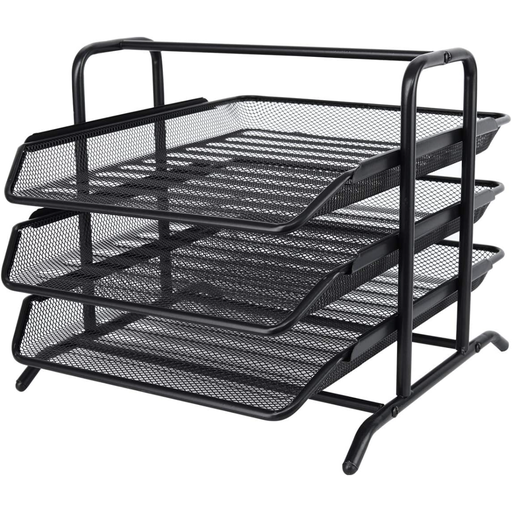
Why this suits the profile: The three pull-out A4 trays offer a clear starting point for a home office, student room or small desk.
The product description lists specific dimensions of 35.5 × 29.5 × 26 cm and rubber feet, so you can assess the space and desk protection in advance.
Metal construction, three tiers, pull-out function and assembly with included screws.
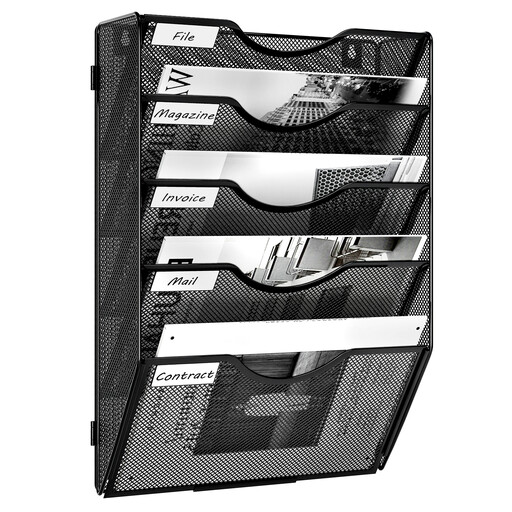
Why this suits the profile: Five vertical compartments help office professionals and small businesses separate projects, post and files by category.
The wall layout uses vertical space instead of desk surface. Included screws allow mounting, but suitable wall anchors must be chosen per surface type.
Five A4 compartments, metal frame, powder coating and a height of 42 cm.
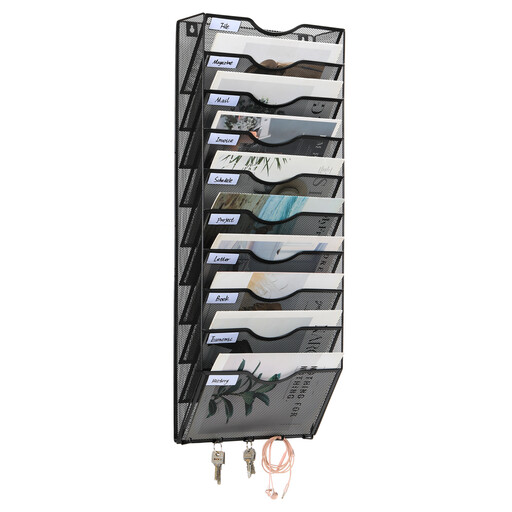
Why this suits the profile: The combination of ten compartments and five hooks is aimed at high document volumes, mail processing and shared office spaces.
The label plates make categories visible, so compartments can be assigned not just by feel but by file, client or status.
Ten A4 compartments, five hooks, label plates and dimensions of 32.5 × 10.5 × 81.5 cm.
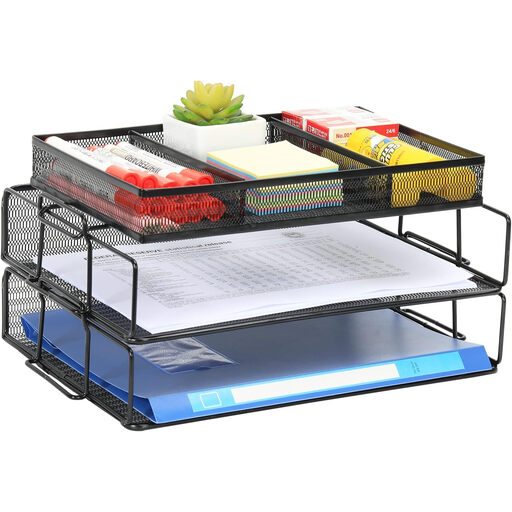
Why this suits the profile: This compact office organiser combines two A4 trays with a top compartment for pens, staplers and other accessories.
You do not need to buy a large cabinet for a limited document flow. The organiser is freestanding, stackable and requires no mounting.
Two A4 tiers, a stationery holder, stackable design and dimensions of 34 × 24.5 × 17.8 cm.
We have put together a full, up-to-date list of products that fully meet these strict selection criteria and current European safety regulations.
An organiser works better when each compartment has a fixed function. You could, for example, use this layout:
Make the compartments visible with labels and place heavier folders at the bottom. For wall-mounted models, check the fixings regularly. Clean with a dry or slightly damp cloth and follow the manufacturer's care instructions.
Not always. Check the internal width, compartment height and depth. Loose paper often fits, but a ring binder, brochure or folder may need more room.
A desk organiser is suitable if you move the holder often or do not want to drill holes. A wall-mounted A4 organiser saves workspace and works well for fixed categories, such as incoming post, invoices and client files.
The lifespan depends on load, mounting, moisture and care. A metal model with powder coating can be suitable for daily office work, but overloading and prolonged exposure to moisture can affect the finish and stability. So check the screws, rubber feet and any wear on trays or compartments regularly.
