
Vandaag of morgen in huis

Kwaliteit gegarandeerd

Welkomstaanbiedingen ontgrendelen: GRATIS bezorging | Tot 80% korting | Gratis 30 dagen JoyPlus-proefperiode
Download de app
Loose invoices, post, project folders and magazines can quickly take over a desk. An A4 document organiser can help, but not every model suits every workspace. A low letter tray works differently to a wall-mounted document holder with multiple compartments. So don’t just look at the number of tiers or the colour.
The most common mistakes when buying are usually easy to avoid:
Check not just the external size, but also the internal width and compartment height. A wall holder around 32.5 cm wide and 10.5 cm deep is suitable for many standard documents, letters and magazines. For thick files or ring binders, a deeper desk model may be more practical.
A taller organiser offers more vertical capacity, but can get in the way above a desk, cabinet or door. So measure the available space beforehand. For wall mounting, also consider the door swing, skirting boards and any cables.
A wall-mounted document holder is handy when you need to keep the desktop clear. Models with three to ten tiers allow you to create categories, such as:
A desk version is suitable when you don’t want to drill holes or you change your workspace regularly. A stackable document tray can also grow with your paperwork. Always place such a model on a flat surface and distribute the weight evenly.
A metal document organiser with a powder coating is, according to the product information, designed for daily use and easy to wipe clean. The mesh structure makes the contents visible, but small papers may not stay as neatly in place as in a closed file holder.
Look out for rounded edges, rubber feet and a handle if you plan to move the organiser regularly. Keep metal away from excessive moisture and clean it preferably with a soft, dry cloth. A slightly damp cloth can be used for stubborn marks, after which you should dry the surface thoroughly.
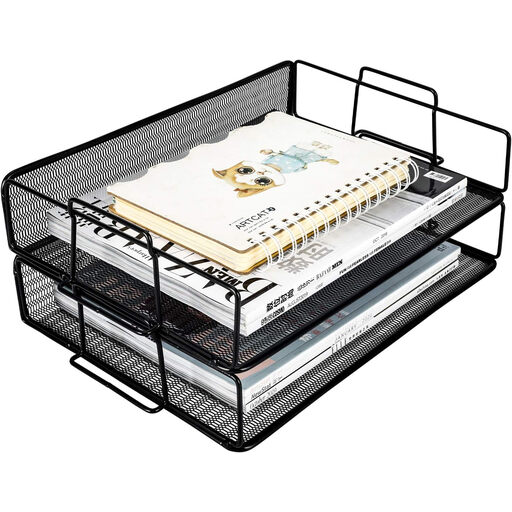
Why this fits the profile: This compact desk organiser has two A4 tiers and is designed for homeworkers, students and small admin setups who want to get started without any mounting.
The dimensions of 34 × 24.5 × 13.5 cm and the A4 specification make the required desk space clear upfront. The model is stackable, but must be loaded stably and evenly.
Metal mesh, handle and two tiers for A4 documents, folders and magazines.
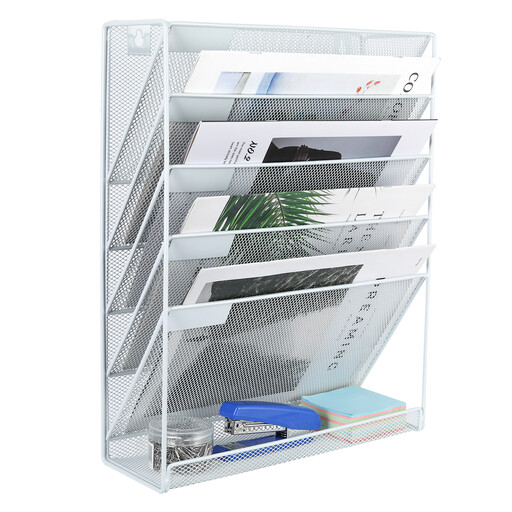
Why this fits the profile: An office professional or homeworker with multiple document streams can use six categories side by side. According to the product information, the model can be wall-mounted or used freestanding.
The product listing states both the dimensions and an internal width of 31.5 cm and a compartment height of 5.5 cm. This lets you better judge which files will fit beforehand.
Six tiers, integrated label plates, a bottom tray and a powder-coated metal housing.
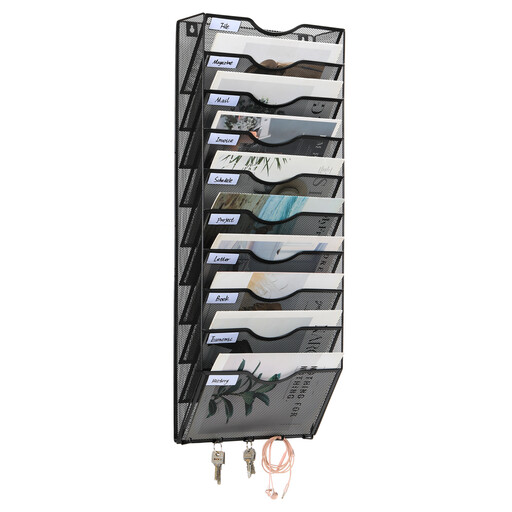
Why this fits the profile: For administrative staff, small businesses or households with a lot of incoming post, a tall wall holder provides a fixed place for each subject.
The ten compartments and five hooks are clearly stated. Before mounting, do check the wall, wall plugs and total load, as a tall organiser needs to be securely fixed.
Ten A4 compartments, label plates, a height of 81.5 cm and five hooks for, say, keys or an umbrella.
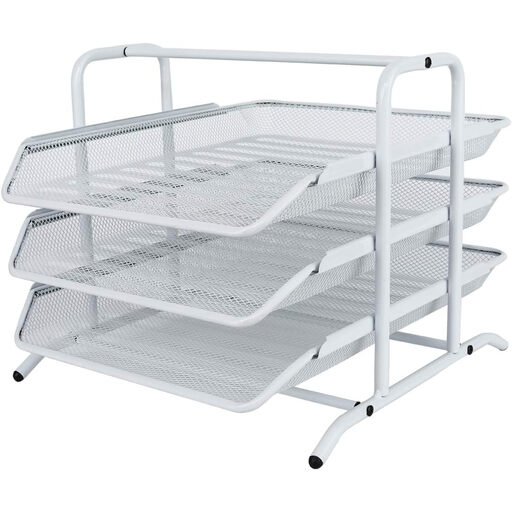
Why this fits the profile: A freestanding model with pull-out trays suits a shared office, hot desk or workspace where documents need to be immediately accessible.
The product information states the external dimensions of 35.5 × 29.5 × 26 cm, three tiers and rubber feet. This makes the required space clearer than a general claim about compact design.
Three pull-out A4 trays, metal mesh, easy assembly with screws and rubber protection for the desk.
We’ve put together a full, up-to-date list of products that fully meet these strict selection criteria and comply with current European safety regulations.
An organiser works better when each compartment has a fixed function. Use labels for things like “action”, “archive”, “invoices”, “post” and “projects”. With a wall-mounted document holder, place frequently used categories at eye level. Less urgent items can be stored higher or lower.
Don’t let documents pile up indefinitely. Plan a time once a week, for example, to archive, digitise or discard paper. This keeps an A4 letter tray usable and prevents a file holder from becoming a dumping ground.
When mounting, always check the wall type. Use suitable wall plugs for plasterboard, brick or concrete, and retighten the fixings after a while. For a desk organiser, flat, stable feet and an even weight distribution are important.
That varies by model. Check the internal width, depth and compartment height. A standard A4 document is narrower than a wide ring binder. For thick files, a deep stackable document tray or roomy drawer is often more practical than a narrow wall compartment.
A metal model with a powder coating is, according to the product descriptions, intended for office and home use. Its lifespan depends on load, mounting, moisture and maintenance. Use the organiser within the recommended capacity and avoid prolonged contact with water.
For a limited paper flow, two or three tiers are usually manageable. Four to six compartments suit multiple projects or a combination of post and files. Ten tiers are mainly useful when you want to manage many categories separately and have enough wall height available.
