
Vandaag of morgen in huis

Kwaliteit gegarandeerd

Welkomstaanbiedingen ontgrendelen: GRATIS bezorging | Tot 80% korting | Gratis 30 dagen JoyPlus-proefperiode
Download de app
Loose invoices, study papers and files can pile up quickly. An A4 document organiser can help, but not every design suits every use. A slim wall-mounted holder works differently from a stackable document tray on a desk. So don’t just focus on looks or a temporary offer – pay attention to dimensions, fixing method and weight capacity instead.
A4 paper measures 21 × 29.7 cm. However, a folder, ring binder or thick file takes up more room than a single loose sheet. Always check the internal width, depth and height. A desk document holder with a narrow opening might be fine for post, but awkward for full folders.
A wall-mounted document holder often comes with screws, but that doesn’t mean every wall uses the same wall plugs or fixings. Concrete, brick, plasterboard and wood each need the right fixing. The product descriptions for wall-mounted models state that the holder must be securely fastened and that the fixing materials should be checked regularly.
A metal desk organiser or mesh document holder may feel sturdy, but the product information for these models doesn’t list a general, universal maximum load. So don’t place heavy ring binders in a holder designed for letters and loose documents. Distribute the weight and prevent a stackable document tray from becoming unstable.
First, decide how you use your documents:
Also consider the orientation. The Senhoglb wall holders mentioned are landscape-oriented and offer roughly 35 cm width and 9 cm depth per compartment. That’s suitable for standard A4 documents, but not automatically for thick ring binders.
For the metal models in this selection, the product descriptions state that the material is metal with a powder coating. The manufacturer describes this finish as intended to prevent oxidation and rust. That’s not a guarantee for use in a damp room: for daily maintenance, a dry cloth is recommended and prolonged contact with water should be avoided.
A wooden office organiser has a different look and can resemble a small cabinet. The vidaXL models are made from engineered wood with smooth surfaces that, according to the product information, can be cleaned with a damp cloth.
Check before you buy:
According to the product description, a desk organiser with rubber feet helps to reduce slipping and scratching on the work surface. For wall-mounted models, the quality of the wall fixing is key. Don’t place a heavy metal organiser above an area where falling objects could cause damage.
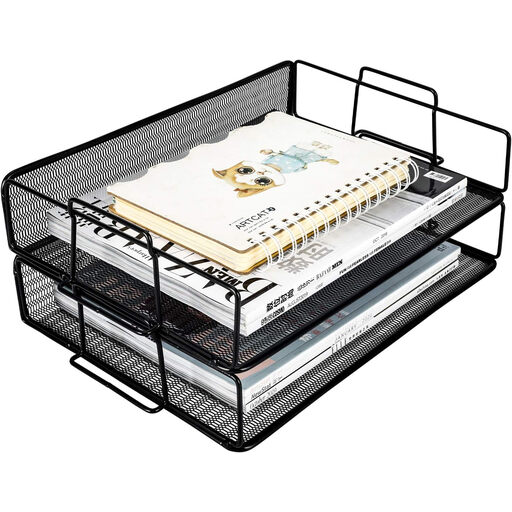
Why it fits this profile: Two compartments offer a simple start for post, invoices and documents without wall mounting.
The two separate A4 trays prevent all papers from ending up in one messy pile.
A4 size, stackable design, handle and metal mesh construction according to the product data.
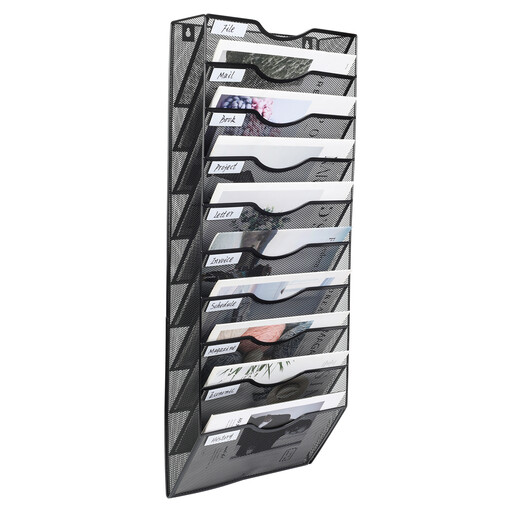
Why it fits this profile: Ten compartments are suitable for administrative professionals or households with many fixed document categories.
The label plates help to clearly mark compartments, so documents don’t get mixed up again.
Ten A4 compartments, label plates and a stated size of 32.5 × 10.5 × 81.5 cm.
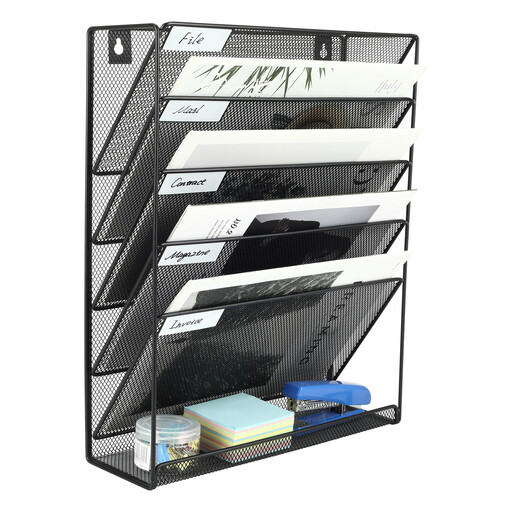
Why it fits this profile: A freelancer or home worker can place six fixed categories vertically next to the desk.
Wall mounting frees up the desktop and the fixed compartments prevent one big pile of paper from forming.
Six compartments, metal powder coating and mounting on wall or door according to the product description.

Why it fits this profile: The compact organiser is designed for pens, staplers, paperclips and small office supplies on a limited desk.
The seven compartments prevent small essentials from taking up space in an A4 document tray.
Seven compartments, a drawer, non-slip feet and a compact size of 22 × 13 × 14 cm.
We’ve put together a full, up-to-date list of products that fully meet these strict selection criteria and current European safety regulations.
Not always. A single A4 page usually fits, but a folder or thick file needs extra depth and opening. Check the internal dimensions and consider the landscape or portrait orientation.
That depends on the wall plugs used, the fixing points and the weight of the contents. Use fixing materials suitable for the specific wall and check after installation that the holder remains stable. Don’t overload the compartments.
Generally, use a soft, dry cloth. For stubborn marks, a slightly damp cloth can be used if the product information allows it. Dry the surface thoroughly afterwards and avoid prolonged exposure to moisture to limit damage to the coating.
