
Vandaag of morgen in huis

Kwaliteit gegarandeerd

Welkomstaanbiedingen ontgrendelen: GRATIS bezorging | Tot 80% korting | Gratis 30 dagen JoyPlus-proefperiode
Download de app
Loose invoices, post and study papers quickly disappear into piles. A good A4 document organiser makes it easier to sort, find and store documents efficiently. Yet not every organiser works as well in practice as it looks on paper. Dimensions, mounting and weight capacity matter more than a striking design or a long product description.
More compartments don't automatically mean more convenience. With a tall wall-mounted document holder, you also need to check whether each compartment has enough height for your documents. An A4 folder, magazine or ring binder can take up more room than a loose letter.
A wall-mounted magazine holder with shallow compartments is handy for post and thin documents, but less suitable for bulky files. So look at the internal width, compartment height and overall depth.
A metal document holder may be sturdy itself, but the wall, wall plugs and screws ultimately determine its stability. A multi-level organiser becomes heavier as you fill it. On a plasterboard wall, you may need different wall plugs than on brick or concrete.
Check before you buy:
A large desk document organiser can hold plenty of paper, but it can also block a significant part of your work surface. So always check the length, width and height. Also pay attention to the space needed to pull out drawers or trays fully.
A compact A4 letter tray or stackable document tray often fits better on a small desk. For a home office, student room or hot desk, a wall-mounted solution can be more practical.
A4 paper is 21 × 29.7 cm. So an organiser must not only be suitable for A4, but also have enough margin for plastic sleeves, folders or bulging documents. With an A4 file holder, the internal width is especially important.
Product descriptions sometimes only mention the external dimensions. So compare:
Many models in this selection are made of metal with a powder coating. According to the product descriptions, this finish is intended to protect the surface against everyday wear and moisture. That is no guarantee against rust in every environment: prolonged contact with water or high humidity remains unfavourable.
A mesh office organiser has the practical advantage that the contents remain visible. Rounded edges can make daily use more comfortable. When mounting, do check for sharp edges and tighten all fixing screws properly.
With a desk organiser, rubber feet are useful to prevent slipping and scratching. With a wall-mounted model, a secure fixing and even weight distribution are more important than appearance.
With drawers and pull-out trays, pay attention to:
If that weight capacity isn't clearly indicated, treat the organiser with care and avoid heavy stacks.
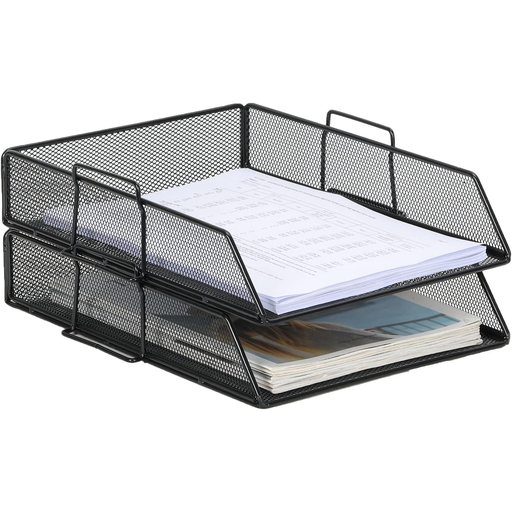
Why this fits the profile: This model offers two A4 trays for a tidy start on a desk, without wall mounting or complicated installation.
The dimensions of 25 × 33.5 × 13.5 cm make the required desk space clear in advance. Stacking can be expanded later, provided the trays remain properly aligned.
Metal construction, handle and stackable design for A4 documents, post and magazines.

Why this fits the profile: If you process multiple document streams daily, five pull-out levels give you more sorting options on one desk.
The product details state a height of 37.5 cm, a metal frame, rubber feet and pull-out trays. Do check whether that height fits on your work surface.
Five levels, pull-out trays and a size of 35.5 × 29.5 × 37.5 cm.
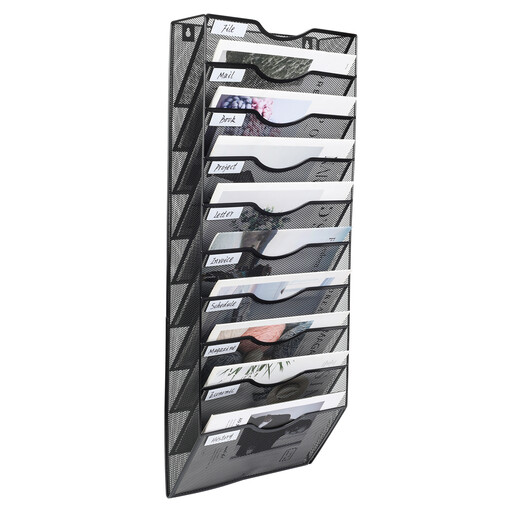
Why this fits the profile: This tall wall holder is designed for users who want to sort post, invoices, files and other A4 streams by category.
The ten compartments and label plates support fixed categories. The organiser is 81.5 cm tall; measure your free wall space and check the fixing carefully.
Ten A4 compartments, label plates and a vertical design of 32.5 × 10.5 × 81.5 cm.
A wall-mounted document holder saves desk space and works well with a fixed layout, for example "incoming", "to pay", "projects" and "archive". A single compartment of 35 × 9 × 21.5 cm can be suitable for daily post. You can mount several individual compartments next to or below each other.
Use suitable wall plugs for every wall-mounted organiser. Distribute heavy files across several compartments and check regularly that the screws are still tight. For a tenant, a desk solution may be more practical if drilling isn't an option.
For more comparison options, you can also browse the range of mesh file organisers.
We've put together a full, up-to-date list of products that fully meet these strict selection criteria and comply with current European safety regulations.
That depends on the internal width and compartment height. Loose A4 paper usually fits without any problems, but a ring binder or full file folder needs more space. Check the product specifications and measure your folder before you order.
First choose a flat, sturdy wall and mark the fixing points. Use wall plugs that suit the type of wall. Hang the holder level, tighten all screws and distribute documents evenly across the compartments. If you're unsure about the load capacity, a desk document organiser is a simpler alternative.
Remove dust with a dry or slightly damp cloth and then dry the surface. Avoid harsh cleaning products and prolonged moisture, as this can damage the coating. Sort the contents regularly; this stops the A4 letter tray or stackable document tray from filling up with old post again.
