
Vandaag of morgen in huis

Kwaliteit gegarandeerd

Welkomstaanbiedingen ontgrendelen: GRATIS bezorging | Tot 80% korting | Gratis 30 dagen JoyPlus-proefperiode
Download de app
A sleek, 90 cm black wall-mounted chimney hood is often the visual centerpiece of a modern kitchen. But behind the design lies a technical appliance where the wrong choice can lead to a noisy kitchen filled with cooking odours. As a Joybuy Product Recommendation Officer, I'm here to help you see through the marketing jargon and choose a model that truly works for your situation. Let's review the most common pitfalls and the key specifications to consider.
Before you make a decision, it's crucial to be aware of a few common misconceptions that can lead to a disappointing purchase.
quiet extractor hood is often promoted with the noise level of its lowest setting. This is not representative of the moments you actually need the hood, like when searing meat or fish. The noise level on the highest setting (expressed in decibels, dB) is the only value that matters for a realistic comparison.extractor hood without external ducting (recirculation) seems like a simple solution. What's often not clearly stated is that the carbon filters, which neutralise odours, need to be replaced every 3 to 6 months. These recurring costs can add up significantly over the years.To make an informed choice, focus on a few objective specifications. These determine the performance and user-friendliness of your 90 cm kitchen extractor hood.
The required capacity depends on the size of your kitchen. A simple rule of thumb is: Length (m) x Width (m) x Height (m) x 10 = required m?/h. For an open-plan kitchen, include the volume of the adjoining living space. For a 90 cm wall-mounted chimney hood in an average to large kitchen, a capacity of around 650 m?/h is a solid baseline for effectively removing cooking fumes.
An energy-efficient extractor hood with an A+++ energy class consumes significantly less power, which you'll notice on your energy bill. Some models use as little as 12 kWh per year. For noise, pay attention to the maximum dB level. A value below 60 dB on the highest setting is generally considered relatively quiet.
90 cm recirculation extractor hood solution if ducting to the outside is not possible. Keep the replacement of carbon filters in mind.Based on objective specifications, we have selected a number of models that suit different user profiles.
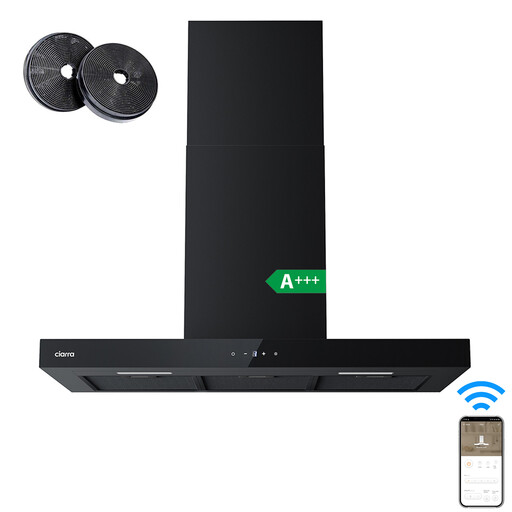
Why This Fits Their Persona: Perfect for those seeking a powerful (90 cm) and technologically advanced solution. The app control fits a modern lifestyle, and the high extraction rate is ideal for larger hobs and open-plan kitchens.
This model provides clear specifications: a maximum extraction rate of 650 m?/h and a noise level of 59 dB on the highest setting. No vague promises, just verifiable facts.
The combination of an A+++ energy label (only 12 kWh/year) and an app-controlled extractor hood via Wi-Fi offers both efficiency and modern convenience.
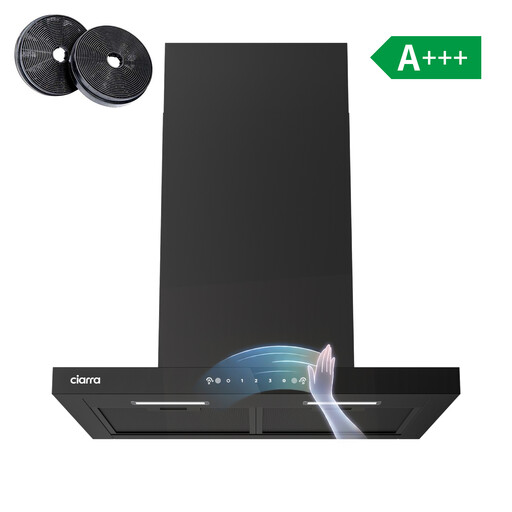
Why This Fits Their Persona: For those who prioritise design and an uncluttered aesthetic. This 60 cm model features an ultra-slim 40 mm glass panel that blends seamlessly into the kitchen. The contactless control via hand gestures is both hygienic and modern.
Despite its slim design, this hood delivers serious performance with 650 m?/h and a noise level of 59 dB. It proves that a minimalist look doesn't have to compromise on functionality.
The ultra-slim 40mm panel and Wave Control (hand gesture control) are unique features. The A+++ energy class makes it a highly efficient choice.
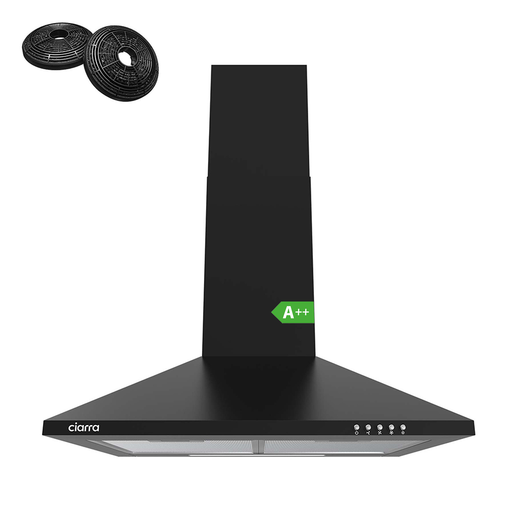
Why This Fits Their Persona: A reliable and affordable choice for a first home or a kitchen renovation on a budget. This 60 cm model offers essential functions without unnecessary frills, packaged in a classic black wall-mounted chimney design.
This model focuses on reliability with physical push-buttons instead of sensitive touchscreens. The specifications are clear: 367 m?/h and 63 dB, providing an honest picture of its performance.
Highly energy-efficient with an A++ energy label and an annual consumption of just 9 kWh. The option for both ducting and recirculation offers flexibility during installation.
An extractor hood is an important investment. If the models above don't fully meet your needs, explore our wider range. We have compiled a complete list of extractor hoods that meet strict selection criteria.
For a recirculation extractor hood, regular replacement of the carbon filters is crucial to continue neutralising cooking odours effectively. The general guideline is to replace the filters every 3 to 6 months, depending on how intensively you cook. Always consult the manufacturer's manual for specific recommendations for your model.
Yes, the difference is significant. A quiet A+++ extractor hood, like the Ciarra 90cm model, can consume as little as 12 kWh per year. An older model with a C or D rating can easily use ten times that amount. Over a 10-year lifespan, the savings on your energy bill can amount to hundreds of euros.
While it is possible for an experienced DIY enthusiast, professional installation is recommended. This ensures a safe electrical connection, correct mounting to the wall, and an optimal connection of the ductwork. Improper installation can reduce performance and create safety hazards.
