
Vandaag of morgen in huis

Kwaliteit gegarandeerd

Welkomstaanbiedingen ontgrendelen: GRATIS bezorging | Tot 80% korting | Gratis 30 dagen JoyPlus-proefperiode
Download de app
A 90-litre compact fridge is ideal for a student room, bedroom, office or small household. But capacity isn’t everything. A fridge might look spacious on paper, yet be awkward to use because of an impractical door, limited adjustment options or high energy consumption.
Keep an eye out for these three common pitfalls:
A 47 cm-wide slim fridge is handy for an alcove, student room or office. Measure the height and depth as well as the width, and allow space for the door to open. For example, the CHiQ JR92DSE is 47.4 cm wide, 44.7 cm deep and 83.1 cm high. The TCL RF120DWE0 is slightly narrower, at 44.9 cm wide.
Don’t place a freestanding fridge right up against a wall or piece of furniture. Keep the ventilation openings clear and follow the clearance guidance in the manual. This helps prevent the compressor from having to work harder.
For one person or a small household, 80 to 100 litres is often enough for everyday shopping, drinks and a few fresh items. A fridge with adjustable glass shelves offers more flexibility than a fixed layout, making it easier to fit tall bottles or food containers.
Check whether the fridge has a crisper drawer, door compartments and, if needed, a separate fridge or chill drawer. A fridge with a chill drawer can be useful for items that need to be kept extra cool for a short time. Always follow the storage instructions on the packaging.
Noise levels are worth considering if you’re looking for a small fridge for a bedroom or office. Models listed in the product specifications at around 39 to 40 dB are considered relatively quiet, but the noise you hear can vary from room to room.
A class E energy-rated fridge meets the current European energy-efficiency labelling requirements. Also check the stated annual energy consumption in kWh. For example, the CHiQ JR92DSE is listed at 85 kWh per year. Actual consumption may vary depending on the ambient temperature, settings and how often the door is opened.
A fridge with a reversible door gives you more flexibility when deciding where to put it. Check that the hinges can be moved according to the manual and that the door can open fully once the fridge is in place.

Why it suits this type of buyer: Its 90-litre capacity is well suited to everyday use in a student room, bedroom or small office. The mechanical controls are simple to use, with no complicated settings to worry about.
The stated external dimensions are 44.9 × 48.5 × 84.2 cm. It also has three glass shelves, adjustable feet and a separate chiller box.
90-litre capacity, energy class E, three adjustable glass shelves and a stated noise level of 40 dB.

Why it suits this type of buyer: This model combines a slim design with an adjustable layout and a separate chill drawer. It’s a good fit for anyone who wants to organise their fridge with care for everyday use.
The product specifications list a 92-litre capacity, a width of 47.4 cm, seven temperature settings and a reversible door. This makes it easier to match the capacity, controls and placement to your needs.
Adjustable glass shelves, crisper drawer, chill drawer, energy class E, 85 kWh per year and a stated noise level of 39 dB.
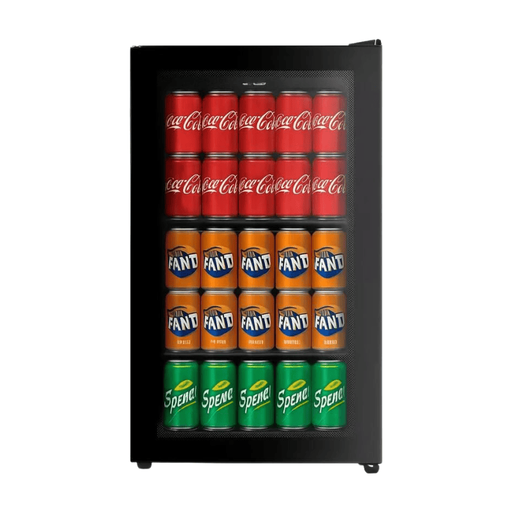
Why it suits this type of buyer: Designed for drinks, this fridge could work well in an office, hobby room or home bar, or as an additional fridge.
The product information lists three adjustable shelves, a reversible door and a thermostat. Be sure to check beforehand that you have the approximately 91 cm of clearance needed to open the door.
93-litre capacity, glass door, LED lighting, energy class E, 81 kWh per year and a stated noise level of 40 dB.
We’ve put together a complete, up-to-date list of products that meet these strict selection criteria and the relevant European safety requirements.
After transporting a new under-counter fridge, leave it upright for the period specified by the manufacturer. Clean the inside before adding food and set the temperature according to the manual. Place the appliance on a level surface and use the adjustable feet to stop it wobbling.
A fridge for an office or bedroom shouldn’t be placed right next to a radiator or oven, or in direct sunlight. Let hot food cool before putting it in the fridge, and leave space between items for air to circulate. If you have a model that needs manual defrosting, as some compact fridges do, remove any ice build-up in good time.
For one person, 80 to 100 litres is often enough for everyday shopping. If you store lots of fresh food, large packs or frozen items, consider a larger model or one with a freezer compartment.
It depends on the stated energy consumption in kWh, your electricity tariff and how you use the fridge. A model rated at 85 kWh per year uses less energy according to its product specifications than one rated at 139 kWh per year. To work out the actual cost, multiply the annual consumption by your rate per kWh.
Yes, as long as the room is well ventilated and the noise level suits you. Check the stated dB rating, but bear in mind that compressor and clicking noises may be more noticeable in a quiet bedroom.
