
Vandaag of morgen in huis

Kwaliteit gegarandeerd

Welkomstaanbiedingen ontgrendelen: GRATIS bezorging | Tot 80% korting | Gratis 30 dagen JoyPlus-proefperiode
Download de app
A 90 cm angled cooker hood is a good fit above a wide hob and offers extra space to capture cooking fumes when you’re preparing food intensively. However, a high capacity figure on a product page doesn’t tell you everything. The connection, noise level and filter maintenance all affect how pleasant the hood is to use every day.
For households in the Netherlands, three pitfalls are particularly important:
A cooker hood with sufficient capacity is important for a medium to large kitchen. The Comfee CH90J64ET4A2B2-EU has a stated maximum airflow of 620 m³/h. This is relevant if you often bake, stir-fry or cook at high temperatures. However, practical performance also depends on the installation and the ventilation mode you choose.
Before buying, check:
With external extraction, fumes and odours are channelled outside. Recirculation requires suitable charcoal filters. In a flat or rented home, recirculation is often easier because you don’t need to make an opening through a wall or exterior wall.
A quiet cooker hood is useful in an open-plan kitchen or if you want to chat while cooking. Don’t just look for the word “quiet”; check the stated noise level and the number of settings.
The Comfee is listed with a noise level of 59 dB and has four speeds. This lets you adjust extraction to suit what you’re cooking: a lower setting for simmering and a higher one for baking or frying. However, check whether the 59 dB figure applies to the highest setting or to a different measurement condition.
A model with touch controls can be convenient, but the control panel should also be easy to reach and clean while you’re cooking. A cooker hood with four settings gives you more control than a model with just two fixed speeds.
An aluminium grease filter traps grease particles before they can reach the motor. A multi-layer filter can be practical if you cook regularly. Check whether the filter is removable and washable, and how often it’s recommended that you clean it.
Also look out for:
An A++ or A+++ energy rating is a product specification and should be considered alongside annual consumption. According to the product information, an energy-efficient cooker hood may use less electricity, but actual consumption depends on how long you use it and which setting you choose. A brand’s claims about savings don’t guarantee what you’ll save on your own energy bills.
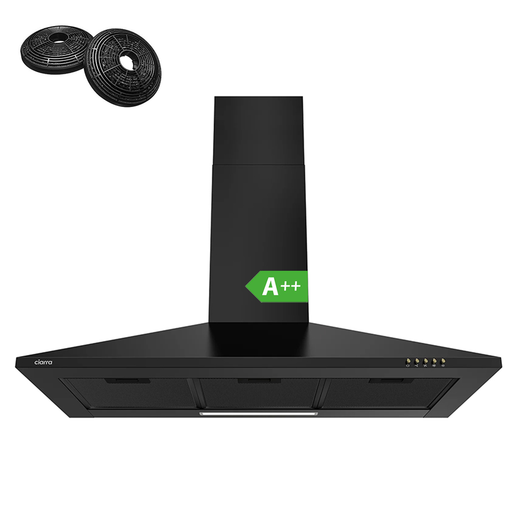
Why it suits this profile: A 90 cm black cooker hood for anyone who wants to pair a wide cooking area with straightforward wall mounting and the choice of external extraction or recirculation.
The product information lists both ventilation modes and aluminium grease filters. However, check first whether the 370 m³/h capacity suits the way you cook.
90 cm wide, black finish, aluminium grease filters, and support for recirculation and external extraction.
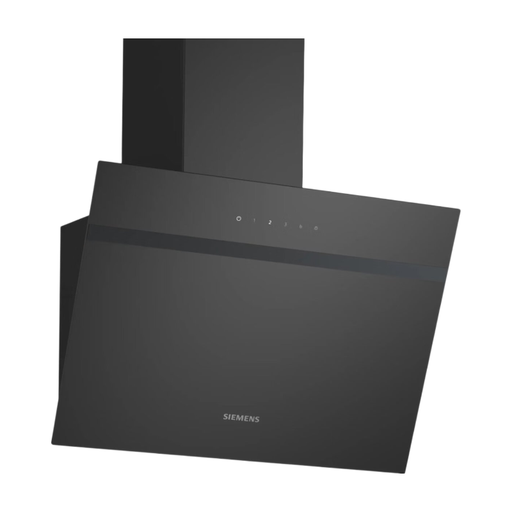
Why it suits this profile: A good choice if you’re looking for a black angled cooker hood with touch controls, a filter indicator and a glass finish. This model is 60 cm wide, so it isn’t designed for a 90 cm hob.
The specifications mention filter saturation alerts, a dishwasher-safe filter and a stated noise range. Check whether a charcoal filter is required separately.
TouchControl, three speeds, a stated maximum capacity of 430 m³/h and maintenance reminders.
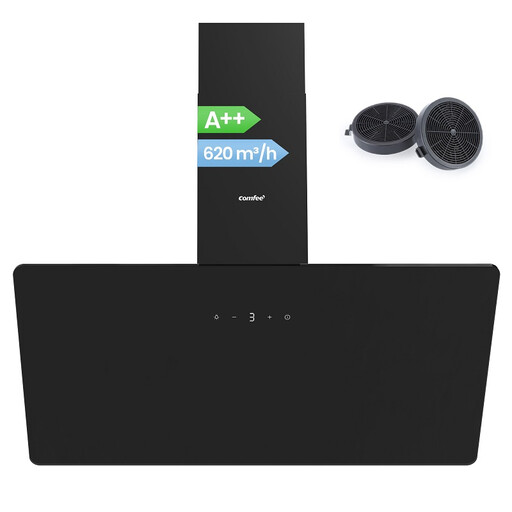
Why it suits this profile: For home cooks with a wide hob who regularly cook, bake or stir-fry intensively and need both recirculation and external extraction.
The product listing specifies 620 m³/h, four speeds, 59 dB and a five-layer aluminium filter. Check the duct route and filter requirements when arranging installation.
90 cm wide, touch controls, A++ energy rating, four settings, 620 m³/h and a choice of recirculation or external extraction.
We’ve put together a complete, up-to-date list of products that meet these strict selection criteria and comply with current European safety regulations.
Yes, a 90 cm model is a natural fit for a hob of the same width. Also check the depth, installation height and distance from wall units. The manufacturer’s manual specifies the minimum permitted distance.
It depends on your home and installation. External extraction vents moisture and cooking fumes outside, but requires a suitable duct. Recirculation is more flexible for flats and rented homes, but uses filters that need maintenance and sometimes replacing. Whichever system you choose, make sure the room is adequately ventilated.
This depends on its power consumption, energy rating, how long you use it and the setting you choose. Check the annual consumption in kWh on the energy label rather than relying on a marketing term such as “energy-efficient”. Cleaning the grease filter regularly also helps prevent unnecessary restrictions to airflow.
