
Vandaag of morgen in huis

Kwaliteit gegarandeerd

Welkomstaanbiedingen ontgrendelen: GRATIS bezorging | Tot 80% korting | Gratis 30 dagen JoyPlus-proefperiode
Download de app
A 7-day pill organiser may seem straightforward, but the wrong model can quickly become impractical. Small compartments, unclear day labels or lids that open inside a bag can create extra work and confusion. This applies to medicines, as well as vitamins, fish oil and food supplements.
A medication organiser should suit your dosage schedule, the size of your tablets and how you plan to use the box. Below, we outline the main pitfalls and checks to consider, followed by some practical recommendations.
A weekly pill organiser with seven compartments is not automatically suitable for everyone. If you take something in the morning, afternoon and evening, you may need several compartments per day. A pill organiser with compartments for 21 or 28 doses may be a better fit.
Before buying, check the following:
The description “large pill box” does not tell you much without information about the dimensions of the compartments. A capsule may be longer or thicker than a standard tablet. So look for specific measurements or a description that explains the capacity.
According to the product description, the VVM organiser’s large compartments can each hold up to 12 fish oil capsules or 13 large vitamins. This is a product specification provided by the seller; the actual capacity depends on the shape and size of your tablets.
A waterproof pill box sounds appealing for travelling, but “moisture proof” or moisture-resistant does not automatically mean that the product is completely waterproof. A click-lock lid may help protect against splashes, but do not store a medicine box in a damp bathroom for extended periods or in a loose bag where water could get in.
Also check the cleaning instructions. Many models may only be cleaned with a damp or dry cloth and are not suitable for the dishwasher.
For one dose per day, a simple 7-day model may be sufficient. If you take medication several times a day, a medication organiser with 21 or 28 compartments is easier to keep organised.
A model with separate daily compartments can be useful when you only want to take that day’s box with you. Do check that the compartments close securely and do not easily get mixed up.
Many pill boxes are made from PP, ABS, TPE or BPA-free plastic. A smooth surface makes cleaning easier. More important than a marketing term is the practical finish:
According to information provided by VVM, some models feature reinforced hinges designed to withstand more than 10,000 bends. This is a claim from the product description and is not a guarantee for every usage situation.
Measure the space at home where you plan to store the box. An extra-large organiser offers more capacity, but also takes up more room. For a day out, a portable pill box is often more practical than a full weekly box.
When travelling, preferably choose a model with:
Do not use a pill box as a replacement for the original packaging when the label, information leaflet or specific storage conditions are important. If in doubt, ask your pharmacist how your medication should be stored and transported.
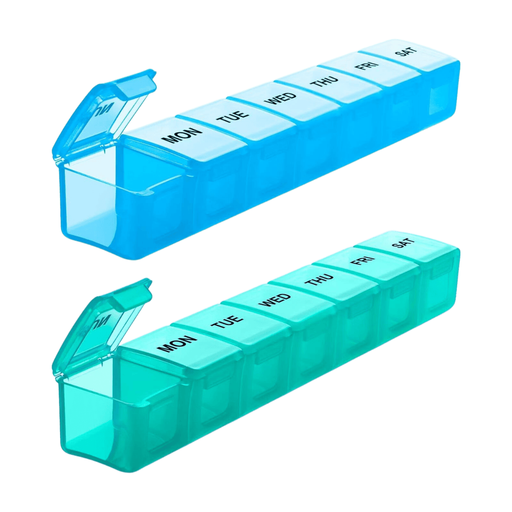
Why it suits this profile: This 2-pack offers a simple way to organise a week’s worth of vitamins, supplements or medicines by day, with an extra organiser for use at home or on the go.
The product description mentions seven separate compartments, a moisture-resistant design and secure-fitting lids. Before buying, check whether one compartment per day is sufficient for your dosage schedule.
2 pieces; large compartments; BPA-free plastic according to the product information; approximately 23.1 × 3.3 × 2.8 cm per organiser.
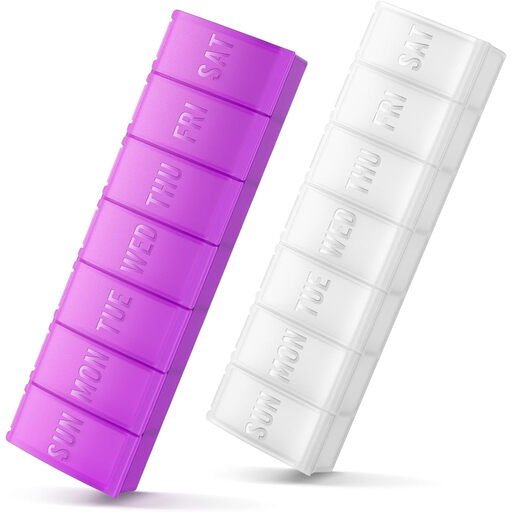
Why it suits this profile: The large compartments and permanently applied day labels are practical for anyone who wants a clearly organised week and regularly takes larger capsules.
According to the product description, the day markings are etched, so they do not rely on loose stickers. It is still advisable to check the closure and whether your own capsules fit properly.
2 pieces; large compartments; BPA-free plastic according to the product information; designed with easy-open lids.
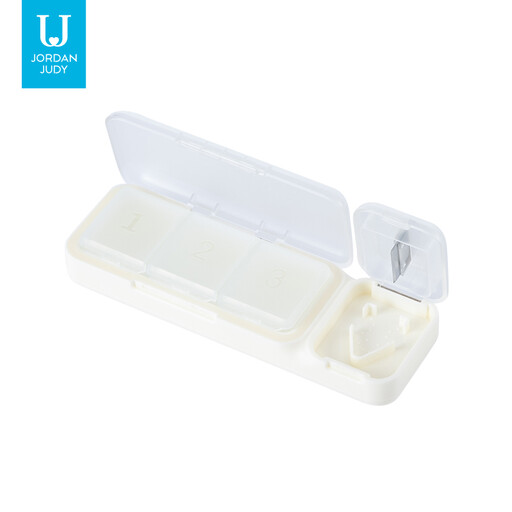
Why it suits this profile: This compact model is designed for a coat pocket, handbag or travel luggage, combining seven daily compartments with an integrated tablet splitter.
The seven marked compartments help prevent the days from getting mixed up. Only use the tablet cutter if your doctor or pharmacist confirms that the particular tablet can be split; capsules and liquid-filled pills are not suitable for this.
Compact size; 7 daily compartments; integrated stainless-steel tablet cutter according to the product description; suitable for everyday use and travel.
We have put together a complete, up-to-date list of products that fully meet these strict selection criteria and the applicable European safety regulations.
A pill box helps organise your medication, but it does not replace the information leaflet, advice from your pharmacy or the original packaging when this is needed for identification.
That depends on the layout. A model with just seven daily compartments is mainly suitable for one combined dose per day. For morning, afternoon, evening and night-time doses, a 21- or 28-compartment organiser is a better choice. Also check with your pharmacy whether your medicines may be stored together in a single compartment.
Its lifespan depends on the material, hinges, closures and frequency of use. A box that is opened several times a day will wear out faster than one used occasionally. Replace the product as soon as a compartment no longer closes properly, a hinge becomes loose or the labels become illegible.
A pill box does not require electricity, cartridges or refills. Recurring costs are therefore usually limited to replacing it when necessary. When buying, focus particularly on the number of pieces, capacity and layout. A 2-pack can be practical if you use one organiser at home and keep one as a travel pill box.
