
Livraison le jour même et le lendemain

Qualité garantie

Débloquez vos offres de bienvenue: Livraison GRATUITE | Jusqu'à -80 % | 30 jours d'essai gratuits à JoyPlus
Téléchargez l'application
A 7-day pill organiser can help you prepare medicines, vitamins, fish oil or supplements for each day. However, many pill boxes look similar, while their ease of use can vary considerably. A small compartment is not always suitable for large capsules, and a lid that is difficult to open can quickly become frustrating when you are out and about.
So don’t just focus on colour or a low price. Pay particular attention to the layout, fastening, dimensions and material. This will help you avoid having to buy another medicine box after only a short time.
A pill organiser with seven compartments is practical if you take your medicine once a day. If you take medicines in the morning, afternoon and evening, several compartments per day may be more suitable. A weekly pill organiser with 21 compartments provides three dosing times per day, while a model with 28 compartments divides the week into four times per day.
Also consider the size of the compartments. Large vitamins and fish oil capsules take up more space than small tablets. As a result, a compact vitamin organiser can fill up more quickly than expected.
A loose lid or unclear day marking increases the risk of pills getting mixed up. Look for a clear day layout, easy-to-read labels and a fastening that stays closed in a handbag, rucksack or suitcase.
You should also treat terms such as ‘waterproof’ or ‘moisture-resistant’ with caution. Not every product description states a testing standard or protection rating. Therefore, don’t automatically assume that a waterproof pill organiser is suitable for swimming or prolonged exposure to water.
A pill organiser with pill splitter can be useful for tablets that may be divided according to the instructions. However, the presence of a cutting blade does not mean that every tablet can be safely split. Capsules, liquid capsules and some tablets must not be divided. Check with your pharmacist or doctor before changing a dosage.
Choose the layout based on your routine:
A system with removable daily trays can be practical when you only want to take medication for one or a few days with you.
Many models are made from PP, ABS or TPE. PP plastic is often used for lightweight storage boxes. ABS can provide a sturdier outer shell, while TPE is found in fastenings or seals. Always check the specific product description; the material alone does not tell you everything about durability.
A pill box must be completely dry before you fill it. Wash the box by hand with mild soap if recommended by the manufacturer. A product that is not dishwasher-safe may warp due to heat or moisture. You should also store medicines according to the instructions on the packaging. A medication organiser does not automatically replace the original packaging and patient information leaflet.
For older people or those with limited hand strength, large lettering, contrasting day labels and easy-to-open lids are more important than an ultra-compact size. Check the external dimensions if the pill box needs to fit in a coat pocket, handbag or hand luggage.
When travelling, also check the rules of the airline and your destination. It is preferable to carry prescribed medicines in their original packaging and keep the relevant documentation close at hand.
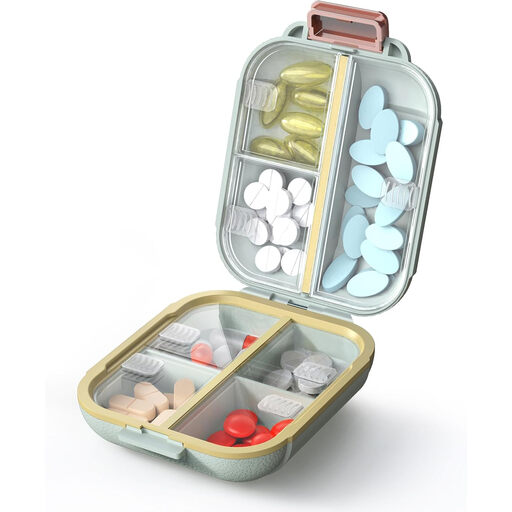
Why it suits this profile: This compact pill box is designed for a simple daily routine and, according to the product information, fits in a bag or pocket. The model has seven compartments and a lid described as airtight.
The seven separate compartments prevent a week’s supply from becoming mixed up. However, check that each compartment is large enough for your tablets.
Seven compartments, a portable size and a lid that, according to the description, closes airtight.
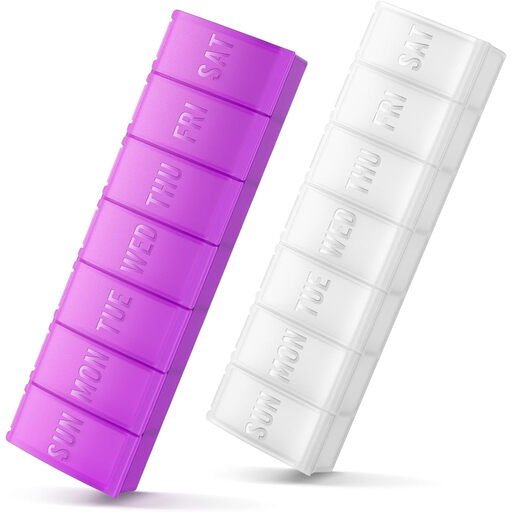
Why it suits this profile: According to the product information, the spacious compartments are designed for large vitamins, fish oil and supplements. The etched day labels and easy-to-open lids are practical for everyday use.
The larger compartments reduce the risk of capsules being crushed or a compartment filling up too quickly.
Spacious daily compartments, two pieces per pack and day labels that, according to the description, are permanently applied.
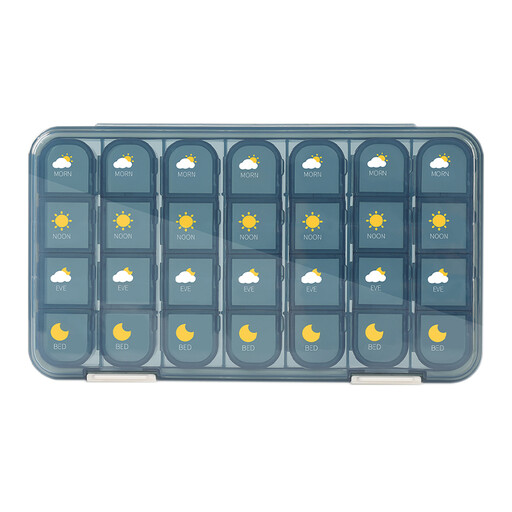
Why it suits this profile: Four compartments per day provide space for a routine with multiple dosing times. The size is suitable for work, travel or use at home when a seven-day layout is needed.
The day and time layout prevents different dosing times from ending up in the same compartment. Make sure the lids are properly closed before carrying it around.
28 compartments, four dosing times per day and a portable design with lids that close securely, according to the product description.
Fill a medicine box at a set time and check the day labels. Do not store medicines in a damp bathroom for extended periods if the patient information leaflet specifies a different storage method. A pill box is primarily an aid to staying organised; the original packaging remains important for the name, strength, expiry date and storage advice.
Only use an integrated pill cutter for tablets that are suitable for this purpose. If in doubt, ask your pharmacist whether the tablet may be divided. Keep a box with a sharp blade out of children’s reach and replace it if it is damaged or the cutting blade becomes blunt.
We have put together a complete, up-to-date list of products that fully meet these strict selection criteria and the applicable European safety regulations.
This depends on the medicine and its storage instructions. Some tablets can be stored temporarily in a dry pill box, but moisture, heat and light may affect them. Check the patient information leaflet or ask your pharmacist for advice.
For a short trip, a travel pill organiser can be useful. It is also preferable to carry prescribed medication in its original packaging. When flying, check the rules of the airline and destination country, particularly for medicines subject to additional regulations.
Choose a pill organiser for older people with clear labels, sufficiently large compartments and lids that open without requiring much force. If you have multiple dosing times, a model with 21 or 28 compartments is often easier to organise than a small box with just seven daily compartments.
