
Vandaag of morgen in huis

Kwaliteit gegarandeerd

Welkomstaanbiedingen ontgrendelen: GRATIS bezorging | Tot 80% korting | Gratis 30 dagen JoyPlus-proefperiode
Download de app
A 7-day pill organiser helps you sort medicines, vitamins, fish oil or food supplements by day. However, not every weekly pill box is equally practical. A lid may be too stiff to open, compartments may be too small for large capsules, and a product described as “waterproof” may only be resistant to splashes.
The right choice therefore depends on your daily routine, hand function, travel plans and how much you take each day. Below, you’ll find the key points to consider, along with a selection of medicine organisers for different situations.
A compact pill case may seem convenient for travelling, but the compartments are not always suitable for large supplements. Fish oil capsules, multivitamins and some food supplements take up relatively little space. Always check not only the number of compartments, but also the practical capacity of each one.
A large pill organiser with spacious compartments prevents you from having to squash capsules together or store several days’ supplies mixed up. Also check the dimensions of the complete product and the internal layout.
“Waterproof”, “airtight” and “moisture-proof” do not automatically mean the same thing. A moisture-resistant medicine organiser may protect against normal humidity or light exposure to moisture, but it is not necessarily suitable for carrying in a wet bag or using in the bathroom.
According to the product information for some models, the compartments are moisture-resistant or fitted with an airtight lid. Always check the product description, and do not use the pill organiser instead of the original packaging when medicines have specific storage requirements.
A sturdy snap-shut lid can prevent the contents from coming loose, but too much resistance makes everyday use difficult. This is particularly important for older people, carers and anyone with limited hand function or arthritis.
Look for terms such as easy-open, ergonomic lids and smoothly hinged flaps. A lid that is easy to open must still stay closed during transport. Look for a balance between accessibility and secure closure.
A 7-day pill organiser should make it immediately clear which compartment belongs to which day. According to the product information, permanently applied or engraved labels are less likely to come loose than stickers. Also check that the layout suits your routine: one large compartment per day is easy to understand, while several doses per day often require a different arrangement.
With a BPA-free pill organiser, the product information states that BPA is not used in the specified plastic material. This is a verifiable product specification, but it does not automatically say anything about all the product’s other features. Also check the hinges, closures, odour, cleaning instructions and the strength of the walls.
Many models should be cleaned with a damp cloth. Allow the compartments to dry completely before filling them again. Do not use aggressive cleaning products if the manufacturer advises against them.
For use at home, a weekly pill organiser with spacious compartments is convenient. For a travel pill organiser, the overall size, weight and closure are particularly important. A separate travel pill box with six or seven compartments is easier to fit into a wash bag, but may offer less space per day.
For air travel and longer stays, also take the original medicine packaging and the patient information leaflet with you when necessary. The pill organiser is intended to make taking and sorting medicines more straightforward, not to replace prescriptions or packaging information.
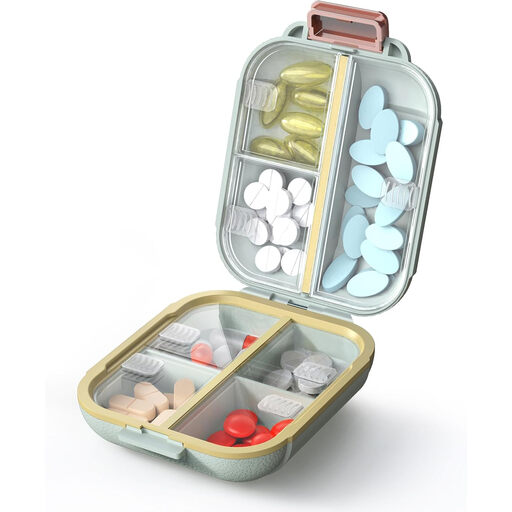
Why it suits this profile: A simple pill organiser for anyone who wants to arrange the week by day without carrying a large model. The green version is designed for use on the go.
The seven separate compartments make it easier to organise the week than one shared storage compartment. Check beforehand that your capsules will fit in the compact compartments.
Seven compartments, a compact design and, according to the product listing, BPA-free material with an airtight lid.
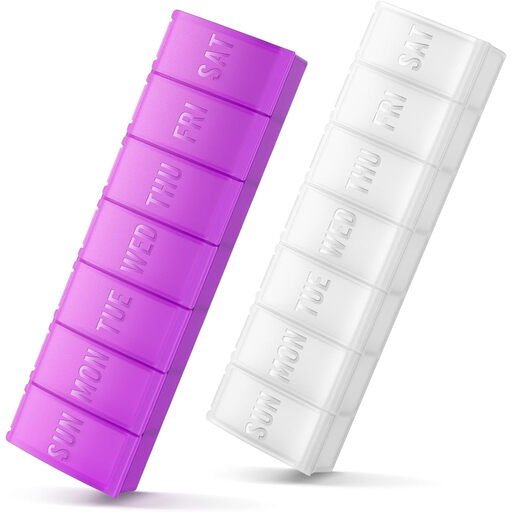
Why it suits this profile: Suitable for everyday use with larger vitamins, supplements and fish oil. The set of two can be useful at home and on the go.
According to the product information, this model has spacious compartments, engraved day labels and easy-open lids. This reduces the risk of unclear labels and difficult opening.
According to the manufacturer’s description, BPA-free medical-grade plastic, permanently engraved labels and a pack containing two organisers.
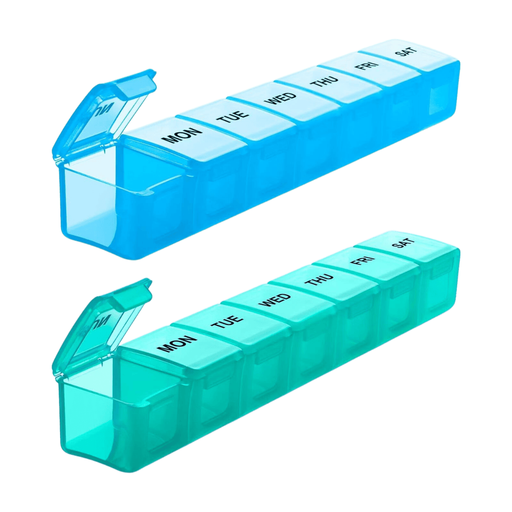
Why it suits this profile: For users who take several large capsules each day or need a spacious pill organiser for vitamins and supplements.
According to the product information, the compartments are extra large and the design is moisture-resistant. This makes it more suitable for large capsules, but does not guarantee complete waterproofing.
According to the manufacturer’s description, seven compartments, BPA-free plastic, reinforced hinges and a set of two organisers.
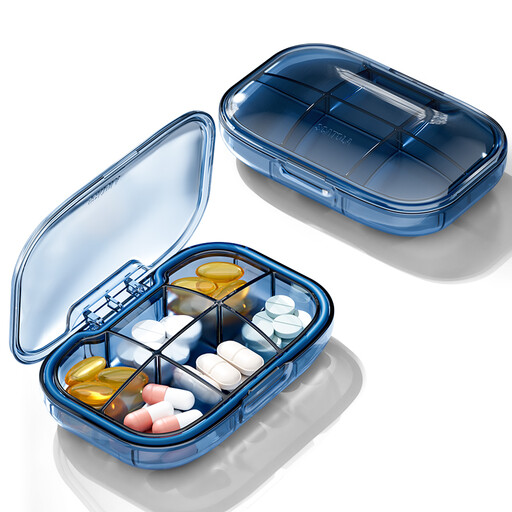
Why it suits this profile: A set of two compact boxes for short trips, a spare organiser or different types of supplements.
The six separate compartments keep different doses or supplements apart. The description mentions moisture-resistant plastic; check the closure for your own travel conditions.
Two items per pack, six compartments per box and a compact design for travelling.
We’ve put together a complete, up-to-date list of products that fully meet these strict selection criteria and the applicable European safety regulations.
Not always. Some medicines must remain in their original packaging or have specific requirements regarding light, temperature or moisture. Only use the organiser when this is compatible with the storage advice. If in doubt, ask your pharmacist for advice.
Clean the compartments when they are visibly dirty and check them regularly when refilling. Follow the product instructions and use a damp cloth or mild cleaning solution. Allow each compartment to dry completely before adding new medicines or supplements.
This depends on the material, hinges, closures and everyday use. Check the box for cracks, loose lids and faded or illegible labels. According to the product information for some models, reinforced hinges are designed for long-term use, but this is a manufacturer’s statement and not a guarantee for every use case.
