
Livraison le jour même et le lendemain

Qualité garantie

Débloquez vos offres de bienvenue: Livraison GRATUITE | Jusqu'à -80 % | 30 jours d'essai gratuits à JoyPlus
Téléchargez l'application
A 7-day pill organiser can help you sort your medicines, vitamins, supplements or fish oil by day. However, not every weekly pill box is practical for daily use. A small compartment can quickly become too full, a lid can be difficult to open, and unclear markings can lead to mistakes.
So don't just focus on colour, price or the term "waterproof". Pay particular attention to the layout, dimensions, closure and material. That way, you can prevent your medication organiser from ending up unused in a drawer after just a few weeks.
A model with seven compartments is suitable when you want to organise one dose per day. If you take medication, for example, in the morning, afternoon and evening, you'll need a pill organiser with multiple compartments. A layout with 21 compartments offers three compartments per day; 28 compartments offers four per day.
Also check whether the compartments are large enough for your tablets, capsules or fish oil. A large pill organiser isn't automatically more convenient if it isn't clearly marked by day and time.
A lid that is too stiff to open is awkward for seniors or people with limited hand strength. A closure that is too loose can open during transport. Look for a clear daily layout and a closure you can easily check.
With products that use terms like "air-tight", "moisture proof" or "sealed", it's wise to read the product description. These terms don't automatically mean the box is completely airtight or suitable for long-term storage in damp rooms.
A loose pill organiser with one large compartment per day offers little distinction between different dosing times. This can be impractical if you have several types of medication. In that case, choose a medication organiser with separate compartments for morning, afternoon and evening, or for morning, afternoon, evening and night.
A pill organiser is a tool for organisation. Always store medicines according to the prescription and, if in doubt, check the instructions from your pharmacy or doctor. Do not use a pill organiser for hazardous substances and keep it out of reach of children.
First, look at the number of compartments:
A pill organiser for morning, afternoon and evening usually has 21 compartments. Do check whether the labels actually match your routine. Some models use days of the week, while others only use a time layout.
A compact, portable pill organiser fits more easily into a handbag, rucksack or suitcase. However, the compartments may be smaller. So look at the external dimensions and the shape of the compartments. Large vitamins and fish oil capsules in particular take up a fair amount of space.
The JORDAN&JUDY models with 21 or 28 compartments are, according to the product description, 9.1 × 5.1 × 1.2 inches in size. They combine a weekly layout with three or four compartments per day. This is relevant for users who have multiple dosing times but still want to take the organiser with them.
Many pill organisers in this category are made from PP, ABS, TPE or other plastic. Check whether the manufacturer provides information about BPA-free material, how to clean it, and its use with moisture. A product that can only be hand-washed should not go in the dishwasher.
Only refill the compartments when they are completely dry. Before travelling, check that each lid is properly closed. Do not store medicines for long periods in a hot car, damp bathroom or direct sunlight, unless the packaging or pharmacy gives different instructions.
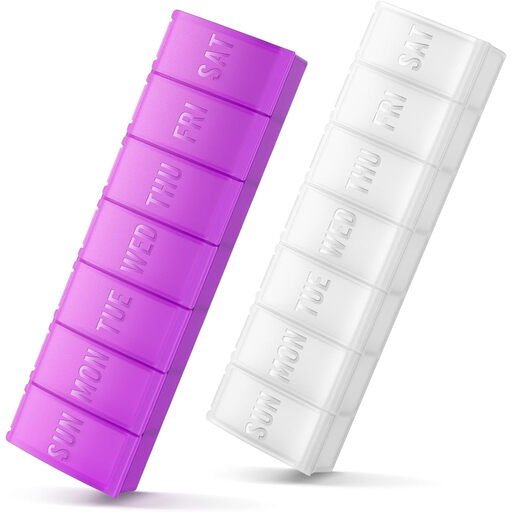
Why this fits the profile: The set of two is practical for someone who wants a weekly organiser at home and a second one for work or travel. According to the product description, the compartments are suitable for larger vitamins, fish oil and daily medication.
The permanently applied day labels are designed, according to the description, to keep the layout readable. Do check whether the compartment capacity suits your pills.
7 day compartments, BPA-free plastic according to the product information, two per pack and a design with easy-to-open lids.
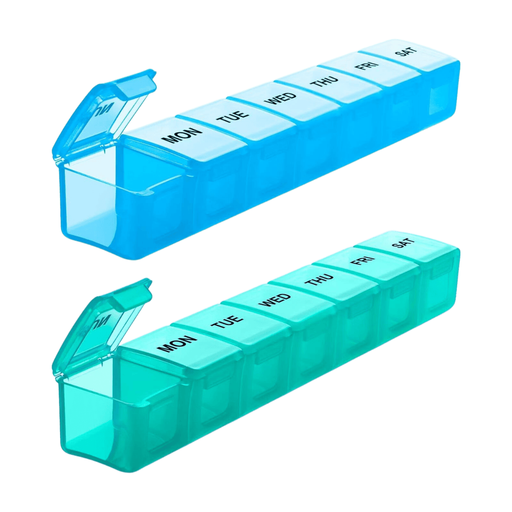
Why this fits the profile: This model is aimed at users who need extra space for large supplements. The pack contains two weekly organisers, which is handy for alternating use at home and on the go.
The product description mentions a thickness of 1.6 mm, reinforced hinges and moisture-resistant properties. These are verifiable specifications, but not a guarantee of complete waterproofing.
Extra-large compartments, 7 day compartments per organiser, BPA-free plastic according to the product information and a pack containing two organisers.
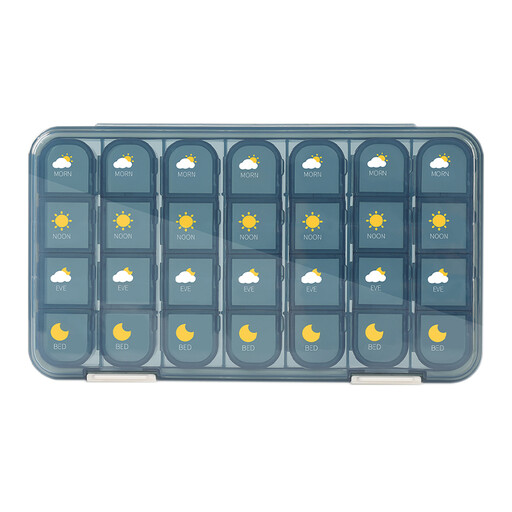
Why this fits the profile: The layout with four compartments per day suits users with multiple dosing times. According to the description, this model is designed for daily use, supplements and travel.
The 28 individual compartments limit the mixing of dosing times. The snap-lock closures are designed to keep the compartments closed during transport.
28 compartments, four times per day, ABS, PP and TPE materials according to the product information and a size that, according to the description, fits in luggage.
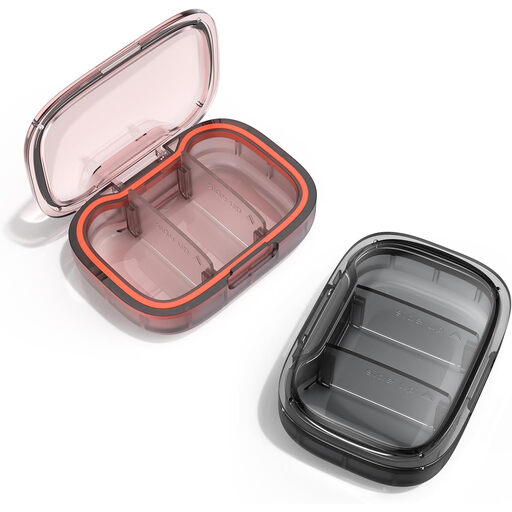
Why this fits the profile: This small, portable pill organiser is designed for a handbag, coat pocket or short trip. The three compartments are suitable for a limited daily schedule or separate supplements.
Thanks to the small layout, you don't need to take a large weekly organiser for just a few days. The moisture-resistant casing is mentioned in the product name; check the closure before travelling.
Two per pack, three compartments per organiser and a compact size for pocket, bag or hand luggage.
We've put together a full, up-to-date list of products that fully meet these strict selection criteria and comply with current European safety regulations.
First, make a list of the days and dosing times. Then fill each compartment individually and check the contents against the prescription or original packaging. Ideally, fill the organiser at a quiet time and keep medicines with special storage requirements separate.
The lifespan depends on the material, hinges, closures and daily use. Regularly check for loose lids, cracks, discolouration or a closure that no longer fastens properly. Replace the pill organiser when compartments no longer close reliably or labels become illegible.
A pill organiser for travel is practical for organising a limited amount of medication or supplements. For prescribed medicines, also take the original packaging, patient information leaflet and any necessary documents with you. Also check the rules of your destination and store medication according to the instructions from your pharmacy or doctor.
