
Livraison le jour même et le lendemain

Qualité garantie

Débloquez vos offres de bienvenue: Livraison GRATUITE | Jusqu'à -80 % | 30 jours d'essai gratuits à JoyPlus
Téléchargez l'application
A 7-day pill organiser can help you arrange medicines, vitamins, fish oil and supplements by day. However, not every medication organiser is equally practical. A box with compartments that are too small, unclear markings or loose-fitting lids can cause confusion rather than prevent it.
For everyday use in the Netherlands, three things are particularly important: the layout by dosing time, the closure and the size. Below, you’ll find what to look for before buying a weekly medication organiser and which models suit different situations.
A 7-day pill organiser with one compartment per day is easy to understand, but it isn’t suitable if you take different medicines in the morning, afternoon and evening. So first check whether you need 7, 21 or 28 compartments:
Never use a medication organiser as a replacement for a prescription or advice from your doctor or pharmacy. Clearly note which pills belong in each compartment.
Compact models are easy to take with you, but large vitamins, capsules or fish oil capsules take up more room than small tablets. A compartment may look spacious on paper, yet quickly become full in practice.
Pay attention to the dimensions of the organiser as a whole as well as the shape of the compartments. For everyday use, a larger model may be more convenient. For a handbag, coat pocket or short trip, a portable pill organiser is often sufficient.
A closure that only applies light pressure doesn’t automatically protect against moisture. Products described as moisture-resistant, moisture proof or waterproof are not designed to be submerged or stored in a very steamy bathroom.
Store medicines according to the instructions on the packaging. A pill organiser is mainly an aid for organisation and transport; the original packaging may contain important information.
For many users, clear day markings are more important than a large number of extra features. Check whether the days are permanently marked or indicated only with a sticker. For older people or carers, large, contrasting lettering and easy-open lids can be particularly practical.
If you have three or four dosing times, it’s best to choose a pill box with compartments for each part of the day. This means you won’t have to combine several types of medicine in one unclear compartment.
A snap-lock or click closure can help prevent pills from falling out of their compartment during transport. However, check that the lids aren’t too tight for the intended user. A closure that is difficult to open can be inconvenient for people with limited hand strength or stiff fingers.
For travel, a compact size, separate compartments and a securely closing case are important. Also place the pill organiser in a dry wash bag or a compartment in your bag, and take the leaflet or original packaging with you when travelling with prescribed medication.
Many models are made from PP, ABS or TPE. These plastics vary from product to product in terms of shape, hinge construction and finish. Pay particular attention to the care instructions:
A pill organiser for vitamins and supplements may be suitable for everyday use, but always check that the compartments are large enough for capsules and fish oil.
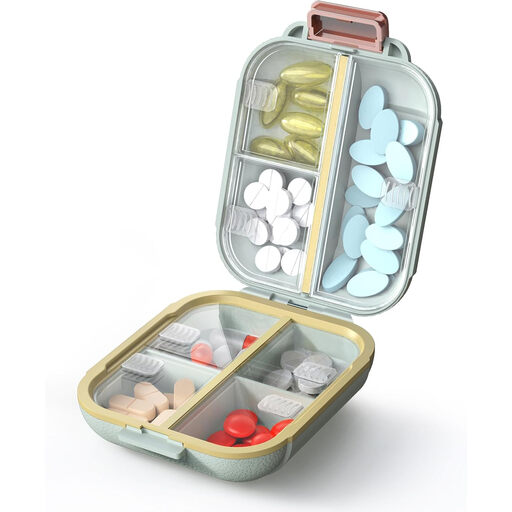
Why it suits this user profile: This model is designed with one clearly organised compartment per day, making it suitable for users who want to keep their daily routine simple.
The seven separate compartments prevent you from storing the entire week’s supply in one container. Check beforehand whether one compartment per day is sufficient.
Seven compartments, a compact design and, according to the product description, an airtight-fitting lid. The model is green.
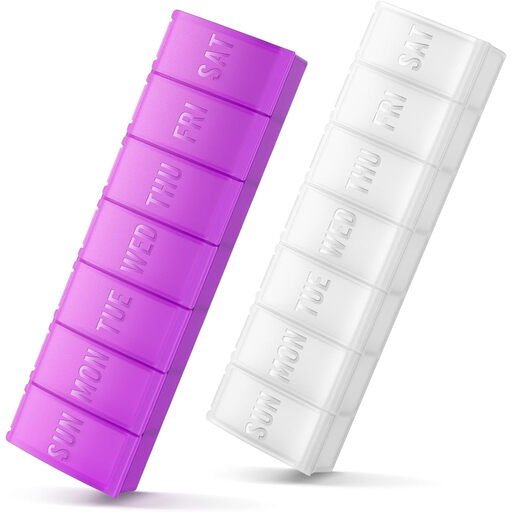
Why it suits this user profile: The two-piece set is practical for anyone who wants to keep one organiser at home and a second one in a bag or at work.
The product description mentions permanently applied day markings and easy-open lids. Check that the compartment size is suitable for your capsules.
BPA-free plastic according to the product information, large compartments and a pack containing two organisers.
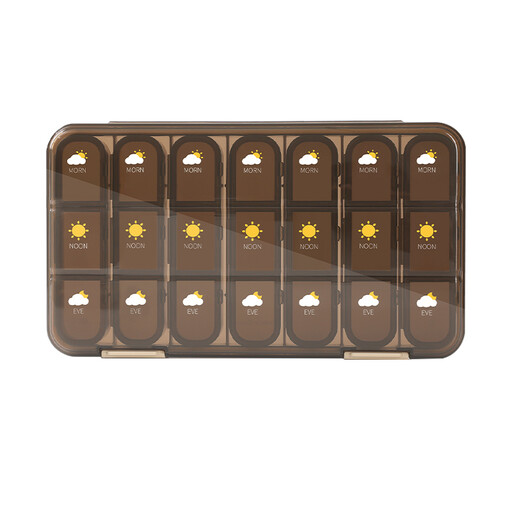
Why it suits this user profile: The layout with three compartments per day is ideal for users with several regular dosing times or a detailed supplement schedule.
The 21 compartments help prevent medicines for different dosing times from being mixed. According to the product description, the model has a sealed design with click-lock lids.
21 compartments, ABS, PP and TPE materials according to the product listing, and dimensions of 9.1 × 5.1 × 1.2 inches.
We’ve put together a complete, up-to-date list of products that fully meet these strict selection criteria and the applicable European safety regulations.
A pill splitter can be useful when a tablet can be divided according to the leaflet. Not every tablet may be split; capsules and liquid-filled pills, for example, are not automatically suitable. Check with your pharmacy or doctor before splitting a tablet.
A compact model with seven removable day compartments is particularly practical for a handbag, bedside table or short trip. For a weekly medication organiser with multiple dosing times, 21 or 28 compartments provide a clearer layout.
Work one day and one dosing time at a time. Check the name and dosage against the prescription, fill one day at a time, and if in doubt, ask a carer or pharmacist to check the layout. Do not simply store medicines that require special storage in an organiser.
Its lifespan depends on the material, hinges, frequency of use and cleaning method. Replace the organiser when a lid no longer closes properly, the markings become difficult to read or cracks appear. A moisture-resistant pill organiser should also be kept dry and clean.
The price mainly varies according to the number of compartments, whether it is a set of several boxes, the size of the compartments and extra features such as a pill splitter. Don’t compare the price alone; also consider the layout, dimensions, closure and care instructions. This will help you avoid finding that a cheap organiser is unsuitable for your daily routine.
