
Beginner waltz player
You want to practise melodies and chords in a regular triple metre. A bar in 3/4 has three beats, as explained by musictheory.net. So check that the metronome or accompaniment on your chosen model suits your lesson materials.


For a waltz lesson involving a melody and simple chords, a portable keyboard may be all you need, provided its metronome or accompaniment suits the time signature and you can practise with headphones. Choose a digital piano with 88 weighted keys if piano technique or the range of your sheet music is your priority. Check that the instrument will fit in the shared room and whether you need to buy a pedal separately.
You want to practise melodies and chords in a regular triple metre. A bar in 3/4 has three beats, as explained by musictheory.net. So check that the metronome or accompaniment on your chosen model suits your lesson materials.
You may need a wider key range and a piano-style touch for lessons or more advanced piano parts. An 88-key keyboard may be suitable, if there’s enough room in the music room.
You want to be able to practise quietly or put the instrument away after use. Check the headphone socket, dimensions and weight, and find out which power supply and accessories come with that version.
A good fit if: you mainly want to practise a waltz melody and simple left-hand chords, and need to be able to move the instrument.
The trade-off: it’s more compact than a full piano keyboard, but has a narrower key range and doesn’t necessarily have weighted hammer action.
A good fit if: you want to work on your piano technique or practise pieces with a wider range.
The trade-off: the larger keyboard takes up more room and is harder to move; a pedal may need to be bought separately.
| What to consider | What to look for | Who it matters to |
|---|---|---|
| Triple metre and accompaniment | Check the manual to see whether the metronome offers a suitable accent or time signature setting; if needed, look for an appropriate waltz style. | I want to practise the three beats, melody and chords properly; around 31% of consumers prioritise keeping time and accompaniment. |
| Quiet practice | Check the headphone socket and whether connecting headphones mutes the speakers; also check the rules for using the practice room. | If other people use the room, I want to be able to practise with headphones; around 25% of consumers prioritise quiet practice. |
| Touch and key range | Compare the range of your sheet music with the number of keys, and don’t confuse touch sensitivity with weighted hammer action. | I want to practise piano technique or a piece with a wider range; around 25% of consumers prioritise piano-style touch and key range. |
| Moving the instrument and accessories | Measure the available space and check the weight, power supply, and whether a pedal, music rest or headphones are included. | If I need to move or put the instrument away after use, its size and included accessories matter; around 19% of consumers prioritise this. |
Touch sensitivity and a weighted keyboard with hammer action are different features. They suit different learning goals.
Ask yourself whether you mainly want to practise dynamics on a compact keyboard, or also work on piano technique on a hammer-action keyboard.
The number of accompaniment styles alone doesn’t tell you whether the time signature, accents or waltz style you want are available.
Check the style list and metronome settings for the exact version against your lesson materials.
Alesis lists a pedal input for the Recital 61, but no sustain pedal is included. Check what comes with the version you’re looking at.
If you want to use a pedal during lessons, check in advance which compatible pedal you’ll need.
A compatible sustain pedal for the Recital 61 may need to be bought separately.
The PSR-E383 is an example of a portable keyboard with 61 touch-sensitive keys and learning features.
The CT-S300 is an example of a portable keyboard with touch-sensitive keys.
The FP-30X is an example of an 88-key digital piano for anyone who wants to work on piano technique as well as waltz repertoire.
The Recital 61 is a 61-key alternative with semi-weighted keys and a lesson mode for two players.
These Joybuy products are 61-key keyboards and keyboard sets for practice and learning. Check that the metronome, rhythms and headphone socket on the exact version suit your waltz lessons and the rules of your music room.
 Image unavailable
Worth considering if you’re looking for a metronome and headphone socket for rhythm practice.
The product description lists 300 rhythms, 300 sounds and weighted keys. Check that the metronome settings and keyboard suit your learning goals.
 Image unavailable
Could be a good fit if you’re looking for a keyboard with a metronome and an output for headphone practice.
The product information lists 300 rhythms, 500 sounds, a metronome and a three-step learning system. Check whether the metronome offers an accent or 3/4 setting.
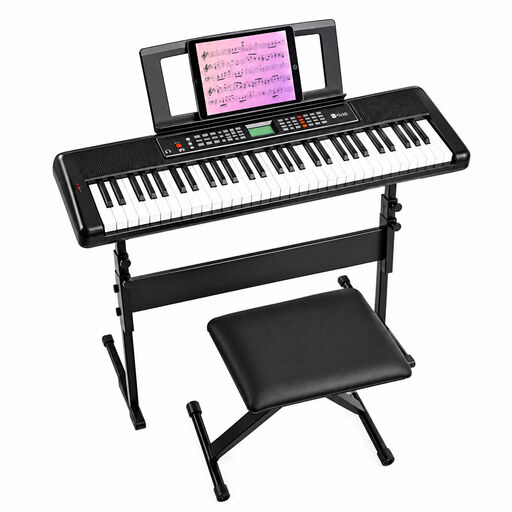 Image unavailable
Worth considering if you also need a stool and stands for your practice space.
The product title lists 300 sounds and 300 rhythms; the description mentions a three-level learning function and a headphone socket. Check which items are included with the exact version.
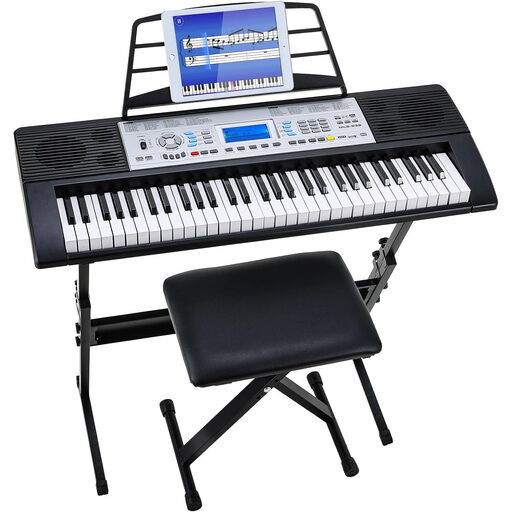 Image unavailable
Could be a good option if you’re looking for a keyboard set with a seat and a learning function.
The product description lists a three-stage learning function, built-in speakers, and 500 sounds and rhythms. Check whether this version has the waltz accompaniment and headphone socket you want.
No. You can also use a suitably set metronome to practise the three beats of a piece in 3/4. If you want accompaniment, check the styles and time signature settings available on the exact model.
That depends on the model and the number of headphone outputs. Roland lists two outputs for the FP-30X and Alesis one for the Recital 61. Also check that the connections are compatible with the headphones you use.
Check whether the exact version includes a power supply, music rest, compatible sustain pedal and, if needed, headphones. Alesis says that a sustain pedal isn’t included with the Recital 61.
For online consumer purchases, you generally have a 14-day cancellation period from delivery, with some exceptions. ACM ConsuWijzer also explains that, under the terms of the legal guarantee, a seller must resolve issues if a product doesn’t do what you can reasonably expect when used normally. This could mean repairing or replacing it.
No. According to the European Commission, CE marking is required when the relevant EU rules say so; it doesn’t mean that an EU body has independently approved every product in advance. Check the applicable requirements and documentation for the exact version and the power supply included.