
Vandaag of morgen in huis

Kwaliteit gegarandeerd

Welkomstaanbiedingen ontgrendelen: GRATIS bezorging | Tot 80% korting | Gratis 30 dagen JoyPlus-proefperiode
Download de app
A 60 cm built-in cooker hood will often fit into a standard kitchen cupboard and help keep a small or modern kitchen looking uncluttered. However, choosing the right model involves more than just checking the width. A cooker hood may look powerful on paper but disappoint in practice because of an incorrect cut-out size, expensive charcoal filters or excessive noise.
In this buying guide from the Joybuy Product Recommendation Officer, you’ll learn what to look for in an integrated cooker hood, flat-screen hood or telescopic cooker hood.
A model with a product width of 59.8 or 59.9 cm won’t necessarily fit every cupboard. Check the following too:
A 52 cm cooker hood may be suitable for a compact hob, but it won’t always cover the entire 60 cm cooking area. Measure both the cupboard and the hob before you order.
A high maximum airflow sounds appealing, but how well the hood performs also depends on the duct, bends, filters and ventilation setting. With recirculation, air passes through a grease filter and usually a charcoal filter. This can affect airflow and noise levels.
So don’t just look at the boost setting. Check the normal settings too. For example, the Ciarra Slimline 60 cm product specifications list 138, 160 and 184 m³/h at progressively higher noise levels.
A recirculating cooker hood doesn’t vent air outside. According to the product description, a charcoal filter helps reduce cooking odours, but it’s a consumable that needs regular replacement. Before buying, check whether the correct filter is included or needs to be purchased separately.
With a ducted cooker hood, it’s important to have a suitable exhaust duct, backdraft damper and correct installation. Venting outside can be a practical option, but it may not be possible in every rented home or existing kitchen.
There are several types to choose from:
Push buttons are simple and straightforward to use. A touchscreen, automatic sensor or app control can offer extra convenience, but may also increase the price and the number of components that can wear out. Choose features you’ll actually use.
A modest extraction rate may be enough for a small, enclosed kitchen. In an open-plan kitchen, or if you do a lot of stir-frying and frying, a higher airflow is more practical. Bear in mind that manufacturers may use different test conditions. Compare models at the same ventilation setting and check the stated noise level.
A quiet cooker hood is particularly useful in an open-plan kitchen, flat or home with an adjoining living room. A noise level of around 45 to 55 dB on a low or normal setting may be more comfortable than a low maximum noise rating alone. Boost settings are usually louder.
An energy-efficient cooker hood may be worth considering if you use it every day. As well as checking the energy rating, look at the annual consumption in kWh per year. A removable, washable metal grease filter helps keep ongoing costs down. If you’re using recirculation, also check which charcoal filter is compatible with the model.
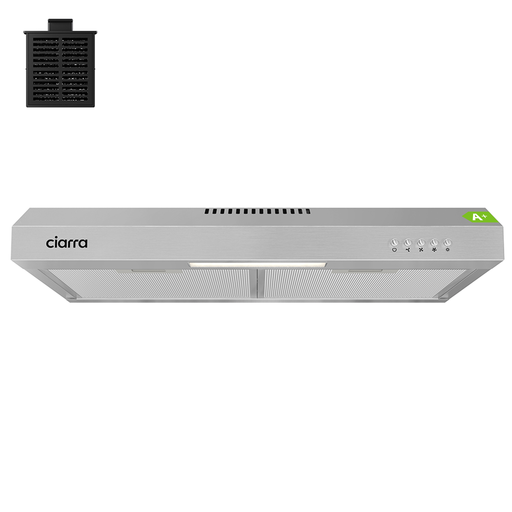
Why it suits this profile: This compact design is suitable for a small kitchen, rented home or low cupboard. It has push-button controls and supports both ducted extraction and recirculation.
The specifications list a width of 596 mm, three settings, a washable aluminium filter and annual consumption of 11 kWh. However, check that the relatively low maximum airflow of 184 m³/h suits the way you cook.
A+ energy rating, maximum airflow of 184 m³/h, two extraction options and a stainless steel housing.
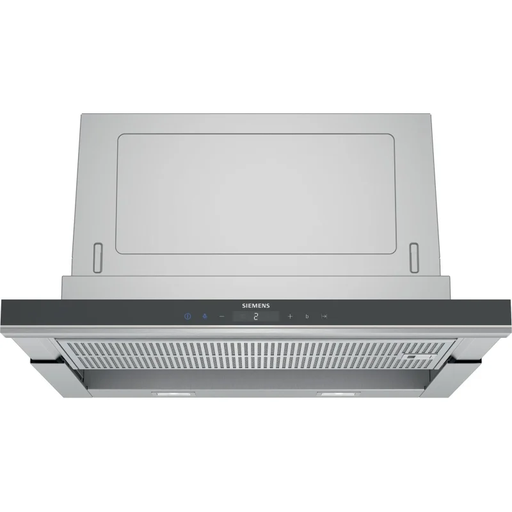
Why it suits this profile: This semi-integrated telescopic design is mostly concealed inside a wall cupboard. It’s a good fit for a streamlined kitchen where controls, lighting and filter maintenance matter.
The product specifications list a noise level of 53 dB, an A energy rating and metal grease filters that, according to the description, are dishwasher-safe. An optional kit is required for recirculation.
According to the product specifications, airflow of up to 717 m³/h, TouchControl, dimmable LED lighting and annual consumption of 38 kWh.
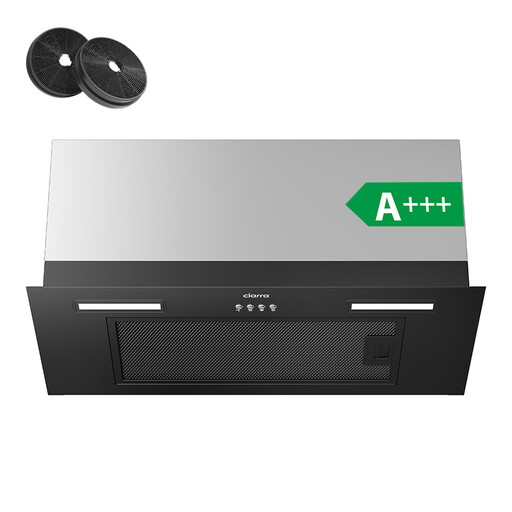
Why it suits this profile: This fully integrated cooker hood is designed for anyone looking for an almost invisible solution with a high stated airflow for regular cooking.
The product description lists both external extraction and recirculation. For ducted extraction, the 1.2-metre duct is not included, according to the description, so remember to allow for this in your budget.
According to the product description, 650 m³/h, an A+++ energy rating and a CBCF003 charcoal filter included for recirculation.
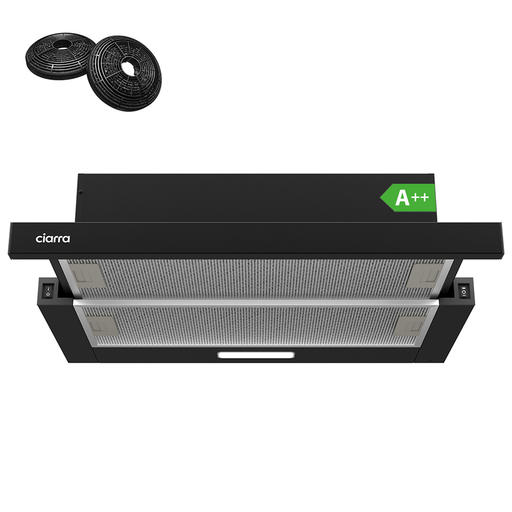
Why it suits this profile: The pull-out design takes up little space when not in use. Its black finish complements a kitchen with dark appliances.
The specifications list both ducted extraction and recirculation, and include an exhaust duct and CBCF002X2 charcoal filters. The maximum setting is audible at 61 dB.
Airflow of up to 355 m³/h according to the product specifications, an A++ energy rating and two control settings with a memory function.
We’ve put together a complete, up-to-date list of products that meet these strict selection criteria and applicable European safety regulations.
Clean metal grease filters regularly, for example every two to four weeks if you use the hood frequently. Always follow the instructions for your chosen model. Switch off the power before removing filters or cleaning the hood.
If you’re unsure, have a qualified installer fit the duct and electrical connection. If you have a gas hob, follow the minimum distance specified in the instructions and make sure there’s adequate ventilation. Never use an open flame beneath the cooker hood, and don’t leave the hob unattended.
No. The external dimensions may differ slightly from the required cut-out size. Check the exact width, depth, height and cut-out measurements in the technical specifications.
Recirculation can be a practical option if venting outside isn’t possible. You’ll still need to clean the grease filter and replace the charcoal filter according to the product instructions. If you do a lot of frying or stir-frying, external extraction may be a more practical choice.
That depends on its annual energy consumption, your electricity price and how often you use it. Check the stated kWh consumption per year, and remember to factor in replacement charcoal filters, installation and any ducting components.
