
Vandaag of morgen in huis

Kwaliteit gegarandeerd

Welkomstaanbiedingen ontgrendelen: GRATIS bezorging | Tot 80% korting | Gratis 30 dagen JoyPlus-proefperiode
Download de app
A 60 cm cooker hood suits many standard hobs and kitchen cabinets. But choosing one involves more than simply measuring the width. A 60 cm cooker hood could be right for a small rented kitchen, an open-plan kitchen or a full renovation, but only if the installation, ventilation method and capacity are right for the space.
Look out for these three common pitfalls:
A built-in cooker hood is fitted mostly inside a wall cabinet. It’s a good choice if you want a neat, integrated look. Before buying, check the recess width, cabinet depth and required ventilation opening.
A telescopic cooker hood has a pull-out front. This keeps the appliance relatively compact when it’s not in use. It’s a practical option for small kitchens and rented homes, but measure the extended depth carefully.
A wall-mounted model is installed above the hob and remains visible. A sloping design often provides more headroom, while a traditional chimney-style model needs more vertical space.
With a ducted cooker hood, cooking fumes are carried outside through a duct. This can be an efficient option, but check that there’s a suitable duct and that its diameter and connection match the specifications. A pipe that’s too narrow or has too many bends can increase noise and resistance.
Recirculation doesn’t require an external duct. This makes it suitable for flats or kitchens where drilling through an external wall isn’t possible. However, the carbon filters must be checked and replaced as instructed in the manual. A cooker hood that supports both options gives you more flexibility if you move home or renovate your kitchen.
Don’t compare only the maximum airflow. Check the different settings and noise level in dB too. A quiet cooker hood is especially useful in an open-plan kitchen. A difference of a few decibels can be noticeable during long cooking sessions, but always check whether the stated noise level applies to the highest or a lower setting.
An energy-efficient cooker hood has a good energy rating and low stated annual energy consumption. Actual running costs depend on how long you use it, the fan setting and the lighting. A cooker hood with LED lighting will generally use little power for illumination, but check the exact wattage in the product specifications.
A cooker hood with a washable grease filter helps reduce the ongoing cost of replacement metal filters. The filter traps grease particles and needs regular cleaning. Product information for various models recommends cleaning it every two to four weeks, depending on how often and how intensively you cook.
Also remember to:
An LED light, push-button controls or touch controls can’t replace a suitable ventilation system. Choose the right installation and ventilation method first, then compare comfort features.
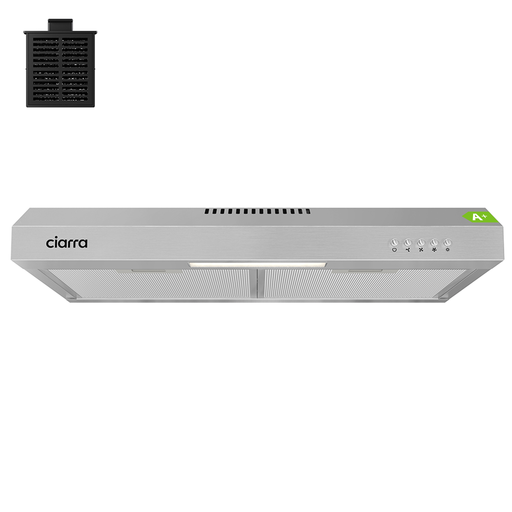
Why it suits this buyer: Its compact design and push-button controls make it easy to use for everyday cooking. It’s also suitable for small or low kitchen cabinets.
The specifications list three settings, a maximum noise level of 61 dB, and both ducted extraction and recirculation options.
A+ energy rating, maximum airflow of 184 m³/h and two washable aluminium filters.
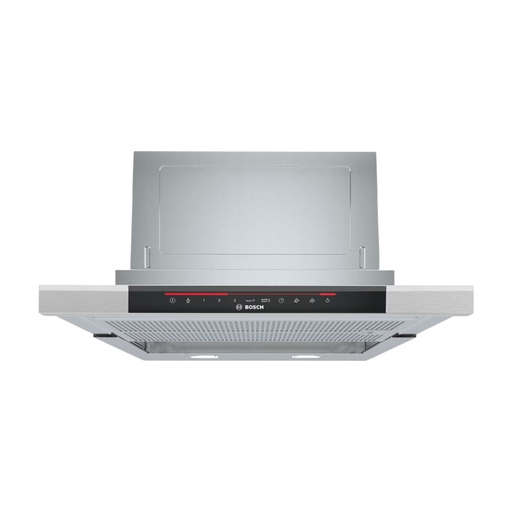
Why it suits this buyer: This semi-integrated model is designed for people who value multiple settings, touch controls and a high stated capacity.
The product details list five speeds, a turbo setting and a dishwasher-safe filter.
Stated capacity of 717 m³/h, maximum noise level of 53 dB and LED lighting.

Why it suits this buyer: The combination of recirculation, ducted extraction, a boost function and Wi-Fi control is well suited to frequent cooking and flexible kitchen layouts.
The filters are washable, and you can choose the ventilation mode to suit your home rather than focusing on appearance alone.
Maximum airflow of 650 m³/h, noise level of 59 dB and A+++ rating, according to the product specifications provided.
We’ve put together a complete, up-to-date list of products that meet these strict selection criteria and comply with current European safety regulations.
Yes, a 60 cm model is often paired with a hob of the same width. Do check the exact dimensions of your hob and the installation instructions. If you cook frequently, a wider hood can provide more coverage, as long as your kitchen has room for it.
It depends on your home. A ducted cooker hood vents moisture and cooking fumes outside, but needs a suitable duct. Recirculation is easier to install when there’s no external outlet, but it uses carbon filters and doesn’t remove moisture from the room.
If you cook regularly, cleaning it every two to four weeks is a good rule of thumb. If you do a lot of frying or wok cooking, you may need to clean it more often. Always follow the manual for your specific model and replace carbon filters at the intervals stated.
