
Vandaag of morgen in huis

Kwaliteit gegarandeerd

Welkomstaanbiedingen ontgrendelen: GRATIS bezorging | Tot 80% korting | Gratis 30 dagen JoyPlus-proefperiode
Download de app
A 60 cm cooker hood suits many standard hobs, making it a practical choice for flats, rented homes and compact kitchens. However, not every model of the same width is the same. The wrong mounting style, inadequate ventilation or costly filter replacements could leave you considering another appliance after just a few months.
This buying guide will help you compare specifications sensibly. The recommendations are based on verifiable details such as dimensions, noise level, ventilation settings, controls and filter type.
A cooker hood measuring 60 cm wide can still be too large for a low kitchen cupboard. So make sure you also check the depth and height. A compact under-cabinet model often has a different shape from a wall-mounted model with a chimney.
Also pay attention to the distance between the cooker hood and the hob. Always follow the installation instructions and the manufacturer's requirements for your type of hob.
A claim such as “quiet cooker hood” means little without a measured decibel rating. Check the noise level for each ventilation setting. An appliance may be relatively quiet on its lowest setting but noticeably louder at maximum capacity.
For flats and open-plan kitchens, it is useful to check both the lowest and highest dB values. This gives you a better idea of what to expect during everyday cooking and intensive frying.
A recirculating cooker hood does not vent air outside. Instead, the air passes through a grease filter and usually a carbon filter before being returned to the kitchen. This is useful when installing an external duct is not possible, for example in a rented home.
A metal grease filter can often be washed, but the carbon filter usually needs to be checked and replaced periodically according to the product information. Check in advance which filter type is required and whether it is readily available.
A ducted cooker hood can carry cooking fumes outside through a duct. In this case, check the duct's diameter, position and length. Bends and long ducts can affect airflow.
Recirculation does not require an external duct. This installation option is often simpler, but it does require regular filter maintenance. Check whether the required carbon filter is included or needs to be purchased separately.
Measure the available space before ordering:
A stainless steel cooker hood is practical if you want a neutral appearance and a metal housing. Stainless steel can show fingerprints, so cleaning it with a soft, damp cloth is generally more suitable than using abrasive products.
A cooker hood with a washable grease filter helps reduce recurring grease-filter costs. According to the product information, the Ciarra models below use two washable aluminium filters. Clean the filter regularly; the stated usage instructions recommend approximately every two to four weeks, depending on how often and how intensively you cook.
Push buttons are easy to operate and allow the fan and lighting to be switched on separately. Also consider the lighting above the cooking zone. This is particularly useful in a small kitchen with limited task lighting.
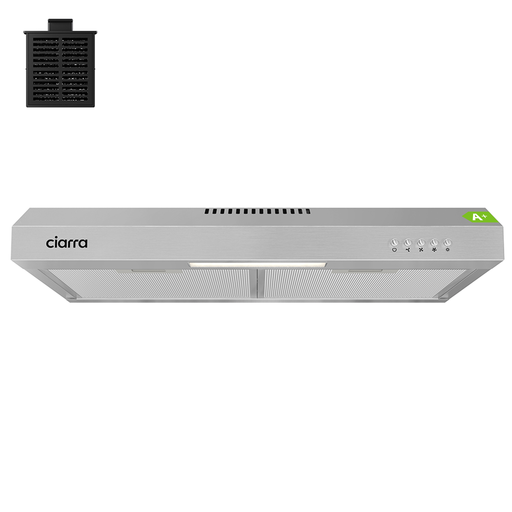
Why it suits this profile: This compact model is designed for installation under a kitchen cupboard, making it suitable for small kitchens, flats and rented homes.
The product information states that it supports both recirculation and connection to an external duct. It also has two washable aluminium grease filters, so not every grease filter needs to be replaced immediately.
596 × 440 × 85 mm, push-button controls, integrated lighting, three settings and a stated maximum noise level of 61 dB.
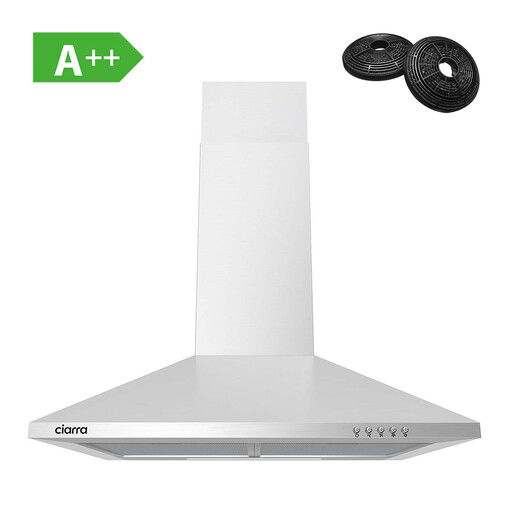
Why it suits this profile: A wall-mounted model is a good choice if you want a visible stainless steel cooker hood with a higher stated airflow and have enough wall space.
The specifications state the exact adjustable height, from 572 to 950 mm. This makes it easier to check in advance whether the wall-mounted installation will suit your kitchen.
600 mm wide, maximum stated airflow of 367 m³/h, washable aluminium filters, push buttons and a maximum noise level of 63 dB.
Why it suits this profile: The higher stated airflow is relevant for households that frequently fry, stir-fry or cook for several people.
The three stated settings allow you to adjust the ventilation. However, bear in mind that the noise level rises to 63 dB on the highest setting.
Maximum stated airflow of 367 m³/h, two washable aluminium filters, and a choice between ducted extraction and recirculation.
Clean metal grease filters as soon as they become visibly greasy and follow the manufacturer's instructions. Do not use abrasive cleaning products on the stainless steel housing. With recirculation, you also need to consider the carbon filter type, such as CBCF009 for the Slimline model or CBCF002X2*2 for the wall-mounted model.
Low energy consumption can be beneficial for everyday use, but consider the complete picture: the ventilation setting, filter costs, installation and any modifications to an external duct all contribute to the total cost.
Not automatically. Check the hob's actual width, the available recess and the mounting height. The cooker hood must also be positioned safely above the cooking surface in accordance with the instructions.
It can be a practical solution when you are not allowed or able to install a duct to the outside. Bear in mind that a carbon filter is required and regular maintenance remains important.
This depends on how much you use it. If you cook regularly, every two to four weeks is a useful starting point. If you often deep-fry or stir-fry, you may need to clean it more frequently. Check the filter and follow the product-specific instructions.
We have compiled a complete, up-to-date list of products that fully meet these strict selection criteria and the applicable European safety regulations.
