
Vandaag of morgen in huis

Kwaliteit gegarandeerd

Welkomstaanbiedingen ontgrendelen: GRATIS bezorging | Tot 80% korting | Gratis 30 dagen JoyPlus-proefperiode
Download de app
A 60 cm cooker hood suits many standard hobs, but choosing the right model involves more than simply comparing widths. Wall-mounted, built-in and under-cabinet cooker hoods differ considerably in how they are installed, how noisy they are and how much maintenance they need. Terms such as “powerful extraction” and “quiet” do not mean much without specific figures.
The most common buying mistakes usually come down to three things:
A standard width of 60 cm suits many hobs, but always check the exact product dimensions. A model might be 595, 599 or 600 mm wide, for example. Check the depth too, along with the clearance above the hob.
Choose a style to suit your kitchen layout:
For gas and electric hobs, check the minimum installation clearance in the manual. Different clearances may apply to some models. Have any electrical connection or fixed installation carried out in accordance with the relevant regulations.
Extraction capacity is measured in m³/h. A 650 m³/h cooker hood may be worth considering if you cook intensively or have an open-plan kitchen, but compare these details too:
A quiet cooker hood will not necessarily be quiet on its highest setting. For example, one Ciarra model lists a maximum extraction capacity of 650 m³/h and a noise level of 59 dB, while another Ciarra model lists 650 m³/h and 58 dB. These figures come from the product specifications; the noise you experience also depends on the installation, ductwork and chosen extraction route.
A washable aluminium grease filter helps reduce ongoing maintenance costs. Check whether the filter is removable and dishwasher-safe. Recirculation requires compatible carbon filters. These are sometimes included and sometimes sold separately.
You can check how energy-efficient a cooker hood is by looking at its stated energy class and annual consumption in kWh. Compare both figures, as the energy class alone does not tell you how much electricity the appliance is expected to use each year according to its product specifications. LED lighting is useful above the hob; some models let you adjust the brightness or colour temperature.
The selection below is based on verifiable details such as dimensions, extraction capacity, energy class, controls and ventilation mode. Brand claims about performance are not presented as independent findings; the figures given come from the product information provided.
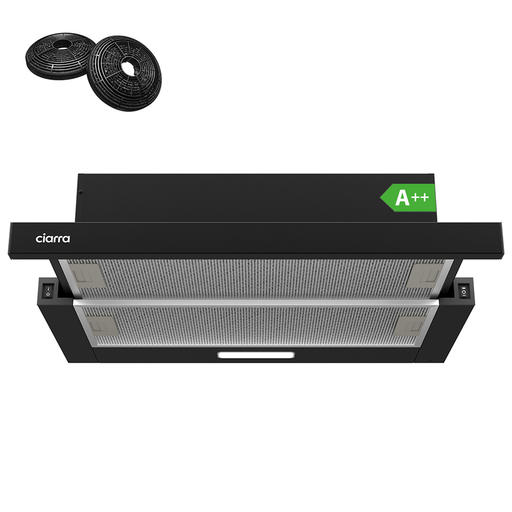
Why it suits this type of buyer: This telescopic under-cabinet cooker hood is a good fit for kitchens where cabinet space matters. It supports both external extraction and recirculation, and is 599 mm wide.
The stated extraction capacity, maximum noise level of 61 dB and annual consumption of 10 kWh make it easier to compare than a marketing claim alone.
370 m³/h, A++ energy class, LED lighting and carbon filters included, according to the product description.
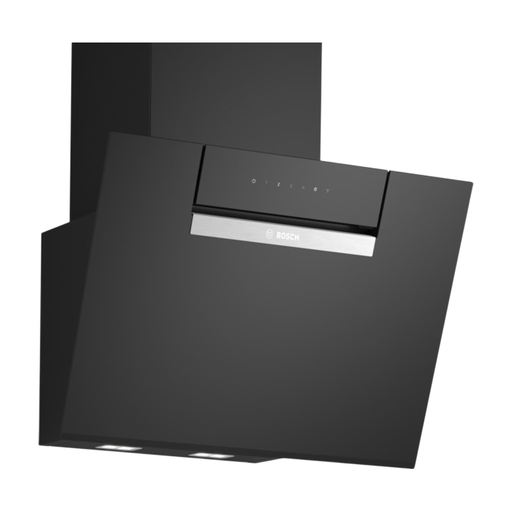
Why it suits this type of buyer: This black angled cooker hood combines a glass wall-mounted design with touch controls and several settings, making it a good choice for households looking for a fixed, modern installation.
The specifications list 768 m³/h, a maximum noise level of 56 dB, A+ energy class and a dishwasher-safe filter. The carbon filter is not included.
Touchscreen, LED lights, four settings and a connection with a stated diameter of 150 mm.

Why it suits this type of buyer: This black wall-mounted model is designed for people who want to combine high extraction capacity, recirculation and app controls.
The product details list both recirculation and external extraction, so you can choose the ventilation method that suits your home. Be sure to check which filters and extraction parts are included.
650 m³/h, maximum noise level of 59 dB, A+++ energy class, touch controls and Wi-Fi/app functionality, according to the product specifications.
Clean metal grease filters regularly. Product information for various models recommends an interval of around 2 to 4 weeks, depending on how often you cook and how much fat you use. For recirculation, use only the compatible carbon filter and replace it as instructed in the manual or when prompted by the saturation indicator.
Also bear these points in mind:
We’ve put together a complete, up-to-date list of products that meet these strict selection criteria and the applicable European safety requirements.
A 60 cm model will often fit a standard hob of a similar width. Always check the exact width and depth of the hob, as well as the installation clearance given in the manual. A wider cooker hood may be more practical for a wide hob.
A cooker hood with external extraction sends cooking fumes outdoors through a duct. Recirculation is more convenient when there is no external duct, but it requires carbon filters and does not remove moisture in the same way. Check your home's ventilation options before ordering.
Compare the stated noise level in dB at each fan setting. The models in this selection list maximum levels of around 56 to 62 dB, but how noisy they seem in practice depends on the setting, installation and extraction duct. A lower figure is particularly useful if your kitchen opens directly onto the living room.
