
Vandaag of morgen in huis

Kwaliteit gegarandeerd

Welkomstaanbiedingen ontgrendelen: GRATIS bezorging | Tot 80% korting | Gratis 30 dagen JoyPlus-proefperiode
Download de app
A 60 cm cooker hood will often fit above a standard hob, but width alone doesn’t tell you whether it’s right for your kitchen. The main differences are extraction rate, installation type, noise level and filtration method. In a flat, rented home or open-plan kitchen, choosing the wrong model can leave cooking smells lingering, make maintenance a hassle or lead to unnecessarily high energy bills.
A manufacturer might quote a high figure, such as 650 m³/u, but performance also depends on the ducting, bends, backdraught flap and fan speed you choose. With recirculation, airflow can differ from a setup that vents air outside. So compare more than just the maximum extraction rate: check the installation type and noise level too.
A cooker hood that vents outside carries cooking fumes away through a duct. A recirculating cooker hood draws air through a grease filter and usually a carbon filter before releasing it back into the kitchen. Recirculation is useful if drilling or connecting to an external duct isn’t possible, but carbon filters need to be replaced regularly according to the instructions.
Also check whether the filters are included. Some models come with them; others require you to buy them separately.
A 60 cm-wide model won’t automatically suit every kitchen. Measure the available width, depth and height. For a 60 cm built-in cooker hood, check the recess and cupboard dimensions. A telescopic cooker hood also needs space for its pull-out panel. A sloping cooker hood often leaves more clearance above the hob, but it still needs secure wall fixings.
For a compact kitchen where you do only light cooking, an extraction rate of around 200 to 400 m³/u may be enough. If you often stir-fry, fry food or cook in an open-plan kitchen, look for models rated at around 500 m³/u or more. An extraction rate of 650 m³/u gives you more capacity in reserve, but check that your ducting can handle it.
The figure is most useful for comparing models tested using the same method. Don’t treat a quoted maximum as a guarantee that every cooking smell will disappear completely.
A quiet cooker hood is especially welcome when your kitchen opens onto the living room. Product specifications usually give the maximum noise level in decibels. You may notice a difference between 59 and 64 dB, but check the noise level at the normal setting too. The highest setting or boost function is usually louder.
You can spot an energy-efficient cooker hood by its favourable energy rating and low stated annual energy consumption. Also check:
Clean the grease filter according to the instructions. Product information for several models recommends doing this roughly every two to four weeks, depending on use.
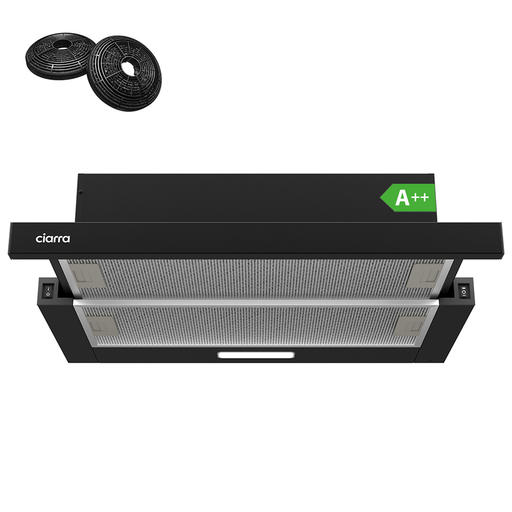
Why it suits this type of buyer: Its telescopic design takes up little space and can be fitted beneath a kitchen cupboard. According to the product specifications, the model supports both recirculation and ducted extraction.
The specifications state a maximum airflow of 370 m³/u, making its capacity easy to assess. The two washable aluminium filters help reduce repeat filter purchases.
60 cm wide, A++ according to the product specifications, stated annual energy consumption of 10 kWh/a and integrated LED lighting.
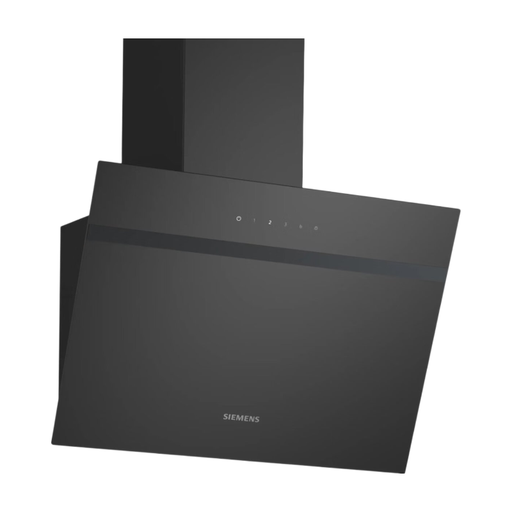
Why it suits this type of buyer: This 60 cm wall-mounted cooker hood has a sloping design, touch controls and a stated maximum noise level of 60 dB.
The product information gives specific figures for three speeds, an energy rating of A and a dishwasher-safe filter. The specifications state that a carbon filter isn’t included.
Sloping wall-mounted design, touchControl, LED lighting and a filter saturation indicator to help you keep on top of maintenance.

Why it suits this type of buyer: A good fit for households that often fry or stir-fry and want app control. According to the manufacturer’s product specifications, this model has a maximum airflow of 650 m³/u.
The product specifications list both recirculation and external extraction. This lets you choose an installation to suit a rented home or a kitchen with an existing duct.
Stated maximum noise level of 59 dB, A+++ energy rating, four settings with a boost function, and control via touch, Wi-Fi and app.
We’ve put together a complete, up-to-date list of products that meet these strict selection criteria and comply with current European safety regulations.
Before buying, check that the cooker hood is suitable for 220–240 V and 50 Hz, as many models in the range are. For ducted extraction, the diameter of the duct matters; 150 mm is common for wall-mounted models. Always follow the installation instructions and check the minimum distance from the hob.
Recirculation is often easier for tenants, as it doesn’t require a permanent external duct. However, remember to check the price and availability of replacement carbon filters. If you’re venting air outside, keep the duct as straight and short as possible to reduce resistance and extra noise.
A 60 cm-wide hood will often suit a standard hob of a similar width. Always measure the hob, cupboard and available wall space. If your hob is wider, a wider hood may be more practical for catching cooking fumes.
That depends on its stated annual energy consumption, the price of electricity and how often you use the highest setting. So compare consumption in kWh per year, not just the energy rating. A model with low stated annual consumption may cost less to run every day, but remember to check the cost of carbon filters too.
With regular use, a grease filter often needs cleaning every two to four weeks. The exact frequency depends on how much you fry and deep-fry. Carbon filters used for recirculation have a limited lifespan, so follow the manufacturer’s instructions.
