
Vandaag of morgen in huis

Kwaliteit gegarandeerd

Welkomstaanbiedingen ontgrendelen: GRATIS bezorging | Tot 80% korting | Gratis 30 dagen JoyPlus-proefperiode
Download de app
A 60 cm cooker hood will usually fit a standard hob or cooker. However, not every model is right for every home. A flat without an extraction duct, for example, needs a different solution from a kitchen with direct ventilation to the outside. The available cupboard space, noise level and maintenance requirements also affect how convenient a hood will be to use.
As Joybuy Product Recommendation Officer, I check product information against verifiable specifications. This helps you avoid giving more weight to a striking design or high airflow rating than to practical features.
A manufacturer may quote a high maximum airflow, but this might not be the setting you use every day. A recirculating cooker hood may also work differently from one that vents air outside. So check:
With extraction, cooking fumes are carried outside through a duct. With recirculation, the air passes through a grease filter and usually a charcoal filter, then the filtered air is returned to the kitchen. Recirculation is practical for rented homes and flats, but charcoal filters need to be replaced periodically.
When buying, check whether the cooker hood supports both systems and whether the required filters are included. Charcoal filters are optional with some models.
A 60 cm cooker hood will not automatically fit every cupboard or wall. Check the full dimensions, adjustable chimney height and depth. A 60 cm built-in cooker hood needs to fit the recess, while a 60 cm wall-mounted cooker hood needs enough clear wall space and a suitable installation height.
Also check the instructions for the minimum distance from the hob. Requirements can vary for electric, ceramic and gas hobs.
A lower airflow may be enough for a compact kitchen, while an open-plan kitchen or frequent wok cooking may call for more capacity. Don’t rely on marketing claims such as “powerful motor”; check the stated figures in m³/h.
A model with several speeds gives you more control. An intensive setting can be useful for frying or deep-frying, but it will often be noisier. If the cooker hood vents outside, the diameter and route of the extraction duct also matter. Long or winding ducts can affect performance.
A quiet cooker hood is particularly useful in an open-plan kitchen or flat. A difference between, for example, 58 and 64 dB can be noticeable during a long cooking session. Always check whether the quoted noise level is the maximum or applies to a lower fan setting.
Bear in mind that the extraction duct, non-return flap and installation can also create noise. The product specification is a useful guide, but it can’t guarantee the final noise level in your kitchen.
The energy rating helps you compare annual consumption, but also check the stated usage in kWh per year. An energy-efficient cooker hood with LED lighting can be a good choice for everyday use. However, the difference in consumption will also depend on how often you use the hood and which setting you choose.
Controls are a matter of preference and how you use the hood:
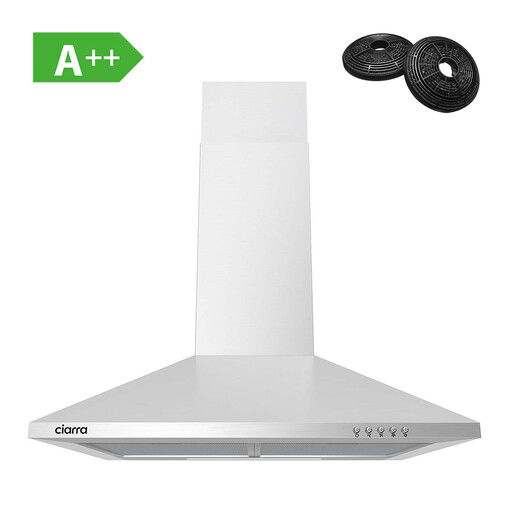
Why it suits this profile: A straightforward wall-mounted cooker hood for standard kitchens, with push-button controls and the option to vent outside or recirculate.
The specifications list three settings at 221, 291 and 367 m³/h, plus a maximum noise level of 63 dB. This makes it easier to compare performance and noise levels.
A++ energy rating, two washable aluminium filters, integrated lighting and a 24-month warranty, according to the product information.
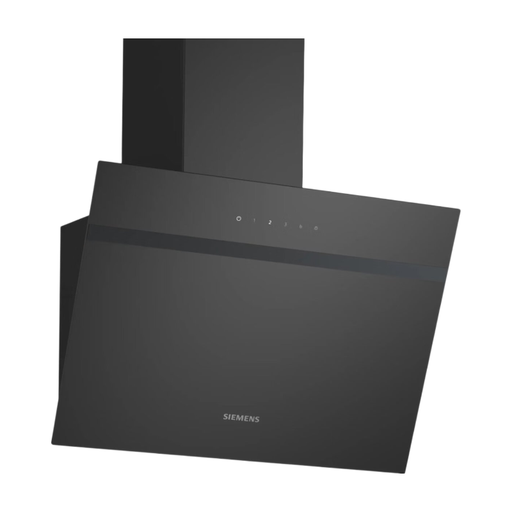
Why it suits this profile: An angled cooker hood with touchControl, LED lighting and filter maintenance alerts.
The stated figures are 430 m³/h, 51–60 dB and three speeds. The filter indicator means you don’t have to rely on a fixed maintenance schedule.
59 cm wide, with a dishwasher-safe filter and a stated energy rating of A. A charcoal filter is not included, according to the product information.

Why it suits this profile: Designed for households that cook often and want a high stated capacity, a boost function and smart controls.
The product information lists both recirculation and extraction, a maximum airflow of 650 m³/h and a maximum noise level of 59 dB. Be sure to check the required connection and filter installation.
A+++ according to the product details, four speeds including a booster, Wi-Fi/app controls and two washable aluminium filters.
We’ve put together a complete, up-to-date list of products that meet these strict selection criteria and the applicable European safety regulations.
Clean metal grease filters regularly, for example every two to four weeks if you cook often. Check the instructions before putting a filter in the dishwasher. With recirculation, replace the charcoal filter as specified by the product manufacturer. Replacement costs should therefore be included in the total running costs.
Ideally, switch the cooker hood on before you start cooking and leave it running for a little while afterwards. Use the lowest setting that suits the amount of steam. This helps reduce unnecessary noise and energy consumption.
Not necessarily. Check the exact width, depth, installation method and minimum distance from the hob. Wall-mounted and built-in models have different installation requirements.
Yes, if it isn’t possible to install an extraction duct to the outside. You’ll need a suitable grease filter and usually a charcoal filter. Remember that the charcoal filter needs to be replaced periodically.
That depends on the stated annual consumption, the fan setting you choose and how many hours you use it for. Compare the figure in kWh per year on the energy label and, if using recirculation, include the cost of replacement filters.
