
Vandaag of morgen in huis

Kwaliteit gegarandeerd

Welkomstaanbiedingen ontgrendelen: GRATIS bezorging | Tot 80% korting | Gratis 30 dagen JoyPlus-proefperiode
Download de app
A 60 cm black cooker hood suits many standard hobs and modern kitchens. But a sleek black finish says little about whether it’s right for your home. The ventilation type, noise level and available installation space are what really determine whether you’ll enjoy cooking with it for years to come.
The most common buying mistakes:
A cooker hood with external extraction sends steam and smells outside through a duct. Before you buy, check the diameter, route and position of the existing duct. Bends and long duct runs can affect the actual airflow. If you’re unsure, have the electrical connection and installation completed by a qualified installer in accordance with the installation manual.
Don’t have an extraction duct in your kitchen? Choose a recirculating cooker hood. Air passes through a grease filter and then a charcoal filter before being returned to the kitchen. Charcoal filters are consumables, so check how often they should be replaced and whether the right type is available.
Models that offer both options, such as the Ciarra 60cm Wall-Mounted Kitchen Extractor, give you more flexibility if you’re renovating your kitchen or moving home.
A black cooker hood may be made from painted metal, black glass or a combination of the two. Glass has a different look and can be easy to wipe clean, but fingerprints and grease splashes often show up more quickly. A matt finish can make them less noticeable, but always check the manufacturer’s care instructions.
Before you buy, measure:
A telescopic cooker hood is practical in a small kitchen, as its pull-out front takes up less space when not in use. A fully integrated model is mostly concealed in a wall unit. A wall-mounted model is more visible, but can make a striking feature in an open-plan kitchen.
A quiet cooker hood won’t necessarily be quiet on every setting. Compare the stated dB(A) rating at the highest or normal setting. There’s a noticeable difference between 58 dB(A) and 69 dB(A) in an open-plan kitchen, although testing conditions can vary between brands.
Also look out for:
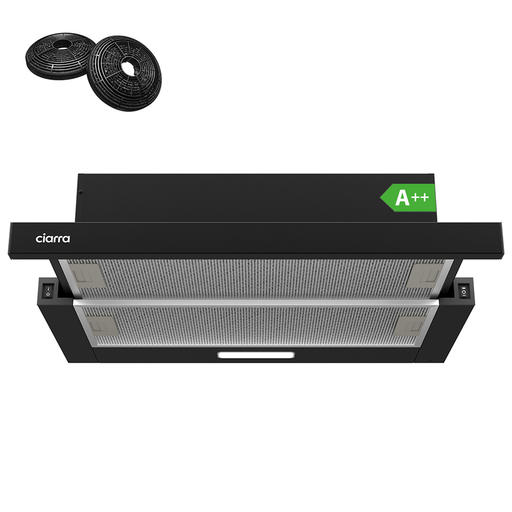
Why it suits this type of buyer: The telescopic design is a good fit for a compact kitchen or a wall unit. According to the product information, this model supports both external extraction and recirculation.
The stated airflow is given for each setting: 215 m³/u and 355 m³/u. This makes it easier to compare the extraction power with your cooking habits.
60 cm wide, two ventilation modes, washable aluminium filters, LED lighting and a stated maximum noise level of 61 dB.
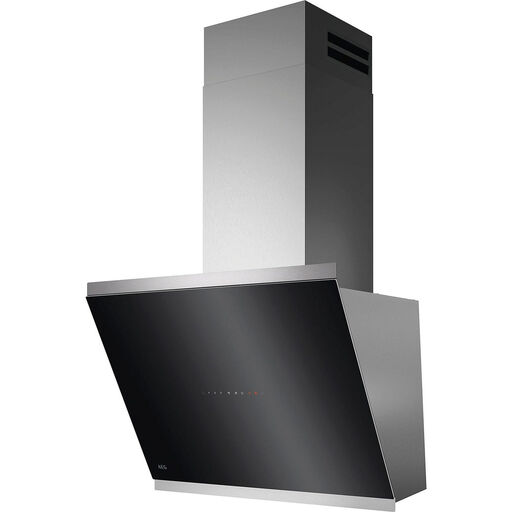
Why it suits this type of buyer: A good choice if you value easy controls, filter maintenance and multiple settings in an open-plan kitchen.
The product information lists separate settings, an intensive mode and a filter saturation indicator. That means you can plan maintenance based on more than guesswork.
598 mm wide, touch controls, LED lighting, five speeds, external extraction or recirculation, and a stated noise level of 50–68 dB(A).
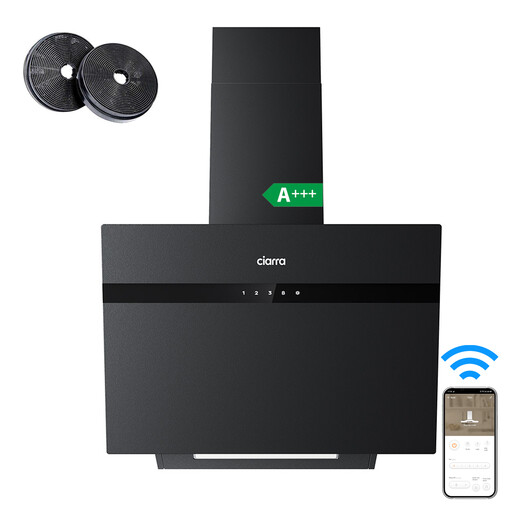
Why it suits this type of buyer: The angled black cooker hood leaves more space above the hob and, according to the product description, combines three speeds with a boost function.
The stated maximum airflow of 650 m³/u is listed alongside a maximum noise level of 58 dB(A), so you can assess extraction power and noise together.
595 mm wide, matt glass finish, two LED brightness levels, Wi-Fi and app controls, recirculation and external extraction.
We’ve put together a complete, up-to-date list of products that meet these strict selection criteria and current European safety regulations.
Clean the grease filter according to the manual, adjusting how often you do so to suit your cooking habits. If you fry or use a wok frequently, you’ll need to clean it more often. A dirty filter can restrict airflow, and neglected maintenance can pose a safety risk.
With recirculation, you’ll also need to factor in the cost of replacement charcoal filters. A model with a low stated annual energy consumption could still have higher maintenance costs. Before buying, check the filter type, price and replacement interval.
Not necessarily. The width of the cooker hood needs to suit both the hob and the available wall or cabinet space. Also check the recommended installation height and the clearance above gas, induction or electric cooking zones in the manual.
With external extraction, steam and smells are carried outside through a duct. With recirculation, the air stays indoors and passes through grease and charcoal filters. Recirculation is practical if you don’t have an extraction duct, but the filters need regular maintenance.
It depends on the setting. Compare the stated dB(A) ratings at minimum, normal and maximum power, where available. A model that’s quiet on its lowest setting may be noticeably louder at full power.
