
Organisers with lots of plates
If you want to wash the plates and other dishes after each workshop session, use the stated place-setting capacity as a starting point, then check the layout with your own plates, dishes and pans.


A 45 cm dishwasher could suit a cookery workshop if the plates, dishes and pans from one session will fit in the racks. The Consumentenbond describes 45 cm as the width of slimline models, compared with around 60 cm for a standard-sized dishwasher. Also compare the programme duration and drying phase for the cycle you plan to run between sessions, and choose a freestanding or integrated model based on the space and connections available. If the workshop involves commercial food preparation or sales, check that your washing-up process meets the relevant food safety requirements, rather than relying on a programme name alone.
If you want to wash the plates and other dishes after each workshop session, use the stated place-setting capacity as a starting point, then check the layout with your own plates, dishes and pans.
If you need the plates again between cooking or mealtimes, programme duration and the drying phase are important factors to compare.
If space is limited, check whether a freestanding appliance will fit near the connections, or whether an integrated model will suit the cabinet space and kitchen door.
A good fit if: you have a narrow space with a water supply and waste outlet, and don't want to fit an integrated kitchen door.
Consider: check whether your dinner plates and cookware will fit in the racks together; the place-setting capacity won't always tell you this.
A good fit if: your kitchen has a suitable appliance space and a compatible cabinet door.
Consider: check the height of the appliance space and the door hinge as well as the width.
A good fit if: a trial load shows that the dishes won't fit in one cycle, or the workshop prepares or sells food commercially.
Consider: a standard-sized model needs more space. For commercial use, your washing-up process must also comply with the relevant food safety rules.
| What to consider | What should you check? | Who should pay attention to this? |
|---|---|---|
| Load per session | Count the plates and check their diameter, the rack height, and the space available for dishes and cookware in your preferred layout. | I want to know if my largest plates and cookware will fit in one cycle; an estimated 36% of consumers with this workshop requirement put capacity first. |
| Turnaround time | Compare the duration and drying phase of the programme you plan to use between sessions, taking into account how dirty the dishes are. | If I need the plates again quickly, I look at the full programme duration and drying time; an estimated 29% of consumers with this workshop requirement prioritise turnaround time. |
| Installation | Measure the available space or appliance recess and check the connections. For an integrated model, check the hinge and cabinet door too. | I want to avoid buying an appliance that won't fit in my narrow kitchen; an estimated 21% of consumers with this workshop requirement prioritise installation. |
| Energy use and maintenance | Compare energy consumption per 100 eco cycles, water consumption per eco cycle and programme duration on the same basis. Follow the model's manual for maintenance. The European Commission describes these consumption figures for the eco programme. | If I use the appliance repeatedly, I also want to know about its energy use and maintenance needs; an estimated 14% of consumers with this workshop requirement prioritise these factors. |
The stated capacity doesn't guarantee that a mixed workshop load will fit in the racks all at once.
Before buying, make a list of your largest plates, dishes and pans, then check that they fit in the available rack space.
The width alone isn't enough if the appliance space, door mechanism or connections aren't suitable.
Compare all the installation measurements and the hinge system with your existing kitchen before choosing a model.
An unsuitable appliance space or cabinet door may mean extra modification work.
The EU label shows eco consumption figures; a short programme may have different drying times and energy use. The Consumentenbond points out that short programmes often dry less effectively and are generally not the most energy-efficient option.
For each model, compare the duration, drying phase and consumption of the programme you actually need.
A programme name alone doesn't establish whether your washing-up process meets commercial food safety requirements. The manual may also limit use to the purposes described.
For commercial workshops, check which hygiene code or HACCP plan applies and read the appliance's terms of use.
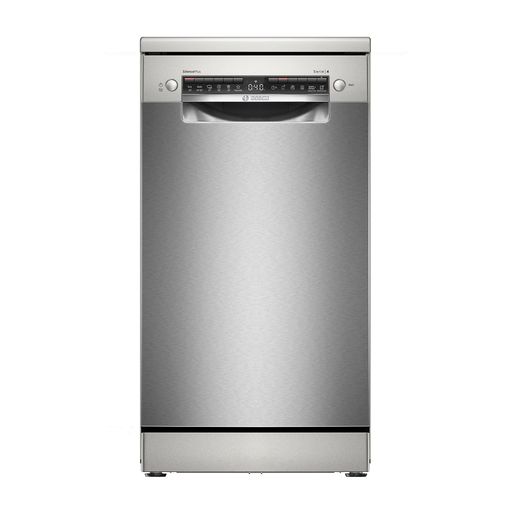
The BDFS26046XQ is a freestanding slimline model with a stated capacity of 10 place settings and an adjustable upper rack.
The freestanding VVW4530AW is a Dutch 45 cm model with an adjustable upper rack and a half-load option.
The VW47SM is a 45 cm fully integrated model for a kitchen with a suitable appliance space and cabinet door.
The SPS4EMI17E is a 45 cm freestanding model to compare in terms of rack layout and eco consumption.
This Joybuy selection includes 45 cm freestanding dishwashers and compact tabletop models. Above all, check that the load for each workshop session and the connection method suit your needs.
 No image available
A freestanding model for a narrow space; check that the rack layout suits the plates and cookware you use in your workshop.
The product description mentions an upper rack adjustable to three positions, a VarioDrawer and automatic door opening. Bosch lists energy class B and 8,7 litres per eco cycle for this model.
 No image available
A freestanding model for anyone looking to arrange the racks to suit different types of workshop dishes.
The product description mentions VarioFlex racks, Auto and Eco programmes, Extra Dry, Home Connect and a water-stop feature.
 No image available
A tabletop model to consider when space is limited; check that the described features and programmes suit the way you plan to use it.
The product name mentions 6+3 programmes and a built-in 5-litre water tank.
 No image available
A compact option for a small workshop load; the stated capacity is up to 4 place settings, so check that your dishes will fit for each session.
The description mentions a quick programme of around 29 minutes and a built-in 5-litre tank. According to the product description, it can be supplied with water from the tank or a mains connection.
 No image available
A tabletop model for a smaller load; the product information states a capacity of 3 place settings.
The description mentions a 35-minute quick programme, a built-in water tank and the option to connect to a water tap.
It depends on the number of participants, the plate diameter and any additional dishes and pans. Use the place-setting capacity as a starting point, then check the rack layout with the load you have in mind. A larger model may be more practical if you have a lot of mixed dishes.
Before installation, check the manual, water supply, waste outlet and suitable electrical connection. For an integrated model, you'll also need to check the appliance space and door mechanism. Remove food scraps and keep the filter and spray arms clear, following the model's manual.
No. The EU label shows, among other things, energy consumption per 100 eco cycles and water consumption per eco cycle. A short programme may have a shorter drying phase or none at all, and is generally not the most energy-efficient option. So compare the programme you actually use.
Check whether the manual covers your intended use, and ask the retailer or manufacturer about the terms that apply to your situation. The Inventum manual limits use to the purposes described in it, so don't assume that a paid or intensive workshop is covered without checking first.
You can't tell from the programme name alone. If the workshop involves commercial food preparation, processing or sales, the relevant food safety rules apply. The NVWA and Ondernemersplein describe the use of a HACCP plan or approved hygiene code. Check that your washing-up process complies too; this doesn't establish that the same commercial requirements apply to a private workshop.