Who is a slimline dishwasher suitable for?

A family with a narrow space in the kitchen

You want to wash your breakfast dishes in a machine, but need to work out whether you have room for a freestanding model or an integrated one. A slimline dishwasher is around 45 cm wide, and freestanding and integrated models are available, according to the Consumers’ Association.

A family with lots of bowls and cups

You want to know whether your usual breakfast dishes will all fit in the racks together. The stated place-setting capacity won’t necessarily tell you; check the rack layout of the model you’re considering.

A daily user who keeps an eye on consumption

You want to compare consumption for regular use. Milieu Centraal recommends only switching on the dishwasher when it’s full. The EU energy label includes figures such as energy consumption for 100 eco cycles and water consumption per cycle.

What should you look for when choosing?

Slimline freestanding

Choose this if: you don’t have a suitable space for an integrated model, but do have a spot near the water supply and drain.

Bear in mind: the appliance will be on show. Also check its height and depth, and allow room to open the door.

Slimline integrated

Choose this if: you have a suitable space and a compatible kitchen door panel.

Bear in mind: the space and door system determine which models will fit. The appliance dimensions aren’t necessarily the same as the required space dimensions.

Consider a standard-size model

Consider this if: you have enough kitchen space and often have more than just breakfast dishes to wash.

Bear in mind: a standard-size model needs more width in your kitchen. Also consider how often you’ll be able to run it when full.

What to consider What should you check? Who is this important for?
Will the appliance fit in the space? For a freestanding model, measure the height, width and depth. For an integrated model, also check the space and door system. I want to know in advance whether a freestanding appliance or integrated model will fit in our kitchen. This matters to around 36% of consumers who focus mainly on installation.
Will the bowls, cups and cutlery all fit together? Check the rack layout, whether it can be adjusted and how the cutlery is stored on the exact model. Compare this with your largest bowls and cups. I want to be able to load our usual breakfast dishes in one go; the place-setting figure doesn’t automatically tell me whether our bowls will fit. Around 29% of consumers focus mainly on loading space.
How much does daily washing use? Compare kWh per 100 eco cycles and litres per eco cycle on the same label basis. Consider how often the dishwasher will be full. If I use the dishwasher regularly, I want to take energy and water consumption into account. Around 21% of consumers prioritise consumption during use.
How important is noise? Compare the noise level in dB(A) on the label and consider where and when you’ll use the machine. If the machine is running while we’re at home, I want to know its stated noise level. Around 14% of consumers focus mainly on noise.

Common buying mistakes

  • Assuming the place-setting capacity guarantees all your bowls will fit

    Place settings are a standard measure of tableware for one person. The shape and positioning of your own bowls can affect how many will fit in the racks at once in practice.

    Compare your largest breakfast bowls with the rack layout and adjustability of the exact model.

    If your usual load doesn’t fit, you may need to wash up more often.

  • Measuring the width only

    A freestanding machine also has a height and depth, and the door needs to be able to open. For an integrated model, the space and door system matter too.

    Check all the relevant measurements and, for an integrated model, follow the installation instructions for the model you choose.

  • Applying the eco-programme figures to every programme

    The energy and water figures on the EU energy label are based on the stated eco programme. Other programmes may use different amounts.

    Compare models using the same label figures, and check separately the programmes you expect to use often.

  • Accepting a retailer’s stated capacity without checking it

    Joybuy lists 13 place settings for the Bosch SPS4EMI17E, while Bosch Netherlands gives a figure of 10 for the same model. This discrepancy makes it important to check the full model number and product specifications.

    Use Bosch’s specifications for the SPS4EMI17E when choosing capacity, and ask the retailer to explain any differences in the product information.

Brands to consider

Bosch

The SPS4EMI17E is a 45 cm freestanding model.

  • Bosch lists this model as having 10 place settings, a cutlery drawer, energy rating B, 51 kWh per 100 eco cycles, 8.7 litres per eco cycle and a noise level of 44 dB(A).
  • These model specifications don’t tell you whether your own bowls will fit together; also check the rack layout and the dimensions of the space available.

Inventum

The VVW4530AW is a 45 cm freestanding dishwasher.

  • Inventum lists this model as having 10 place settings, an adjustable upper rack and a removable cutlery basket.
  • The stated energy rating D, 11 litres per wash and 45 dB noise level apply to this specific model; compare consumption on the same programme basis.

Beko

The BDFS26046XQ is a freestanding slimline model.

  • Beko lists this model as having 10 place settings, a cutlery drawer, energy rating C, 8.9 litres per cycle and a noise level of 44 dB(A).
  • The claims about the intensive zone and automatic door opening are Beko’s claims about this model, not the result of an independent comparative test.

Siemens

The SR65EX09ME is a fully integrated 45 cm model.

  • Siemens lists this model’s appliance dimensions as 815 × 448 × 550 mm, with energy rating B and water consumption of 8.7 litres on the eco programme.
  • The appliance dimensions don’t guarantee that the model will fit a specific space or work with a particular kitchen door panel; check the installation instructions.

Joybuy products

This selection features 45 cm slimline freestanding dishwashers for anyone short on kitchen width. Before buying, check that the racks will fit your own bowls, cups and cutlery.

Bosch SPS4HKW49E Series 4 freestanding dishwasher, 45 cm, white

Bosch SPS4HKW49E Series 4, 45 cm, white

A 45 cm freestanding model for anyone looking for a slimline fit. Check whether the racks have room for your usual breakfast bowls and cups.

View at Joybuy
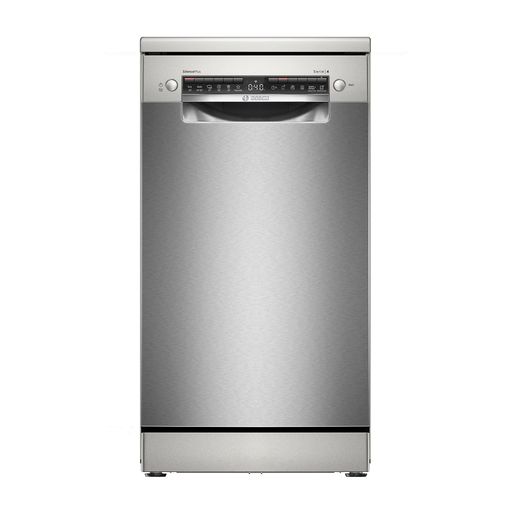
Bosch SPS4EMI17E freestanding dishwasher, 45 cm

Bosch SPS4EMI17E, freestanding, 45 cm

This freestanding model could suit a narrow space in your kitchen; your own bowls and cups will determine how much you can usefully fit inside.

Bosch lists the SPS4EMI17E as having 10 place settings, energy rating B, 51 kWh per 100 eco cycles, 8.7 litres per eco cycle and a noise level of 44 dB(A). Bosch also specifies a cutlery drawer.

Check the specifications for the exact model: the Joybuy product listing gives a different place-setting capacity.

View at Joybuy

Frequently asked questions

Are 10 place settings enough for all our family’s breakfast bowls?

You can’t tell from the number alone: a place setting refers to the tableware for one person for one meal. Compare the model’s rack layout with the sizes and quantities of your own bowls, cups and cutlery.

How can I check whether a freestanding or integrated dishwasher will fit?

For a freestanding model, measure the available height, width and depth, and allow for the door when it’s open. For an integrated model, also check the dimensions of the space and the door system; the appliance dimensions aren’t necessarily the same as the required space dimensions.

Can I compare eco figures with those for any dishwasher programme?

No. Compare energy and water figures on the same eco-programme basis. The EU energy label includes figures such as energy consumption per 100 eco cycles and water consumption per cycle; other programmes may have different figures.

Why is the Bosch SPS4EMI17E listed as having both 10 and 13 place settings?

Bosch Netherlands lists 10 place settings for the SPS4EMI17E, while the Joybuy product listing says 13. Check the full model number and ask the retailer to explain the difference before using capacity as a deciding factor.

Is an energy label compulsory for a new dishwasher in the Netherlands?

Yes. The Dutch government states that household appliances must have an energy label. The EU label for dishwashers includes energy consumption per 100 eco cycles, water consumption per cycle, capacity and noise level.
