
Vandaag of morgen in huis

Kwaliteit gegarandeerd

Welkomstaanbiedingen ontgrendelen: GRATIS bezorging | Tot 80% korting | Gratis 30 dagen JoyPlus-proefperiode
Download de app
A 4-in-1 hand blender can replace several kitchen appliances, from a blender and whisk to a chopper and measuring beaker. However, a large set of accessories isn’t automatically useful in every kitchen. If you only look at the wattage or number of functions, you could end up with an appliance that’s difficult to clean, overheats quickly or doesn’t have enough capacity for your family.
This buying guide will help you distinguish marketing claims from features you can check for yourself. That way, you can choose a multi-purpose hand blender that suits your recipes, kitchen space and how often you’ll use it.
On paper, a 600W hand blender has more motor power than a 300- or 500-watt model. That can be useful for thick soups, purées or hard ingredients, but the results also depend on the blade design, operating conditions and maximum running time.
So always check:
Some models, for example, specify that the motor can run for no more than one minute at a time, followed by a rest period. This matters when making large quantities of soup or several portions of baby food.
A whisk, chopper, measuring beaker and blending foot may sound appealing. In practice, accessories take up space and tend to be used less often if they’re difficult to attach or clean.
Check how the parts come apart. A hand blender that’s easy to clean should ideally have detachable accessories and clear care instructions. Also check whether only the accessories are dishwasher-safe. The motor housing must not be submerged in water.
A 500 or 800 ml measuring beaker is suitable for smoothies, sauces and small portions. For soup for several people, a larger pan or blender jug is more practical. You can use a hand blender directly in a pan, but always check the instructions for hot liquids and take care to avoid splashes.
A chopper is also not the same as a large kitchen blender. Check the bowl capacity and maximum fill line before processing meat, nuts, herbs or vegetables.
For everyday blending and puréeing, power is only one factor to consider. A 600W model may be suitable for soup, purée, smoothies and baby food. For thicker mixtures, a powerful hand blender with several speeds can give you more control.
A two-speed appliance is simple to use. A model with variable speed control or multiple settings offers more control for tasks such as:
Use a low setting to reduce splashing, and increase the speed once the ingredients are moving well.
A hand blender with a whisk is a good choice for keen bakers, while a hand blender with a chopper is better suited to anyone who wants to process onions, herbs, vegetables or small quantities of meat. A hand blender with a measuring beaker is handy for shakes, dressings and smoothies without needing an extra bowl.
For each component, check:
Dishwasher-safe doesn’t mean every part is suitable for every temperature or programme. Follow the product manual.
The blades are sharp, so disconnect the appliance from the power supply before cleaning it. Unplug it before changing accessories, too. Also check whether the product has a splash guard, locking mechanism or non-slip base.
A CE mark refers to the applicable European declaration of conformity, but it says nothing about the texture of your smoothie or how well the appliance will hold up to intensive use. So also check the warranty, manufacturer details, manual and stated usage limits.
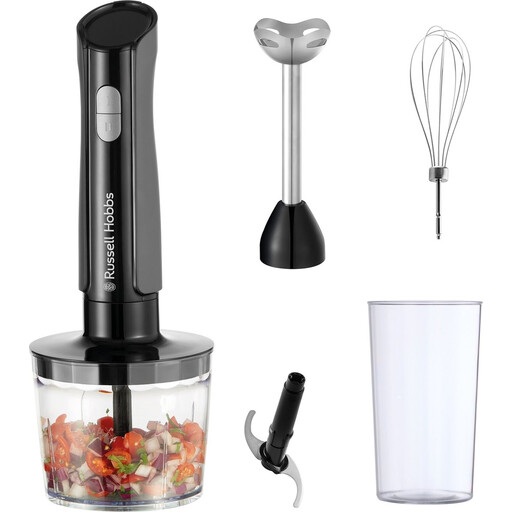
Why it suits this buyer: This model blends, chops and whisks, with two speed settings. Its 500W motor and 600ml blending beaker are designed for everyday portions.
The accessory set is straightforward, and the product description lists detachable, dishwasher-safe parts. Check the maximum capacity before use.
500W power, two speeds, a 500ml chopper bowl and a 600ml blending beaker. The manufacturer lists a two-year warranty, which may be extended after registration.

Why it suits this buyer: The specifications list a 1000W motor, 25 speeds, a turbo setting and a chopper with three texture settings.
You can adjust the speed more precisely than with models that have just one or two settings. According to the product information, accessories attach with a click.
1000W power, 25 speeds, a turbo function and dishwasher-safe parts, according to the product description.

Why it suits this buyer: The set is designed around four functions: blending, whisking, chopping and grinding. It’s a good fit for households looking for one compact appliance for a range of food preparation tasks.
The product description lists two speeds and a detachable shaft. The set includes a 500 ml chopper bowl and an 800 ml measuring beaker; don’t fill them above the marked limit.
600W power, a whisk, chopper, grinding attachment, 500ml chopper bowl and 800ml measuring beaker, according to the product details.
We’ve put together a complete, up-to-date list of products that meet these strict selection criteria and the applicable European safety requirements.
For everyday portions, 600W may be suitable for soup, purée and smoothies, depending on the ingredients and how long you use the appliance. Cut hard vegetables into smaller pieces and add enough liquid. Check the manual before processing hot liquids or hard ingredients.
Its lifespan depends on how often you use it, how you clean it and whether you follow the maximum running time. Let the motor cool down if the manufacturer specifies a rest period. Check the shaft, connectors, blades and cable regularly. Many consumer products in the EU come with a statutory guarantee of at least two years, but additional manufacturer terms may vary.
A hand blender usually only uses electricity for a short time, as soup, sauce or a smoothie can often be prepared in a few minutes. The wattage indicates the maximum electrical power used while the appliance is running, not the total energy used for each recipe. Short bursts of use and following the manual’s instructions for breaks can help reduce unnecessary energy use and prevent overheating.
