
Vandaag of morgen in huis

Kwaliteit gegarandeerd
Download de app
Categorieën

A failed print can often be traced back to the quality of the filament. Inconsistencies in diameter, moisture in the material, or poor spool winding can completely ruin a project that took hours to complete. Choosing the right 3D printer filament is therefore not an afterthought, but a fundamental step towards a successful result. This guide helps you make an informed choice based on specifications and application, without the marketing jargon.
Before you proceed to buy 3D printer filament, it's helpful to understand a few basic parameters. These factors determine the printability, strength, and final appearance of your object.
The two most common materials for Fused Deposition Modeling (FDM filament) printers are PLA and PETG.
Most consumer printers use 1.75mm filament. It is crucial that the diameter remains consistent along the entire length of the spool. A high dimensional tolerance, for example, ±0.05 mm or less, prevents nozzle clogs and ensures smooth, even extrusion. A lower value, such as ±0.02 mm, typically indicates higher manufacturing quality.
Filament is typically sold on 1kg spools. Pay attention to the packaging: a vacuum-sealed bag with a desiccant packet is the standard. This protects the filament from moisture, which is a major cause of print issues like stringing and brittle filament. Always store opened spools in a dry environment.
Based on material specifications and intended use, we have selected filaments that excel in their respective categories.
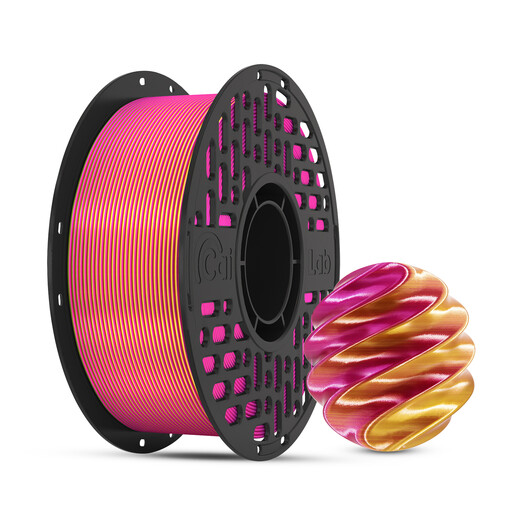
Why this product: This filament is engineered for maximum visual impact. The combination of two colours in a single strand creates a dynamic finish that shifts depending on the viewing angle and the model's geometry. The 'silk' additive gives it a glossy, almost metallic appearance.
Advantages:
Who is this for: Makers, artists, and hobbyists who want to print aesthetically unique objects, such as vases, figurines, or decorative pieces.
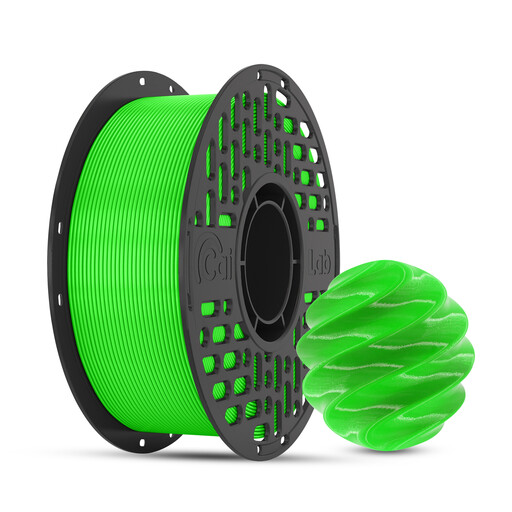
Why this product: This PETG filament from CaiLab combines the mechanical advantages of materials like ABS with the printability of PLA. According to the manufacturer, it offers high impact resistance, flexibility, and heat resistance.
Advantages:
Who is this for: Users who print functional parts, electronics enclosures, tools, or prototypes that require a higher degree of durability and heat resistance.
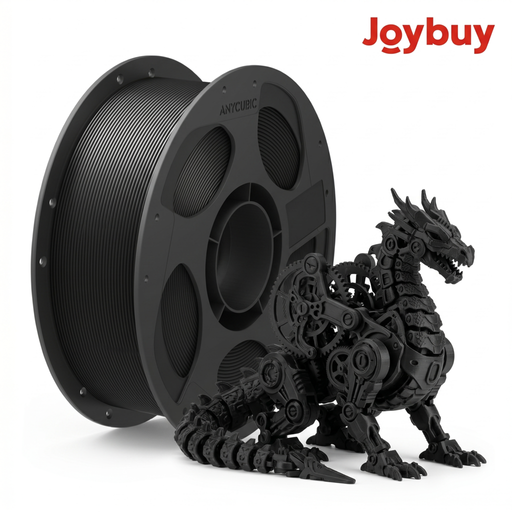
Why this product: This is a reliable workhorse. The JOYBUYxANYCUBIC PLA Basic filament is designed for consistency and reliability. Its deep black colour and matte finish make it a versatile choice for a wide range of applications, from rapid prototypes to finished parts.
Advantages:
Who is this for: Beginners, educational institutions, and professionals who need a reliable and cost-effective filament for day-to-day use, iterative design, and prototyping.
The selection above covers some popular applications, but the world of 3D printer filament is much larger. There are materials with specific properties such as flexibility (TPU), extreme strength (Nylon, Polycarbonate), or special finishes like wood or metal fills. Each material has its own unique print settings and application area.
For a more complete overview of materials, colours, and brands, you can browse our full assortment. Here you will find a wide variety to find the perfect material for your next project.
Browse all 3D printer filament here
The main difference lies in their properties. PLA is easier to print, more rigid, and ideal for visual models. PETG is stronger, more flexible, more durable, and more resistant to heat and chemicals, making it better suited for functional parts.
Always store filament in a cool, dry place, away from direct sunlight. An opened spool is best kept in a resealable bag with a desiccant packet, or in a dedicated dry box. Moisture is the greatest enemy of most filaments and leads to poor print quality.
The vast majority of desktop 3D printers, such as those from Creality, Anycubic, Prusa, and Bambu Lab, use 1.75mm filament. A small number of (older) printers, like some Ultimaker models, use 2.85mm filament. Always check your 3D printer's specifications to ensure you have the correct diameter.
Written by: Joybuy Product Recommendation Officer