
Players who want to see map details clearly
You enjoy gaming on a large screen and want to make out small map details and interface information clearly. Compare screen size with resolution: BenQ and ASUS offer models in the 32-inch 4K category.


A 32-inch 4K monitor is a good fit if clear map details and small interface elements are your priority. A 34-inch ultrawide is worth considering if you want extra width and your game handles 21:9 well. Check that your PC and connection can support your chosen resolution and refresh rate. With OLED, also consider the care instructions and any game elements that stay on screen for long periods.
You enjoy gaming on a large screen and want to make out small map details and interface information clearly. Compare screen size with resolution: BenQ and ASUS offer models in the 32-inch 4K category.
You want more room for the playing area or side panels, and you check whether your favourite games and their interfaces work well in 21:9. Samsung and Xiaomi offer different 34-inch ultrawide models.
You want your PC, connection and monitor to handle your chosen settings together. If you often have static interface elements on screen, factor in the model-specific care instructions when considering an OLED monitor.
Choose this option if: you want map details and small interface elements to look sharp.
Bear in mind: your PC needs to handle your chosen resolution in your game.
Choose this option if: extra horizontal space for the playing area or side panels matters more.
Bear in mind: the game and interface need to support the ultrawide layout effectively.
| What to consider | What to look for | Especially suited to |
|---|---|---|
| Map and interface readability | Compare screen size, native resolution and your game’s scaling settings; check that your PC can handle your chosen resolution. | If I want to make out small map details clearly on a large screen, I look at both size and resolution. Around 40% of consumers prioritise readable map and interface information. |
| Width of the playing area | Check that your games support 21:9, and measure the screen width and the space available on your desk. | If you want extra room for the playing area or side panels, check that the game makes good use of the extra width. Around 30% of consumers prioritise this wider view. |
| Smooth visuals and connection | Check which resolution and Hz combinations are supported by each input, as well as the cable you use and your PC’s performance. | If I want my PC and monitor to handle my chosen settings together, I check the entire signal chain. Around 20% of consumers prioritise this compatibility. |
| Panel care and positioning | For OLED, check the instructions for the exact model and measure the available space and any intended mounting position. | If menus are often visible for long periods or you need to fit in a large screen, consider both care and positioning. Around 10% of consumers put these points first. |
A large screen alone won’t tell you whether small map and interface elements will be comfortable to read.
Compare the screen size with the native resolution, and check the scaling settings in the games you play.
The stated refresh rate is a monitor specification; the combination you can achieve also depends on your PC, port and cable.
Before buying, check which combinations your PC and connection actually support.
Xiaomi lists VESA 75 × 75 mm for the G34WQi and VESA 100 × 100 mm for the G34WQi 2026; the stated dimensions also differ.
Check the full model name and the specifications of the version you’re considering. The difference in VESA size may make your existing monitor arm unsuitable.
If game elements stay visible for long periods, the risk of burn-in is worth considering. ASUS describes measures to reduce this risk, not eliminate it.
Check the care instructions and warranty terms for the exact model, or compare it with an LCD model if this risk is a major concern.
The EX321UX is an example of a 32-inch 4K Mini LED monitor for anyone considering a large 16:9 screen.
The Odyssey G5 LC34G55TWWPXEN is a curved 34-inch ultrawide LCD model.
The G34WQi is a 34-inch ultrawide option; the G34WQi 2026 is a different version.
The AW3425DW is a 34-inch QD-OLED ultrawide model for anyone specifically considering this screen technology.
The PG32UCDM is an example of a 32-inch 4K QD-OLED monitor.
This selection includes large 4K monitors and ultrawide models, including OLED versions, for anyone weighing up screen detail against extra room for gameplay.
 No image available
A good fit if you’re looking for an exceptionally wide playing area and an adjustable setup.
49 inches, 32:9, 5120 × 1440 and up to 165 Hz; 1500R curvature, VA panel and AMD FreeSync.
Check that your desk or monitor arm can support at least 15 kg; two-person assembly is recommended.
 No image available
A good fit if map details on a large 16:9 screen matter to you and you’re considering an OLED panel.
31.5 inches, 3840 × 2160, OLED and up to 165 Hz; the description also mentions QD-OLED and adjustable height, tilt, swivel and pivot.
If static interface elements stay visible for long periods, OLED requires careful maintenance and consideration of burn-in risk; follow the instructions for the exact model.
 No image available
A good fit if you’re looking for a 21:9 screen with an LCD panel and can check that your games support ultrawide.
34 inches, 3440 × 1440, 21:9, VA panel and up to 180 Hz; the description mentions FreeSync Premium Pro and an adjustable stand.
 No image available
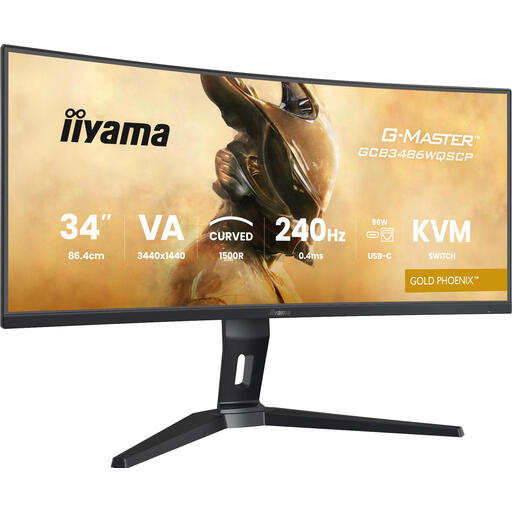
A good fit if you’re looking for a large ultrawide screen and want to check the aspect ratio of your games.
34 inches, 21:9, 3440 × 1440 and up to 240 Hz; 1500R curvature, FreeSync Premium and a built-in KVM switch.
 No image available
A good fit if you’re specifically considering an OLED monitor with extra horizontal space.
34 inches, 21:9, 3440 × 1440 and QD-OLED; the description mentions OLED Care 2.0 and an adjustable stand.
If static interface elements stay visible for long periods, maintenance remains important; protective measures don’t eliminate the risk of burn-in.
First, check the specific game and its interface. The monitor’s aspect ratio alone won’t tell you how the game lays out the picture, map and menus.
Check which combinations of resolution, port and cable are supported, then select your preferred refresh rate in the display settings. Xiaomi recommends using the supplied DisplayPort cable for the optimum combination with the G34WQi; check the instructions for other models separately.
Follow the care instructions for the exact model. ASUS describes OLED Care as a way to reduce the risk of burn-in, not eliminate it.
According to ACM ConsuWijzer, for a standard online product purchase you generally have a statutory 14-day cooling-off period after delivery; exceptions may apply. If a product is faulty, the retailer is responsible for the statutory guarantee, separate from any commercial manufacturer’s warranty.
The Dutch Government lists several options for old electrical appliances, including returning them to the shop or online retailer where you buy a similar new appliance, or taking them to your local council’s recycling centre.