
Vandaag of morgen in huis

Kwaliteit gegarandeerd

Welkomstaanbiedingen ontgrendelen: GRATIS bezorging | Tot 80% korting | Gratis 30 dagen JoyPlus-proefperiode
Download de app
A 3-in-1 waterproof men’s jacket looks like a practical buy on paper: an outer layer to protect you from rain and wind, a warm inner layer and the option to wear both together. Yet after a few months, many buyers find that their jacket has its limitations. It may be water-repellent, for example, but not suitable for prolonged rain. Or the fleece lining may keep you warm but make moving uncomfortable on a strenuous walk.
As a Joybuy Product Recommendation Officer, I focus on the product information that matters in practice. Below, you’ll find out which specifications to check, which marketing claims deserve closer attention and what type of jacket suits the way you use it in the Netherlands.
A coating that repels light drizzle won’t necessarily provide enough protection on a long cycle ride or walk in heavy rain. Check whether the product description lists a hydrostatic head rating. This indicates how much water pressure the fabric can withstand in a particular test.
Also check the seams, zips, hood and cuffs. A high rating for the fabric doesn’t tell you everything about the jacket as a whole. Treat any additional performance figures as claims made by the brand. For example, PELLIOT’s product description gives a hydrostatic head rating of 35.900 mm H₂O according to JIS. This is a verifiable product specification, but the test conditions and how you care for the jacket still matter.
A fleece-lined men’s jacket feels comfortable when you’re taking it easy, but excess heat can build up when you’re trekking or walking at a brisk pace. Look for a stated MVTR rating: the amount of water vapour that passes through one square metre of fabric in 24 hours, according to a test.
PELLIOT’s product description gives a breathability rating of 16.000 g/m²/24 hours according to JIS. This offers a technical indication, but it doesn’t guarantee that every wearer will feel dry and comfortable in all conditions. Fit, clothing layers, exertion and the outside temperature all play a part too.
A combination jacket needs enough room for a fleece or jumper without the outer layer pulling across your shoulders. On the other hand, a jacket that’s too roomy can get in the way on your bike or when climbing. Measure your chest and compare it with the size guide for the specific model.
When choosing a 3-in-1 waterproof men’s jacket, pay particular attention to:
For commuting and everyday use, a jacket with basic rain protection may be enough. For camping, trekking and long walks, a higher hydrostatic head rating, covered zips and adjustable fastenings are more important. A windproof men’s rain jacket needs more than a tightly woven fabric: the hood, hem and cuffs also affect how much cold air gets in.
A breathable outdoor jacket is especially useful when you’re on the move. As well as checking the MVTR, look for ventilation zips, a mesh lining and the option to wear the inner layer on its own. A shell without fleece can work well on a wet summer’s day, while the lining can be worn as a light warm layer in dry weather.
Hard-wearing fabric is useful on rocky ground, around branches and for intensive use. According to its product description, PELLIOT lists more than 40.000 abrasion cycles for the outer fabric. This is a brand claim based on a cited test, not a prediction of the jacket’s exact lifespan.
How you care for your jacket directly affects its performance:
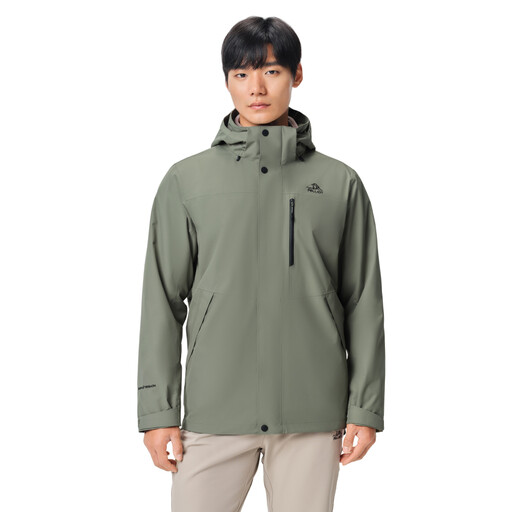
Why it suits this profile: The three ways to wear it make this jacket suitable for everyday use, camping and walks in changeable weather.
The product description says you can wear the shell and lining separately, and lists technical ratings for waterproofing and breathability.
According to the product information: 35.900 mm H₂O, an MVTR of 16.000 g/m²/24 hours, and an adjustable hood, hem and cuffs.

Why it suits this profile: The Triclimate system is designed for people looking for a technical combination for trails, travel and cold weather.
According to the product description, you can wear the outer layer and down inner layer separately or together.
Listed features include an adjustable hood, taped outer seams, underarm ventilation zips and 550 fill power down insulation.

Why it suits this profile: This shell is suited to running, training and active outdoor use when you need a lightweight men’s rain jacket.
The product information lists a DryVent outer fabric with sealed seams and a standard fit; be sure to check the care instructions too.
The jacket has an adjustable hood, chest and hand pockets, and is made from 100% recycled polyester according to the product description.
We’ve put together a complete, up-to-date list of products that meet these strict selection criteria and current European safety regulations.
It depends on the inner layer, fit and outside temperature. A fleece-lined men’s jacket is usually suitable for moderately cold weather. If you’re looking for a warm winter jacket for men, you should also consider the insulation, windproofing and room for extra layers.
Its lifespan depends on how you use it, friction, washing and reapplying the water-repellent finish. A durable men’s jacket made from hard-wearing fabric can be suitable for more intensive use, but technical ratings don’t guarantee a set lifespan. Check the seams, zips and coating regularly.
Often, yes, if the layers can be worn separately. Wear just the outer layer in the rain, just the lining in cool, dry weather, and both together in cold, wet conditions. Even a lightweight shell may be too warm on hot summer days, so a four-season jacket needs good ventilation and a suitable combination of layers.
