
Vandaag of morgen in huis

Kwaliteit gegarandeerd

Welkomstaanbiedingen ontgrendelen: GRATIS bezorging | Tot 80% korting | Gratis 30 dagen JoyPlus-proefperiode
Download de app
A 28 cm stainless steel frying pan with a lid is handy for larger portions, stir-fries, meat, fish and dishes that need to simmer after browning. However, not every pan with a stainless steel appearance is suitable for everyday use. The wrong base, an unclear oven temperature limit or an impractical lid could mean you need to buy another pan sooner than expected.
This buying guide will help you distinguish product specifications from marketing claims and choose a pan that suits your hob, recipes and cleaning routine.
A product description may say that a pan is suitable for gas, electric, ceramic, halogen and induction hobs. For induction, a magnetic, flat base is particularly important. Also check that the base diameter suits your induction zone. A 28 cm pan does not always have a base that is exactly 28 cm across.
A frying pan described as suitable for all hobs should therefore come with clear information about induction compatibility and the type of base. A broad marketing claim without technical details offers less reassurance.
A 3-ply frying pan often consists of stainless steel with an aluminium core. Aluminium conducts heat well, while stainless steel provides strength and a neutral cooking surface. Check whether the layers are only in the base or run throughout the entire pan. A product description that refers to a “tri-ply” or three-layer composite structure is clearer than one that simply uses the term “sandwich base”.
Good heat distribution helps to limit hot spots, but you still need to use the right temperature. Stainless steel behaves differently from a non-stick pan: when searing, it is usually important to preheat the pan and then add oil.
A frying pan with a glass lid lets you keep an eye on your food without constantly losing heat and moisture. Check whether the lid has a steam vent, a heat-resistant knob and a clearly stated maximum temperature.
Take extra care when using the pan in the oven. The pan and lid may have different temperature limits. For example, the product information for the PURECOOK Tri-Ply 304 states that it is oven-safe up to 220 °F, which is approximately 104 °C. This is not the same as a pan that can be used at much higher temperatures without its lid.
A 304 stainless steel frying pan is a popular choice for cookware. According to the PURECOOK pan’s product description, the cooking surface is made from 304 stainless steel and the pan is designed without a non-stick coating. This may appeal if you are looking for a coating-free pan, but “without a coating” does not automatically mean it is officially certified as a PFAS-free frying pan. Check for an explicit statement from the manufacturer or seller.
316 stainless steel is also used in saucepans and, according to product information, is known for its greater corrosion resistance. That does not automatically make a 316 model more suitable as a frying pan. Look at the full construction, base, handle and care instructions.
A diameter of 28 cm is suitable for several portions, but the pan also needs enough space on your hob. Check:
A deep pan is more practical for stir-frying and braising. A shallow frying pan is often better for pancakes, omelettes and quick searing.
A dishwasher-safe frying pan can save time, but check whether this also applies to the lid and handle. Some models are recommended for hand washing to help keep their shine, handles or coatings in good condition for longer.
White spots or rainbow-like discolouration can appear on a coating-free stainless steel pan due to minerals, starch or high temperatures. These marks do not automatically mean the pan is faulty. A soft sponge, mild washing-up liquid and a little vinegar may help. Abrasive cleaners can dull the surface.

Why it suits this profile: According to the product description, this large stainless steel frying pan combines a 304 stainless steel layer with an aluminium core and a glass lid. It is a practical starting point if you want one pan for frying, stir-frying and braising.
The specifications state that it has a three-layer construction and is compatible with gas, induction, electric, ceramic and halogen hobs, as well as having a glass lid. Before buying, check the stated oven limit of 220 °F.
28 cm size, 304 stainless steel, 3-layer construction, glass lid and, according to the product information, dishwasher-safe.
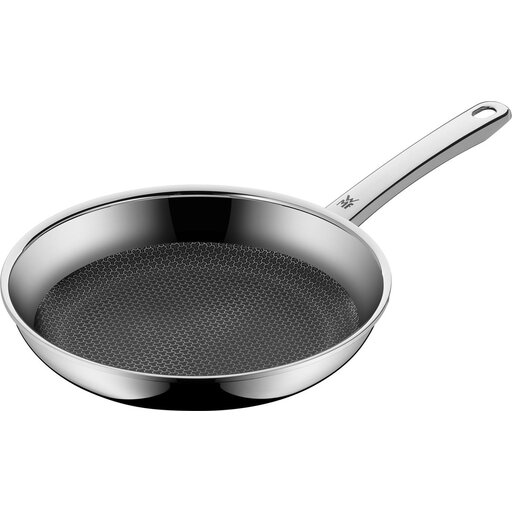
Why it suits this profile: This model is designed for people who want to combine the heat-retention properties of stainless steel with a non-stick coating. According to WMF, the pan has a three-layer construction with an aluminium core and is suitable for induction and other heat sources.
The product information specifically mentions the PermaDur non-stick coating, honeycomb structure and maximum heat resistance of 260 °C. According to the description, the pan is not dishwasher-safe.
28 cm diameter, three-layer material, suitable for all heat sources and, according to WMF, heat-resistant up to 260 °C.
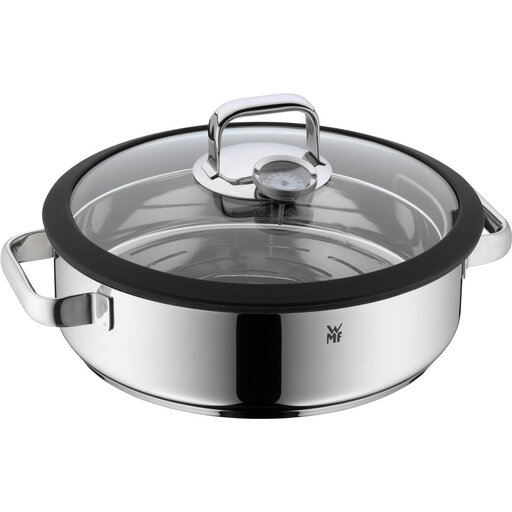
Why it suits this profile: According to the product description, this pan is designed for steaming, roasting and braising. With a capacity of around 5 litres, it is a good option for households that cook larger meals and need more than just a frying pan.
The product information gives separate oven limits: up to 180 °C with the lid on and up to 250 °C without it. It also states that the thermometer is not dishwasher-safe.
28 cm diameter, capacity of around 5 litres, glass lid, steaming insert and, according to the product description, suitable for all heat sources.
We’ve put together a complete, up-to-date list of products that meet these strict selection criteria and the applicable European safety regulations.
A coating-free stainless steel frying pan needs a different approach from a traditional non-stick pan:
When using an induction hob, do not use a higher setting than necessary. Stainless steel retains heat well, so a medium heat is often enough once the pan has warmed up.
That depends on the base. Choose a model that is explicitly described as suitable for induction. Also check the base diameter and centre the pan on the cooking zone.
Not always. The pan, handle and lid may each have a different maximum temperature. Check the product specifications before use. Some models have a lower oven limit with the lid on than without it.
Stainless steel is durable and resistant to wear, but the pan’s lifespan depends on how you use and care for it. Avoid sudden temperature changes, let a hot pan cool down first and do not use harsh abrasive cleaners. For pans with a non-stick coating, you should also follow the manufacturer’s specific care instructions.
