
Vandaag of morgen in huis

Kwaliteit gegarandeerd

Welkomstaanbiedingen ontgrendelen: GRATIS bezorging | Tot 80% korting | Gratis 30 dagen JoyPlus-proefperiode
Download de app
A 28 cm stainless steel frying pan provides ample cooking space for several portions, vegetables, fish or meat. The size also often fits well on a large induction zone or gas burner. However, not every stainless steel frying pan is made the same. The construction of the base, compatibility with your hob and the way you maintain the pan determine how convenient it is to use.
As a Joybuy Product Recommendation Officer, I filter product information for practical details. Below, you’ll find what to look for and which models suit different cooking styles.
A pan may be made entirely of stainless steel and still heat less evenly if its base is thin or consists of a single layer. A tri-ply frying pan often features a construction made from stainless steel, an aluminium core and another layer of stainless steel. Aluminium conducts heat more efficiently than stainless steel and can therefore contribute to more even heat distribution.
So don’t assess the material alone—check the construction as well. Look for terms such as tri-ply, 3-layer composite or “aluminium core”.
A frying pan without a non-stick coating does not have a chemical non-stick layer. This can appeal to those looking for a simple, durable cooking surface, but stainless steel requires a different cooking technique. Preheat the pan gradually, then add oil and allow the ingredients to sear sufficiently before turning them.
Claims such as “non-stick” in a product description do not automatically mean the same thing for uncoated stainless steel pans as they do for pans with a non-stick coating. According to product information for various models, the risk of food sticking is reduced by using the correct temperature and the “hot pan, cold oil” method.
A frying pan for induction must have a magnetic base. Products suitable for induction are generally also compatible with gas, electric and ceramic cooktops, but always verify this in the product specifications.
Also pay attention to the oven temperature limit. For the PURECOOK models, oven resistance is listed as 220 °F, which is approximately 104 °C. This is very different from oven suitability at high baking temperatures. Use the pan in the oven only within the stated limit, and check whether the lid has the same maximum temperature.
A 304 stainless steel frying pan is often described in product information as rust-resistant and suitable for contact with food. The PURECOOK and Maxcook models in this selection list 304 stainless steel as part of their construction. According to the relevant product information, this includes references to Chinese standard GB 4806.9 and US FDA regulations. These are supplier-provided product specifications; if in doubt, always check the latest compliance information on the product page.
An uncoated stainless steel pan can be scratched by sharp metal utensils. “Resistant to metal utensils” is also a supplier claim and is not a reason to deliberately scrape sharp edges across the cooking surface.
A three-layer construction may consist of:
This design is particularly interesting if you want to fry evenly on an induction or ceramic cooktop. Also check the diameter of the effective base. A 28 cm pan may have a smaller flat base than its upper rim, meaning that the entire surface does not sit directly over the cooking zone.
A 28 cm pan is practical for families and households that prepare several portions at once. Do take the pan’s weight and the available storage space into account. A frying pan with a glass lid is useful for simmering, reducing sauces and preparing dishes where you want to retain moisture. A transparent lid means you can monitor the cooking process without repeatedly opening the pan.
A lid does make the pan heavier and takes up additional space. Choose a model without a lid if you mainly fry, sear or use your own universal lid.
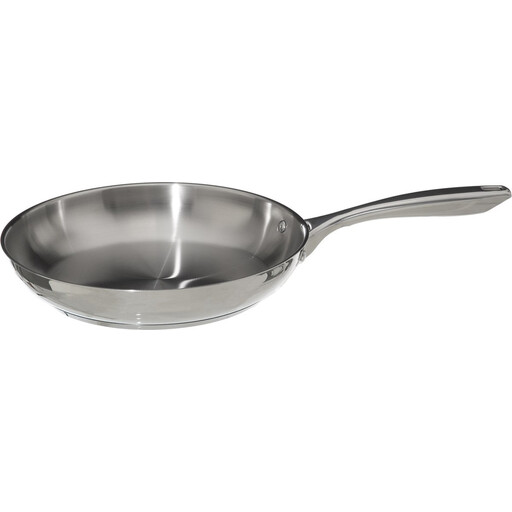
Why This Fits Their Persona: A straightforward 28 cm model for everyday cooking, from potatoes and vegetables to burgers and stir-fries.
The specifications list the diameter, a 2.2-litre capacity and compatibility with gas, induction, ceramic and electric cooktops.
Stainless steel body, aluminium induction disc, dishwasher-safe according to the product information and a 2-year warranty.

Why This Fits Their Persona: Ideal for those who want to combine frying and braising in one pan while keeping an eye on the cooking process through the lid.
The product description specifies a three-layer stainless steel–aluminium–stainless steel structure and compatibility with gas, induction, ceramic and electric cooktops.
304 stainless steel, a glass lid with a silicone rim and dishwasher-safe construction according to the product information.
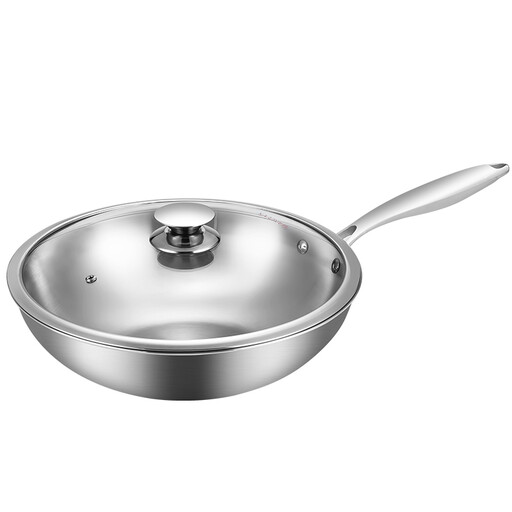
Why This Fits Their Persona: Its shape is well suited to stir-frying, searing and dishes that require frequent tossing and stirring.
This model has no non-stick coating, so you avoid expecting a coating to remain indefinitely resistant under intensive use.
304 stainless steel, a thick composite base, compatibility with induction, gas, electric and ceramic cooktops, and dishwasher-safe construction according to the listing.
Wash a new pan with warm water and mild washing-up liquid before using it for the first time. For some models, the manufacturer notes that dark residue may come from polishing wax. If this applies, follow the cleaning instructions on the product page.
For everyday use:
A dishwasher-safe frying pan is convenient, but hand-washing can help prevent discolouration and dull patches. According to the Maxcook product information, white spots or rainbow-coloured marks can often be removed with diluted vinegar or a suitable stainless steel cleaner. Do not use an abrasive scouring pad if the manufacturer advises against it.
Browse a current selection of uncoated stainless steel pans and compare size, base construction, cooktop compatibility and care requirements.
That depends on the base. Choose a model that explicitly states that it is induction-compatible. The models mentioned above also list compatibility with gas, ceramic and electric cooktops.
In most cases, the pan is not hot enough, the cooktop is set too high or the food is being turned too soon. Preheat the pan gradually, use enough oil and allow the ingredient to form a crust first. An uncoated pan behaves differently from one with a non-stick coating.
Several selected models are listed as dishwasher-safe in their product information. Check each product individually, especially when a glass lid, silicone components or a special handle is included. For everyday care, hand-washing with a soft sponge remains the gentlest option.
