
当日/次日达

品质保障

开启新人专享福利: 全场免邮 | 低至 2 折 | 免费试用 30 天 JoyPlus 会员
下载 Joybuy
A 28 cm deep frying pan may seem like a straightforward purchase at first glance. However, pans vary considerably in capacity, heat distribution, coating and maintenance. A shallow frying pan is not automatically suitable for dishes with lots of sauce, while a deep pan without a good lid can be inconvenient for braising or simmering.
For households in the Netherlands, three pitfalls are particularly important:
A diameter of 28 cm is practical for families and meals for several people. The high sides make a deep sauté pan suitable for stir-frying, pasta, curries, stews and sauces without ingredients quickly spilling over the edge.
Pay attention to the following details:
A 28 cm pan also requires sufficient space on the hob. On a small induction zone, the base may not heat as evenly.
An aluminium pan generally heats up quickly. For induction, a magnetic base is required. According to the product description, the SENSARTE Deep Frying Pan 28 cm has an aluminium pan body with a ceramic coating and a magnetic stainless steel base. The model is stated to be suitable for gas, induction, halogen, ceramic and electric cooking.
An uncoated stainless steel cooking pan does not have non-stick properties, but may be appealing for intensive use and deep-frying. According to the product description, the PURECOOK pan is made from 304 stainless steel, has a multi-layer magnetic base and a capacity of approximately 4.3 litres.
Always check the information on the product page for the model you choose. “Induction suitable” does not automatically mean that every pan will work optimally on every cooking zone.
A ceramic frying pan can be a good choice when food needs to release easily and you want to cook with little oil. Claims such as PFAS-free frying pan, PFOA-free or frying pan without harmful substances should not be assessed separately from the full product specifications.
According to SENSARTE’s own product description, the 28 cm pan is free from PTFE, PFAS, cadmium and lead. According to Brabantia’s own product description, the Onyx pan is PFAS-free and has a ceramic coating. These are product claims made by the brands; they are not presented here as independently verified performance claims.
For a longer service life:
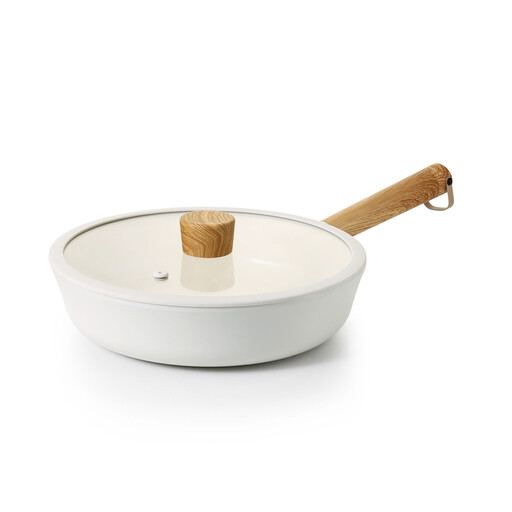
Why it suits this profile: A versatile entry-level choice for everyday frying, stir-frying and sautéing on various hobs.
The specifications mention a 28 cm size, a lid, ceramic coating and compatibility with gas, induction, ceramic and electric cooking.
Ceramic non-stick coating, magnetic stainless steel base, lid and multiple usage scenarios.
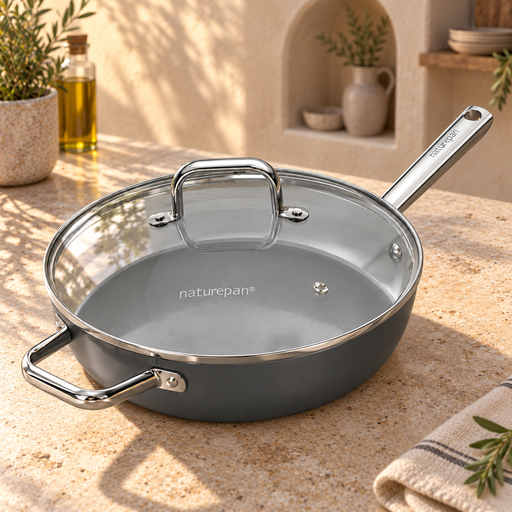
Why it suits this profile: Designed for anyone looking for a high-sided pan with a lid for sauces, stews and one-pan meals.
According to the product description, the pan is 7.5 cm high and comes with a lid. It is oven-safe up to 260 °C, with the lid removed.
PFAS-, PTFE- and PFOA-free coating according to the product description, compatibility with all common hobs and an included lid.
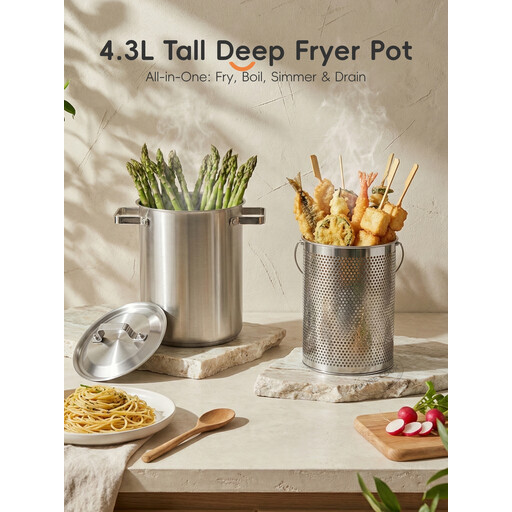
Why it suits this profile: Suitable for anyone who regularly deep-fries as well as cooking and braising, and is looking for an uncoated stainless steel pan.
According to the product description, the pan has a capacity of 4.3 litres, a three-layer magnetic base and a removable perforated basket.
Uncoated 304 stainless steel construction, suitable for induction, gas and ceramic hobs, plus a frying basket.
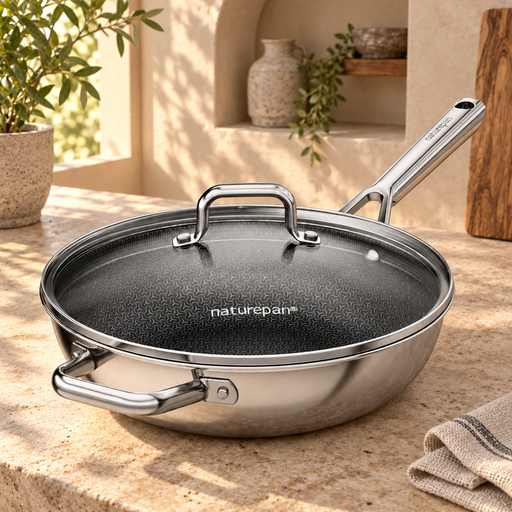
Why it suits this profile: A combination of stainless steel, an aluminium core and ceramic coating for anyone who alternates between frying and searing.
The product description mentions a multi-layer construction, an aluminium heat-conducting core, a 28 cm size and compatibility with induction, gas, electric and ceramic hobs.
Hybrid cooking surface, lid, oven use up to 230 °C without the lid and dishwasher-safe design according to the product specifications.
We have put together a complete, up-to-date list of products that fully meet these strict selection criteria and the applicable European safety regulations.
That depends on the base. Look for a magnetic base and check the stated induction compatibility. Also measure the diameter of the induction zone. A wide pan may heat less evenly on a smaller zone.
The terms are often used interchangeably. A sauté pan usually has higher sides and is designed for frying, sautéing and simmering. A deep frying pan can have similar features. In particular, check the side height, base diameter, capacity and whether a lid is included.
Its lifespan depends on use and maintenance. Use low to medium temperatures, avoid metal utensils and do not leave the pan heating empty for a prolonged period. A coating that is peeling or visibly damaged should not be used any further, in accordance with the product’s safety information. For intensive deep-frying, an uncoated stainless steel deep-frying pan with a basket may be more practical than a non-stick frying pan.
