
Vandaag of morgen in huis

Kwaliteit gegarandeerd

Welkomstaanbiedingen ontgrendelen: GRATIS bezorging | Tot 80% korting | Gratis 30 dagen JoyPlus-proefperiode
Download de app
A smart 22 kW Type 2 EV wallbox sounds appealing if you want to charge your electric car faster at home. However, a higher charging capacity does not automatically mean your car will charge faster. The maximum speed depends on your car’s on-board charger, your home’s electrical connection and the installation of the charge point.
There are three common pitfalls for households in the Netherlands:
An 22 kW EV charge point normally uses three phases. At 400 V and 32 A, the charging station can deliver up to 22 kW, but your car determines how much power it actually draws. So check your car’s manual for:
A Type 2 charging station is suitable for many European electric cars and plug-in hybrids, but a car with only CHAdeMO or another connector will need a different charging solution.
A fixed electric car charge point must be connected to a suitable dedicated circuit. Have a qualified electrician carry out the installation and commissioning. For a 22 kW installation, the following should be checked:
Product descriptions often list features such as leakage-current, overheating, overvoltage and overcurrent protection. Treat these as product specifications, not as a substitute for correct installation. Do not use an extension lead or an unsuitable adapter.
A Wi-Fi wallbox can be useful for scheduled charging, checking charging status and controlling the unit remotely. Some models work with Tuya or a similar app. Check that your home network has a strong enough signal where the charge point will be installed.
If your home has a heat pump, induction hob or several electrical appliances, dynamic load balancing may be worth considering. According to the product description, this feature adjusts the charging current based on the electricity being used elsewhere in your home. Check how it is connected and whether additional metering equipment is required.
RFID is useful if several drivers need access to the charge point. Some models let you start a charging session with an RFID card, even if the network connection is temporarily unavailable.
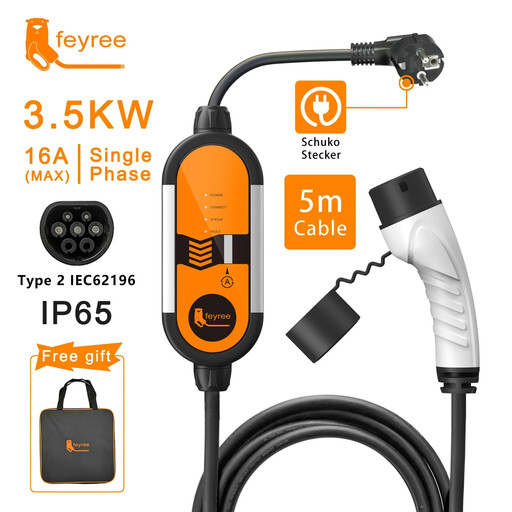
Why it suits this profile: A 3.5 kW portable EV charger is a good choice if you want to try charging an electric car without having a fixed wallbox installed. Its Schuko plug fits a suitable household socket.
Its maximum capacity is clearly stated as 3.5 kW at 16 A. So you won’t buy a 22 kW charger for a car or home that isn’t ready for one.
Type 2 connector, adjustable current from 8 to 16 A, OLED status display and a 5-metre cable.
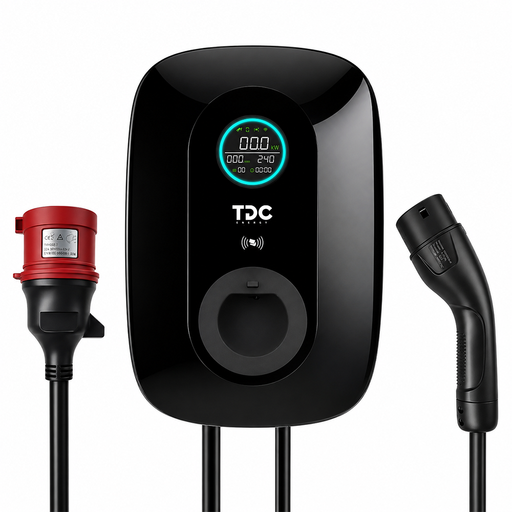
Why it suits this profile: This wallbox is a good fit for drivers with a suitable 3-phase installation who want to combine charging status updates, RFID access and app control.
The requirements of 400 V, 3-phase and 32 A are stated explicitly. This makes checking your meter box beforehand essential, not optional.
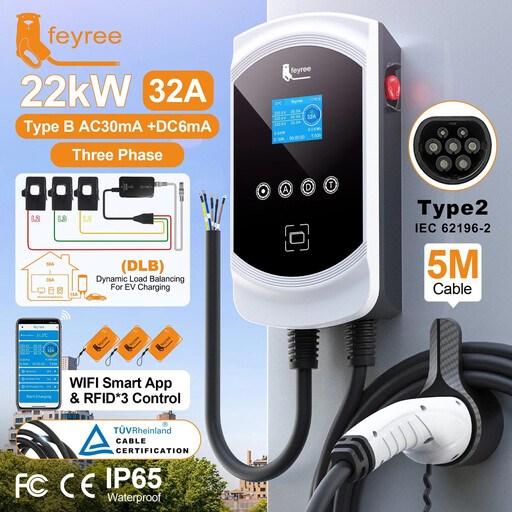
Why it suits this profile: This option is designed for homes with fluctuating electricity use, several electrical appliances or more than one charging point.
The product description mentions dynamic load balancing, which allows the charging current to be adjusted to the electricity used by appliances in your home. Check what metering equipment is needed during installation.
3-phase charging up to 22 kW according to the product specifications, app control, adjustable charging current, LCD screen and a 5-metre Type 2 cable.
We’ve put together a complete, up-to-date list of products that meet these strict selection criteria and the applicable European safety regulations.
No. Your car may only accept a lower charging capacity, such as 7.4 kW or 11 kW. The wallbox won’t automatically deliver 22 kW. Check the maximum AC capacity of your car’s on-board charger.
Not always. You’ll generally need a suitable 400 V 3-phase connection and enough grid capacity. Before you buy, an electrician should assess your meter box, wiring, protection and earthing.
A portable charger can be practical for occasional or limited use. However, a 3.5 kW model charges considerably more slowly than an 11 kW or 22 kW wallbox. Only use a household socket if it is suitable for a sustained load and has been connected in accordance with the regulations.
