
Vandaag of morgen in huis

Kwaliteit gegarandeerd

Welkomstaanbiedingen ontgrendelen: GRATIS bezorging | Tot 80% korting | Gratis 30 dagen JoyPlus-proefperiode
Download de app
Charging at home is convenient, but a high charging capacity doesn’t automatically mean your car will charge faster. If you’re looking for a 22 kW Type 2 EV charger with Wi-Fi, you’ll need to consider differences in connections, vehicle compatibility, app features and safety. Choose the wrong charger and it might not deliver its full power at home, have the wrong plug or require extra installation work.
This buying guide will help you assess a smart EV wallbox, portable charger or Type 2 charging station using verifiable specifications.
A 22 kW charging point can only deliver up to 22 kW if both your electrical installation and your car’s onboard charger support it. Many electric cars charge on AC at a maximum of 11 kW, while plug-in hybrids often support less. In that case, a 22 kW wallbox won’t charge the car any faster than it can handle.
So check:
An EV charger with an app can start, stop, schedule and monitor charging. That doesn’t automatically mean it measures your home’s total electricity consumption. For that, you need dynamic load balancing.
Load balancing adjusts the charging power when appliances such as a heat pump, oven or washing machine are using a lot of electricity. Check that this feature is explicitly mentioned in the product description, and whether it requires an additional energy meter or installation component.
An IP rating tells you about protection against dust and water under certain conditions, but it doesn’t cover every outdoor situation. A long cable isn’t always practical either, especially if the connector is heavy or the cable is difficult to store.
As well as checking for IP65 or IP66, look for:
An 11 kW 3-phase EV charger typically operates at 400 V and up to 16 A. A 22 kW Type 2 EV charger usually uses 400 V and 32 A. Your home’s electrical installation must be able to handle this load, and the wallbox should be connected to a suitable dedicated circuit.
A portable 11 kW EVSE charger with a CEE plug may be a good option if you have a suitable connection, but it isn’t the same as a permanently installed wallbox. A 3.5 kW charger with a Schuko plug uses a standard socket and is easier to set up, but charges considerably more slowly.
The Type 2 connector, as specified in IEC 62196-2, is the standard AC connection for many European electric cars and plug-in hybrids. Tesla drivers with a Model 3 or Model Y also generally use a Type 2 connection for AC charging, but the maximum speed still depends on the car.
Always check:
Product descriptions may list features such as Type B residual-current protection, AC 30 mA + DC 6 mA, overvoltage protection, earth fault detection and temperature monitoring. According to Feyree’s product information, these features are built into various models. However, check whether your home’s electrical installation also needs additional protection.
An RFID EV charger can authorise charging with a card, which is useful for a shared driveway or garage. Wi-Fi and Bluetooth are particularly useful if you want to schedule charging, check your consumption or adjust the charging current remotely.
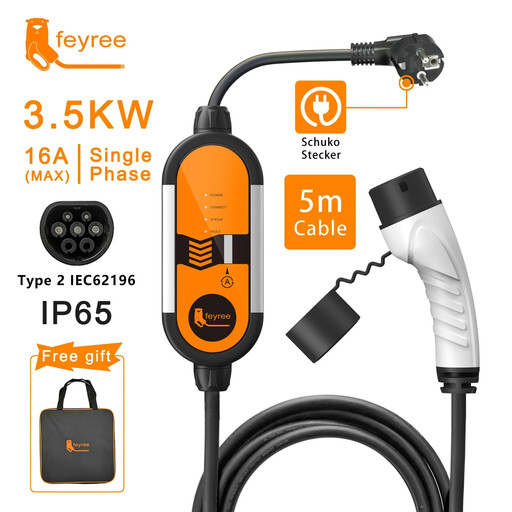
Why it suits this type of user: This portable charging cable works with a standard Schuko socket, making it a good choice if you want to try charging at home without a complicated setup.
The product information lists adjustable current settings of 8 A, 10 A, 13 A and 16 A. This lets you match the charging level to the socket and installation you’re using.
Type 2 connection, 5-metre cable, OLED status display and up to 3.5 kW on 1-phase.
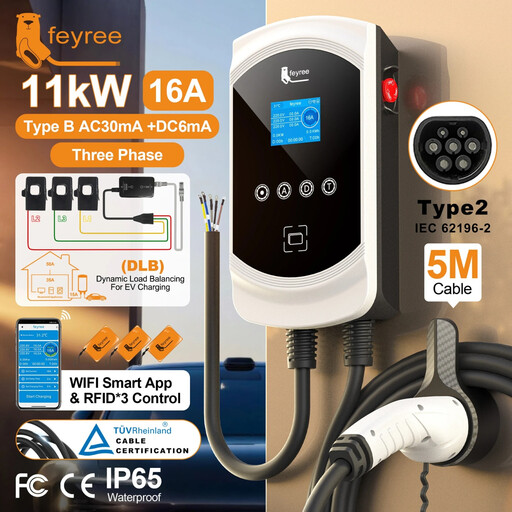
Why it suits this type of user: This smart wallbox is designed for households with a 3-phase connection that want more control over charging through Wi-Fi and an app.
The product description lists dynamic load balancing, which the manufacturer says adjusts the charging power according to the consumption of other appliances.
Up to 11 kW, Tuya app, RFID function, 2.8-inch colour screen and, according to the product information, Type B residual-current protection.
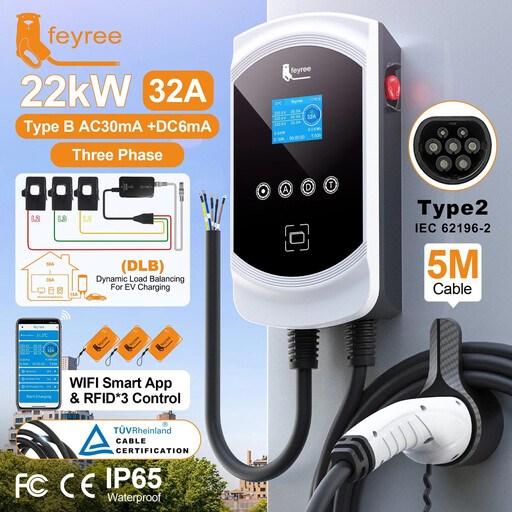
Why it suits this type of user: This model is designed for households with a suitable 400 V installation and a car that supports 22 kW AC charging.
The product information advises that professional installation is required and lists load balancing, so you don’t have to rely on the 22 kW figure alone.
Up to 32 A and 22 kW, app control, RFID, screen display and adjustable charging current, according to the product description.
We’ve put together a complete, up-to-date list of products that meet these strict selection criteria and the applicable European safety regulations.
No. The car needs a 22 kW 3-phase onboard charger. If its onboard charger supports a maximum of 11 kW or 7.4 kW, the charging power will be limited automatically. Also check that your electrical installation is suitable.
Not in every home, but it can be useful when several high-power appliances are running at the same time. A wallbox with dynamic load balancing can adjust the charging power to match other electricity use, as specified in the product features. Ask an installer what meter or connection is needed.
The cost mainly depends on your electricity tariff and how many kilowatt-hours you charge. An app with scheduled charging can help you charge during cheaper periods if your energy supplier offers different rates. The charger itself won’t automatically reduce the cost of electricity, so always check your contract and the app settings.
