
Vandaag of morgen in huis

Kwaliteit gegarandeerd

Welkomstaanbiedingen ontgrendelen: GRATIS bezorging | Tot 80% korting | Gratis 30 dagen JoyPlus-proefperiode
Download de app
A 22 kW EV charging point may seem like a straightforward purchase on paper: choose a Type 2 connection, connect the wallbox and charge faster than with a standard charging point. In practice, its suitability depends on your consumer unit, your car’s onboard charger and how you intend to use the charging point.
Private owners of electric cars and plug-in hybrids often encounter the same issues. A charging point may appear technically suitable, yet still fail to deliver the expected charging speed. Features such as an app, RFID and splash protection are also sometimes promoted without clear context. Below, you’ll find the key points to check before buying.
A 22 kW charging station only operates at full capacity when three conditions are met:
However, many electric cars accept a maximum of 11 kW on AC power. A 22 kW wallbox can still be useful in this case, but the car determines the actual charging speed. With a plug-in hybrid, the AC charging capacity is often lower.
A 22 kW charging point is not designed for a standard household socket. Models with a CEE 5-pin 32 A plug require a suitable three-phase circuit, correct earthing and appropriate protection. Do not use a household extension lead or multi-socket adaptor as a temporary solution. This could lead to heat build-up, voltage issues and an unsuitable installation.
Have the connection and commissioning carried out by a qualified installer, in accordance with local regulations and the product manual.
A smart charging point with an app can be useful for starting and stopping charging and viewing charging data. However, this feature requires a network connection. If Wi-Fi is temporarily unavailable, the app may not work as expected.
A charging point with RFID provides a second control method. Check how many cards are included, whether RFID works without a network connection and whether the charging point is suitable for multiple users. For a small business or shared driveway, access management may be more important than a large display.
Look for the following in the technical specifications:
A three-phase EV charger distributes power across three phases. This is different from a 22 kW charger that would operate on a single phase. Have an installer check that the main fuse, cable diameter, residual-current protection and available grid capacity are suitable for one another. Also take other high-power appliances into account, such as a heat pump, induction hob or home battery.
A Type 2 charging point uses the connection commonly found on electric cars and plug-in hybrids in Europe. Nevertheless, always check whether your car supports Type 2 AC charging. A Type 2 connection does not automatically mean that the car accepts 22 kW.
A wallbox with a 5-metre cable often gives you more freedom of movement on a driveway. Measure the distance between the intended installation location and the car’s charging port beforehand. A cable that is too short is impractical, while a much longer cable may be heavier and more difficult to store.
Pay attention to the protection provided for the cable and connector, but do not confuse this with unlimited weather resistance. According to the product specifications, the TDC ENERGY RAC22 is rated IP54 when the vehicle connector is in the holder and IP65 when the protective cap is fitted. The manufacturer also recommends sheltering it from rain and sunlight.
The product description mentions, among other things:
These features are relevant product specifications, but they do not remove the need for correct installation and regular maintenance.
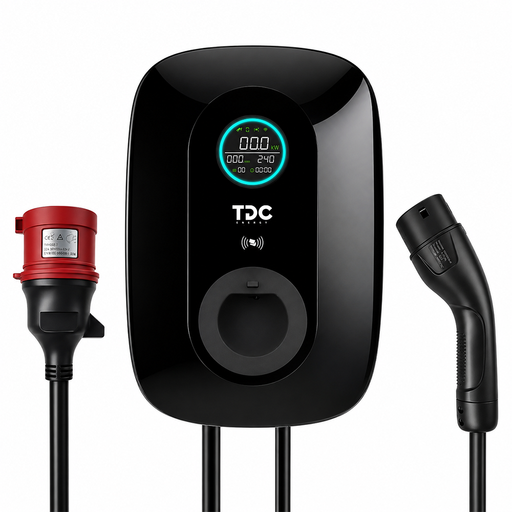
Why it suits this profile: The combination of a 5-metre cable, Type 2 connector and control via RFID or app provides a straightforward foundation for home users with a suitable 400 V connection.
The specified 400 V, 32 A and three-phase specifications make it clear that this is not a solution for a standard household socket. The actual charging speed still depends on the car.
Up to 22 kW AC charging capacity, 5-metre cable, 3-inch LCD screen and two RFID cards included.
Why it suits this profile: Suitable for users who value status information, access management and multiple safety features alongside charging capacity.
According to the product specifications, RFID can also be used without a network connection. The app features do depend on a compatible connection.
Wi-Fi and Bluetooth, a 3-inch segment LCD screen and specified AC and DC leakage detection.
Why it suits this profile: A logical choice for a household or small business where a fixed wallbox, multiple users and daily charging come together.
The wallbox is designed for wall mounting and has a fixed 5-metre cable. Check the positioning, shelter and capacity of the electrical installation in advance.
Compact housing measuring 368 × 256 × 133,3 mm, weighing approximately 5,6 kg, with a specified operating temperature of -30 °C to +50 °C.
We’ve put together a complete, up-to-date list of products that fully meet these strict selection criteria and the applicable European safety regulations.
Before buying, take the following points into account:
According to the product information, the TDC ENERGY RAC22 has a two-year warranty period. Keep your purchase details and check the terms and conditions applicable at the time of purchase.
No. The car must have an onboard AC charger that supports 22 kW. If the car accepts a maximum of 11 kW or less, the charging capacity will be limited automatically. The charging point can therefore be more powerful than the car requires.
Yes, the specified 22 kW configuration generally requires a suitable 400 V three-phase connection. Have an electrician check whether your consumer unit, main fuse, cables and protection are suitable.
Energy costs depend on the car’s consumption, the electricity tariff and charging losses. A higher maximum charging capacity does not automatically make a charging session more expensive; you mainly pay for the kilowatt-hours used. However, check whether your connection requires additional standing charges or modifications.
