
Vandaag of morgen in huis

Kwaliteit gegarandeerd

Welkomstaanbiedingen ontgrendelen: GRATIS bezorging | Tot 80% korting | Gratis 30 dagen JoyPlus-proefperiode
Download de app
A 206 cm cat tree can be a practical solution for active indoor cats or a multi-cat household. Its height gives cats extra room to climb, while different perches, hideaways and scratching areas help keep the tree interesting throughout the day.
However, impressive height isn’t everything. Some models take up a lot of space but have a narrow base. Others have several levels but very little usable sisal. Before you order, pay particular attention to the construction, layout and maximum load capacity.
A tall cat tree has a greater tipping moment than a shorter model. If the base is too small or too light, the tree may become unstable when a cat jumps up from the floor. Always check:
For models taller than 150 cm, wall fixing is strongly recommended. Use the anti-tip kit supplied, if there is one, or suitable fixings for your type of wall.
A cat tree with hideaways and platforms may look comprehensive, while cats mainly use the sisal-covered posts. So don’t just look at the number of levels; check the position and length of the scratching areas too. A cat tree with 13 sisal posts offers more places to scratch than a model with just one central post.
A sloping scratching board may also suit cats who prefer to scratch horizontally or at an angle. Every cat has its own preferences.
A stated load capacity doesn’t guarantee that each platform can support the same weight on its own. Check the difference between:
For example, the JOYFURNOS Cat Tree specifies a total static load of up to 70 kg and around 10 kg per platform. These figures refer to a stationary load; jumping, running and swaying create additional forces. Position the tree carefully and check the fixings regularly.
Measure not only the available floor space, but also the clearance around the cat tree. A 206 cm model needs enough ceiling height to leave a comfortable margin. Also take skirting boards, radiators, windows and curtains into account.
Place a tall cat tree on a level surface, ideally somewhere your cats can see the room. A non-slip mat may help prevent it from sliding, but it isn’t a substitute for wall fixings if these are recommended for the model.
For a sturdy cat tree, a combination of load-bearing panels, metal fixings and a wide base is important. According to the product information, the JOYFURNOS Cat Tree uses E0 particle board, polyester plush, natural sisal rope and iron fixings.
The plush covering makes the resting areas more comfortable and, according to the product description, can be spot-cleaned. When buying, also check that the screws are accessible so you can tighten them again. This is particularly useful for a cat tree used by several cats, as its components will be under greater strain.
A cat tree is more practical for multiple cats when it has several routes and resting spots. This means cats are less likely to have to share the same platform or hideaway. Look for a combination of:
A cat tree with a hammock and hideaways is especially appealing to cats who like to alternate between climbing, retreating and watching the room from a higher spot.
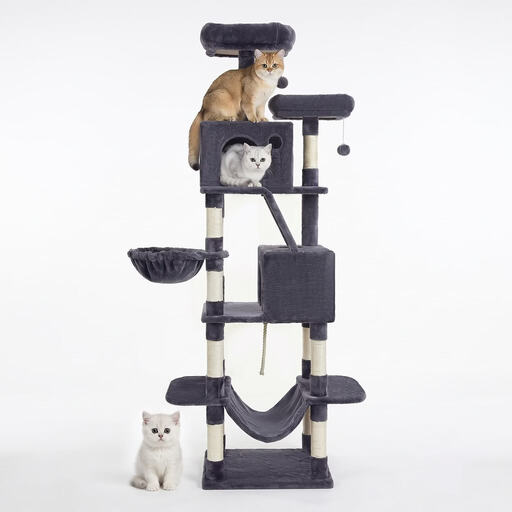
Why it suits this profile: This tall cat tree combines several features in one piece of furniture: climbing, scratching, playing and resting. It could be a practical choice if you’d rather not buy several separate scratching posts and cat furniture.
The specifications list 13 sisal posts and a sloping scratching ramp, so the scratching space isn’t limited to a single post. The wide, reinforced base is designed to provide greater stability.
206 cm tall, with 13 sisal posts, two hideaways, two platforms, a basket and a hammock. The grey plush covering suits many neutral interiors.
Why it suits this profile: The layout offers several different types of spot. Cats can choose between a raised platform, an enclosed hideaway, a basket and a hammock.
The product information specifies a reinforced base and a total static load of up to 70 kg. Do check the load capacity for each platform and secure the tall structure in line with the instructions.
E0 particle board, natural sisal rope and iron hardware, according to the product specifications. The layout is designed for households with multiple indoor cats.
Why it suits this profile: The combination of vertical play space, several scratching areas and resting spots suits active cats who regularly climb and observe their surroundings.
The sloping sisal ramp and 13 scratching posts spread use across several components. With intensive use, regularly inspect the screws, fixings, sisal and plush.
A two-metre-high play structure with two enclosed cat hideaways, two raised platforms, a hammock and a toy ball.
Assemble the cat tree exactly as shown in the instructions provided. Tighten all screws by hand first, then check that the components are straight and properly aligned. Only move the tree to its final position after checking all the fixings.
Pay particular attention during the first few weeks to whether:
At first, supervise kittens, older cats and very active climbers as they get used to the different levels. Stop using the tree if any component is cracked, loose or damaged.
We’ve put together a complete, up-to-date list of products that meet these strict selection criteria and the current European safety requirements.
It depends on the ceiling height and the clearance above the top platform. Measure the height in several places, especially if you have sloping ceilings. Also consider whether you can secure the structure to the wall.
Its lifespan depends on the number of cats, their weight, how much they jump and how well the tree is maintained. Regularly check the sisal posts, plush covering, screws and platforms. Any loose or damaged components should be secured or replaced before the cat tree is used again.
It can be, provided the cat tree has several resting spots and scratching areas, and its stated load capacity is suitable. For the JOYFURNOS Cat Tree, the product information specifies a total static load of up to 70 kg and around 10 kg per platform. Use wall fixings and check the load capacity of each platform rather than relying only on the total figure.
