
Vandaag of morgen in huis

Kwaliteit gegarandeerd

Welkomstaanbiedingen ontgrendelen: GRATIS bezorging | Tot 80% korting | Gratis 30 dagen JoyPlus-proefperiode
Download de app
Whether you want to use a coffee maker in your camper, need power tools in your work van, or are looking for a reliable power source for your garden shed, a good inverter is indispensable. But the search for the right model, specifically a 12V to 230V 2000W pure sine wave inverter, is riddled with marketing traps and technical claims that confuse more than they clarify.
As a Joybuy Product Recommendation Officer, I see where things go wrong every day. Many people fall into the same traps, leading to an inverter that doesn't work or, worse, damages your expensive appliances. Let's tackle the two most common missteps head-on.
To avoid a bad purchase, you need to look beyond the marketing buzzwords. Pay attention to these three objective specifications that determine whether an inverter is right for your situation.
This is the most important distinction.
Pro Tip: Add up the wattage of the devices you want to use at the same time. Choose an inverter with a continuous power rating at least 20% higher to prevent overload.
As mentioned earlier, a pure sine wave is crucial. It produces power that is identical to that from a household outlet. This ensures that:
For any serious application, from a camper van inverter to an off-grid power system with an inverter for a solar panel battery, a pure sine wave is the standard.
An inverter also consumes power itself. The efficiency (expressed as a percentage) indicates how much of the power from your battery is actually converted to 230V. A model with >90% efficiency wastes less precious battery capacity.
Additionally, built-in safety features are essential. Check if the model is equipped with protection against:
Below are a few models that score well on the objective criteria above, matched with specific user profiles.
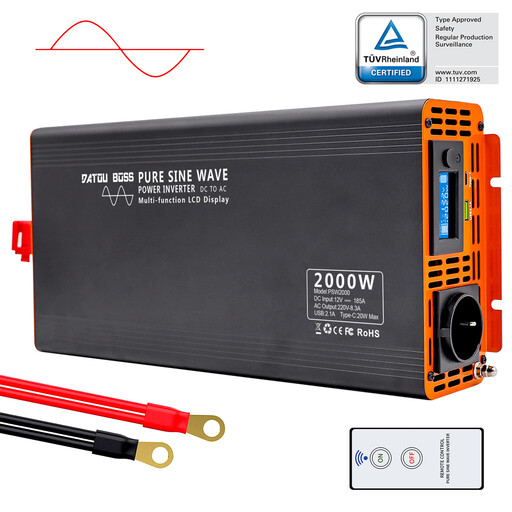
Why it's a match: Perfect for campers or DIY enthusiasts who need a reliable 2000W pure sine wave inverter to run a coffee maker, small fridge, or light tools, without paying for extras they don't need.
Delivers a specified continuous power of 2000W and a peak of 4000W, avoiding the 'peak power pitfall'. The pure sine wave protects your appliances.
Includes a wireless remote control and a clear LCD screen for monitoring status; convenient features often missing from basic models.
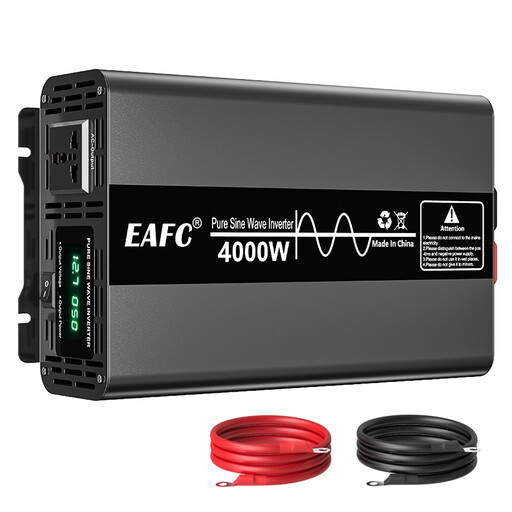
Why it's a match: For the user investing in a professional work van or a serious off-grid system who demands maximum efficiency and reliability for long-term, heavy-duty use.
The pure sine wave is a given here. According to the manufacturer, the 'Amorphous Silicon Technology' provides higher conversion efficiency (>95%), meaning less precious battery power is lost.
The dual cooling fans and wide temperature range (-30°C to 60°C) ensure stable performance under heavy, continuous load, even in demanding conditions.
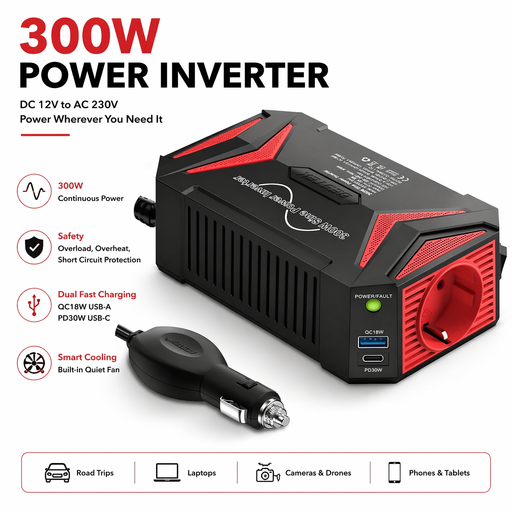
Why it's a match: Ideal for the sales rep or freelancer who needs to charge a laptop, tablet, and phone on the go via the cigarette lighter socket, without risking damage to expensive equipment.
This is a pure sine wave inverter, unlike cheap modified models that can damage sensitive electronics. Its 300W power rating is safe for most cigarette lighter sockets.
Includes modern PD 30W and QC 18W USB ports for fast-charging the latest laptops and phones, right out of the box. No more separate adapters needed.
We have compiled a complete, up-to-date list of products that meet these strict selection criteria.
No, absolutely not. A car's cigarette lighter socket is typically fused at 10A or 15A, which corresponds to a maximum of 180W. A 2000W 12v to 230v power inverter can draw over 160A at full power. This would melt your car's wiring and create a fire hazard. An inverter of this calibre must always be connected directly to the battery terminals with appropriate, thick-gauge cables.
This is a critical safety question. For a 2000W inverter on a 12V system, a substantial cable gauge is required to handle the high amperage safely and minimise voltage drop. As a general rule of thumb, a cable thickness of at least 35mm? is required, but for optimal performance and safety, 50mm? is often recommended, especially if the cables are longer than 1-2 metres. Always check the recommendations in the specific inverter's manual.
An inverter consumes power even when no appliance is plugged into it. This is called 'no-load power consumption'. On modern inverters, this is often low (e.g., 0.5A to 1.5A), but this can slowly drain your battery over several days. It is therefore wise to switch the inverter off completely via its main switch when you are not using it for an extended period.
