
Vandaag of morgen in huis

Kwaliteit gegarandeerd

Welkomstaanbiedingen ontgrendelen: GRATIS bezorging | Tot 80% korting | Gratis 30 dagen JoyPlus-proefperiode
Download de app
A 20-litre dehumidifier may seem straightforward to choose on paper. However, many buyers compare only the number of litres it can remove per day. This can lead to a unit that’s too noisy, needs emptying often or turns out to be less suitable for a cellar, bedroom or utility room.
The main pitfalls are:
A model that removes 20 litres per day is designed for relatively high moisture levels. However, the stated capacity is a maximum figure measured under specific conditions. Use it as a point of comparison, not as a guaranteed daily output.
For a home of around 40 m², room volume is also relevant. With a ceiling height of 2.5 metres, that’s around 100 m³. According to its product information, the Comfee MDDF-20DEN7 is designed for rooms up to approximately 100 m³ or 40 m². This makes it suitable for spaces such as:
A single unit may work less predictably in several connected rooms. Ideally, keep doors and windows closed while dehumidifying, and move the unit if you want to treat different rooms.
A dehumidifier with a water tank is practical if you only use the unit occasionally. The Comfee has a removable 3-litre tank. According to the product description, a full-tank indicator and automatic shut-off help prevent the tank from overflowing.
For a cellar or another room with persistent damp, a dehumidifier with a drainage hose is more convenient. You can connect a hose to the Comfee’s continuous drainage outlet. The hose is not included as standard, according to the product information supplied. Position the drain lower than the unit and check that the water can flow away freely.
A quiet dehumidifier is especially useful in a bedroom or home office. According to the stated specifications, the Comfee MDDF-20DEN7 has a noise level of 46 dB. The actual noise may vary depending on the fan setting and the room.
Also look for features that make everyday use easier:
According to Comfee’s own product information, smart mode regulates humidity within this range. This is a manufacturer’s claim, not a guarantee that every room will reach this level in all conditions.
The product selection provided includes one dehumidifier that matches the capacity and features mentioned. The other items supplied are doormats and drainage mats, so they are not alternatives for managing damp. Use the profiles below to decide whether this model suits your needs.
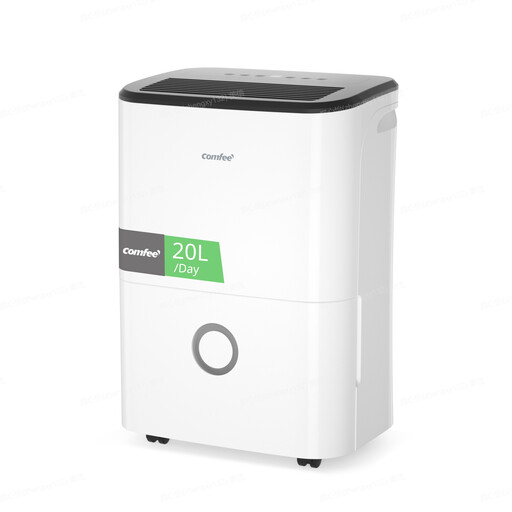
Why it suits this profile: This model combines a 3-litre tank, timer and multiple settings in one unit for rooms up to around 40 m².
The room capacity, tank size and maximum output are clearly stated. Do check that 40 m² is suitable for your ceiling height and moisture levels.
3-litre tank, timer of up to 24 hours and automatic shut-off when the tank is full.
Why it suits this profile: Continuous drainage, automatic defrosting and automatic restart make this a good choice for users who want to keep manual maintenance to a minimum.
You’re not reliant on a small tank alone. Bear in mind that you’ll need a suitable drainage hose, positioned correctly below the unit.
Continuous drainage, auto-restart and R290 refrigerant, according to the product details.
Why it suits this profile: Normal, continuous, smart and drying modes make the unit suitable for a range of indoor spaces and situations.
The drying mode is a practical feature for laundry, while the timer stops the unit running for longer than necessary. Always check ventilation and positioning.
Laundry-drying function, three fan speeds and a stated airflow of up to 166 m³ per hour.
We’ve put together a complete, up-to-date list of products that meet these strict selection criteria and the applicable European safety regulations.
Place the unit on a stable, level surface and don’t block the air inlet or outlet. If it has been transported or tilted, the safety information says to leave it upright before switching it on. Keep it out of reach of children and use it indoors only.
For a bedroom:
For a cellar:
According to the specifications, the stated power consumption is around 280 watts typically and up to 360 watts. The cost depends on how long you use it and your electricity price. A simple calculation is: power in kW × number of hours × electricity price. Actual costs may be lower if the compressor switches off intermittently.
It can be, if the room is around 100 m³ and the moisture levels aren’t exceptionally high. Also check the ceiling height, ventilation and whether several rooms are connected.
That depends on how much moisture is in the room. The tank may fill up more quickly in a damp cellar than in a bedroom. Use continuous drainage if you don’t want to empty the tank regularly.
It depends on the power, running time and your electricity tariff. At a stated typical consumption of 280 watts, it uses around 0.28 kWh per hour of operation. The timer and smart mode can help limit unnecessary running time, but actual consumption will vary depending on the situation.
