
Vandaag of morgen in huis

Kwaliteit gegarandeerd

Welkomstaanbiedingen ontgrendelen: GRATIS bezorging | Tot 80% korting | Gratis 30 dagen JoyPlus-proefperiode
Download de app
If you own a PlayStation 5, Xbox Series X, or a high-end gaming PC, you know your hardware is capable of great things. Yet, your gaming experience might not feel as fluid as you'd expect. Chances are, your current television is the bottleneck. A 144Hz TV can be the difference between a standard gaming session and a fully immersive, stutter-free experience.
In this article, we'll help you make the right choice. We'll explain what to look for and highlight several models specifically designed for the modern gamer and film enthusiast.
TV specifications can be overwhelming. Let's break it down and focus on what truly matters for a smooth and sharp visual experience.
A high 144Hz refresh rate is the foundation for fluid visuals, especially in fast-paced action. But to take full advantage of it, you need a TV with HDMI 2.1. This connection has enough bandwidth to transmit a 4K 144Hz TV signal. Furthermore, HDMI 2.1 supports crucial features for gamers:
Many modern gaming TVs use QLED technology. A QLED TV uses a layer of quantum dots to display colours more accurately and brightly than a standard LED TV. This results in a more vibrant and realistic picture, which benefits not only games but also movies and shows. Also, look for support for HDR formats like Dolby Vision and HDR10+, which further enhance contrast and colour detail.
A 55-inch TV is often a popular choice. This size offers an immersive experience without overwhelming most living rooms. When making your choice, also consider the design. A TV with thin bezels and a sturdy stand will fit more easily into your decor.
Based on the specifications that matter to gamers and entertainment enthusiasts, we have selected a few compelling models.

The TCL 55T8C is a versatile gaming TV that combines a QLED panel with a range of performance-oriented features. The Google TV operating system provides a user-friendly interface and access to a wide array of apps.
Why It Stands Out This TV is equipped with Game Master mode, which bundles features like ALLM, VRR, and FreeSync Premium for an optimised gaming experience. The combination of a 144Hz panel and HDMI 2.1 ports makes it a solid choice for next-gen consoles and PCs.
Pros
Who Is This TV For? For the all-around user seeking a reliable gaming TV with an excellent smart TV platform and great sound quality, without the premium price tag.
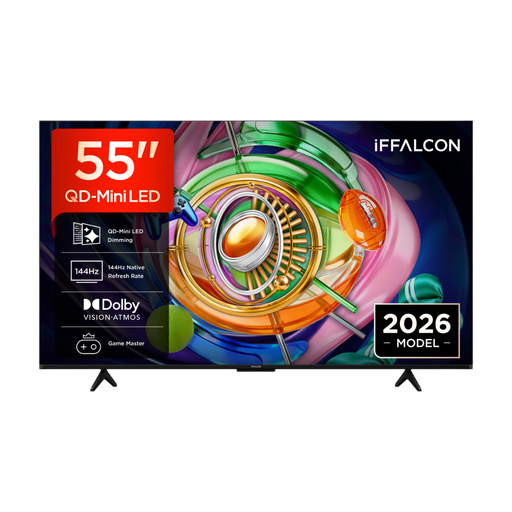
The iFFALCON 55U85A takes it a step further with QD-Mini LED technology. This technique uses thousands of tiny LEDs for backlighting, allowing for much more precise control over brightness and contrast.
Why It Stands Out The combination of QD-Mini LED and a 144Hz VRR panel delivers an impressive picture with deep blacks and bright highlights. According to the manufacturer, the TV can even simulate a refresh rate of up to 288Hz via its Game Accelerator mode, which could be compelling for PC gamers.
Pros
Who Is This TV For? For the image purist and tech enthusiast looking for advanced display technology to get the best possible picture quality while gaming and watching movies.

The Hisense 55E7Q PRO is aimed squarely at gamers with its 144Hz Game Mode PRO. This TV combines a QLED panel with fast image processing to ensure a responsive and fluid experience.
Why It Stands Out The focus here is heavily on gaming performance. The 144Hz Game Mode PRO, combined with AMD FreeSync Premium and low input lag, makes this a highly capable gaming TV. The VIDAA U9 smart TV platform is known for its speed and simplicity.
Pros
Who Is This TV For? For the serious gamer who wants a TV designed primarily for performance, with a fast interface and all the necessary features for a competitive edge.
These models are a great starting point, but the television market is large and diverse. Are you looking for a different size, a different technology, or do you simply want to compare more options?
Explore our full selection and find the TV that perfectly matches your needs.
Yes, absolutely. Although the PlayStation 5 currently has a maximum output of 120Hz at 4K resolution, a 144Hz TV can handle this signal perfectly. This also makes you future-proof for any potential updates or consoles that might support higher refresh rates. The key benefits, such as VRR and ALLM via HDMI 2.1, work excellently with a PS5.
The difference lies in the number of times the image is refreshed per second. A 144Hz screen can display 144 frames per second, compared to 120 on a 120Hz screen. For console gamers (PS5/Xbox) playing at 120Hz, the difference is negligible in practice. For PC gamers who can achieve frame rates above 120 fps, the step up to 144Hz can provide an even smoother and sharper motion display.
To combine 144Hz with a 4K resolution, a TV with HDMI 2.1 is essential. Older HDMI versions do not have the bandwidth to process this amount of data. Additionally, HDMI 2.1 is necessary for other key gaming features like 4K@120Hz, VRR, and eARC (for high-quality audio).
