
Vandaag of morgen in huis

Kwaliteit gegarandeerd

Welkomstaanbiedingen ontgrendelen: GRATIS bezorging | Tot 80% korting | Gratis 30 dagen JoyPlus-proefperiode
Download de app
By the Joybuy Product Recommendation OfficerLast updated: July 16, 2026
Being on the road doesn't mean you have to be without power. Whether you're travelling in your camper van, working at a remote site, or simply need to charge your laptop in the car, a reliable power source is indispensable. A 12V to 230V power inverter converts the direct current (DC) from your car or camper battery into the alternating current (AC) you get from a household outlet.
However, the market offers a dizzying array of choices, specifications, and claims. This article is designed to help you buy the right power inverter. We'll explain the key considerations and present a selection of popular models, so you can make an informed choice that fits your needs.
Before making a choice, it's helpful to understand a few technical aspects. This will help you find a model that not only works but is also safe for your equipment.
This is perhaps the most critical distinction.
An inverter's power is expressed in Watts (W). Pay attention to two values:
A car power inverter that plugs into the cigarette lighter socket is typically limited to around 150W. For higher power, you must connect the inverter directly to the battery.
Check which connections the inverter offers. A standard 230V outlet is the baseline, but an inverter with USB ports (USB-A, USB-C) is convenient for directly charging phones and tablets. Essential safety features include protection against overheating, short-circuiting, over- and under-voltage. This protects both the inverter and your valuable equipment.
Based on specifications and functionality, we have selected several models that offer a solution for different use cases.
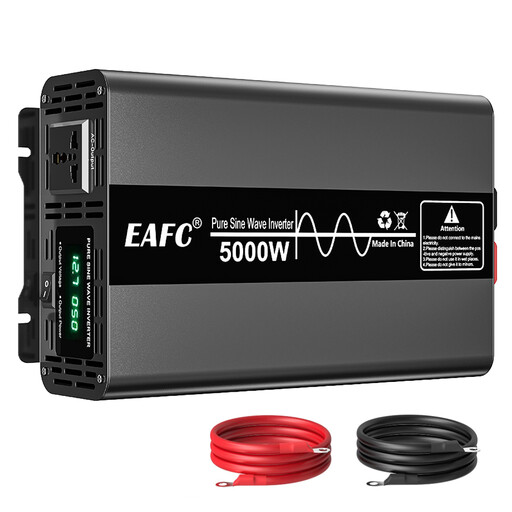
Why It Stands Out This inverter is designed for heavy-duty applications. With a continuous power of 2500W and a peak power of 5000W, it can effortlessly power tools, kitchen appliances, and multiple devices at once. The digital LCD provides real-time status information, such as input/output voltage and power consumption.
Pros
Who Is It For? This model is an excellent choice for camper inverter owners looking for a powerful solution, professionals on location, and for off-grid applications or as an emergency power supply at home.
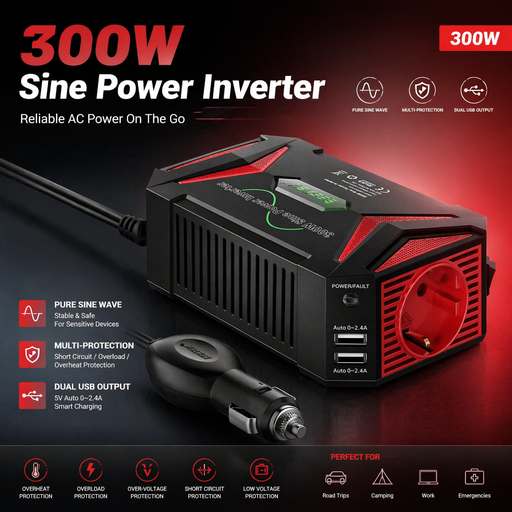
Why It Stands Out This compact car power inverter from BESTEK is T?V-certified and delivers a stable, pure sine wave. With 300W of continuous power, it's perfect for providing in-car power for laptops, cameras, and other personal electronics. The two USB ports, with a combined output of 4.8A, automatically detect the connected device for efficient charging.
Pros
Who Is It For? Ideal for daily use in the car, for travellers, and anyone looking for a reliable way to charge personal devices without directly burdening the battery.
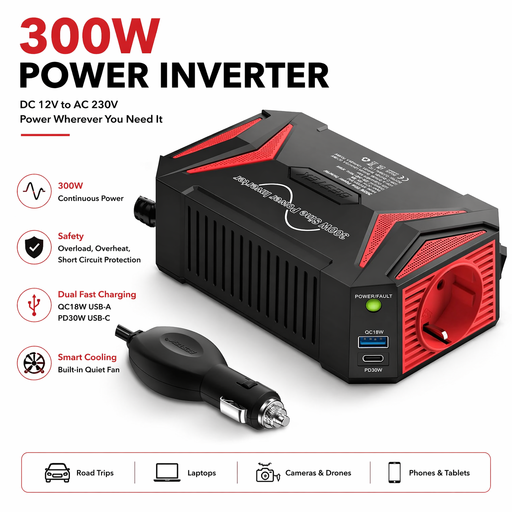
Why It Stands Out This model builds on the reliable foundation of the 300W inverter but adds modern fast-charging technology. With a PD30W Type-C port and a QC3.0 USB port, you can charge the latest smartphones, tablets, and even some MacBooks at high speed. According to BESTEK, the PD port is up to 6 times faster than a standard charger.
Pros
Who Is It For? The perfect 12V inverter for tech-savvy users who want to fully utilize the fast-charging capabilities of their modern devices, both on daily commutes and longer journeys.
If an inverter isn't exactly what you're looking for, or if you want to explore more options for power on the go, check out our extensive range of USB Devices for power banks, car chargers, and other mobile power solutions.
A pure sine wave inverter produces an alternating current (AC) with a smooth, consistent waveform, similar to the power from a household outlet. This is essential for the correct and safe operation of sensitive electronics like laptops, televisions, and devices with an electric motor. Modified sine wave inverters produce a blocky, stepped wave that can interfere with or damage these devices.
No. Most cigarette lighter sockets in cars are protected by a 10A or 15A fuse, meaning they can deliver a maximum power of about 120W to 180W. Inverters up to 300W can often be connected, but you won't be able to utilize their full power. For higher-power inverters, a direct connection to the battery using the included cables is necessary.
Most laptop chargers consume between 45W and 100W. An inverter with a continuous power rating of 150W is typically sufficient to charge a laptop. Always check the wattage listed on your laptop's power adapter. To be on the safe side, choose an inverter with a slightly higher continuous power rating than you strictly need.
