
Vandaag of morgen in huis

Kwaliteit gegarandeerd

Welkomstaanbiedingen ontgrendelen: GRATIS bezorging | Tot 80% korting | Gratis 30 dagen JoyPlus-proefperiode
Download de app
A flat battery often strikes at the worst possible moment: on a cold morning, during a camping trip or in a car park with no help nearby. A 12V jump starter can get you out of trouble, but not every model is right for every car. A compact power bank for a small petrol car, for example, has different requirements from a jump starter for a diesel car, SUV or campervan.
When comparing models, focus on the actual specifications. A high peak current may sound impressive, but it doesn’t tell you everything about whether the device is suitable for your vehicle.
Manufacturers often quote a peak current, such as 1200A, 2000A or even 7000A. This alone doesn’t guarantee that every vehicle will start without a problem. Check the following too:
A jump starter for an SUV or diesel car will generally need more reserve power than a model for a compact city car.
A high capacity in mAh doesn’t automatically make a portable jump starter suitable for large engines. Peak current, starting current and battery capacity are different figures. Also consider the device’s size and weight. A device weighing over two kilos is less convenient to carry every day, but may offer more features, such as an air compressor or 12V output.
A jump starter with an air compressor is handy if your car tyre is underinflated, but check the maximum pressure, hose and supplied valve adapters. A USB port or 230V inverter also has a power limit. Never connect devices that require more watts than the specifications allow.
Compare the stated peak current with the manufacturer’s recommendation for your vehicle. For example, the Porbi S306 lists a 1200A peak current and support for 12V petrol and diesel vehicles. The manufacturer also lists cars, SUVs, motorbikes, boats and snowmobiles as suitable applications.
For larger engines, a model with more reserve power makes more sense. According to the product description, the UTRAI JS-30 is specified for 12V petrol engines and diesel vehicles up to 14 litres. Always check the manual and your vehicle details before ordering.
Look for features such as:
These features reduce the risk of connecting the device incorrectly, but they don’t replace careful use. Connect the red clamp to the positive terminal and the black clamp to the negative terminal or a suitable earthing point, as directed by the manufacturer.
A jump starter with an air compressor can be useful for car and bicycle tyres, as well as sports balls. Check whether you can set the pressure in PSI, bar or kPa. A jump starter with an LED light is useful for checking your vehicle at night, but also look at the light modes and remaining battery charge.
A USB output is usually enough to charge a phone. If you want to power a laptop or another device, check the USB-C PD output or whether there’s a separate inverter. A 12V to 230V inverter is not a jump starter and cannot start a flat battery on its own.
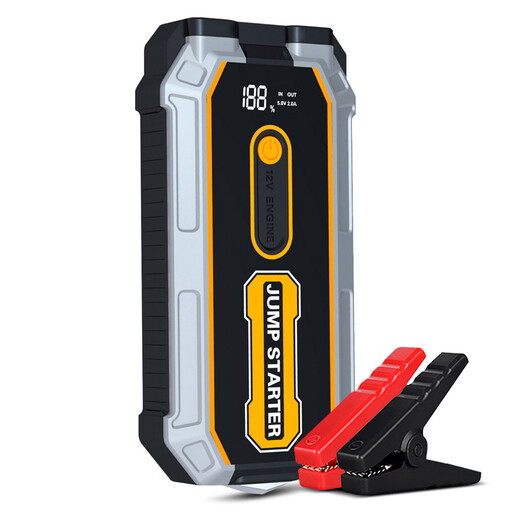
Why it suits this profile: A compact choice for drivers looking for an emergency car jump starter and a simple power bank for a 12V vehicle.
The specifications list a 1200A peak current, 600A starting current and 12V application separately. This makes it easier to compare the figures with your car’s requirements.
12800mAh battery according to the product description, 10W USB output, LCD screen and three LED modes, including SOS.
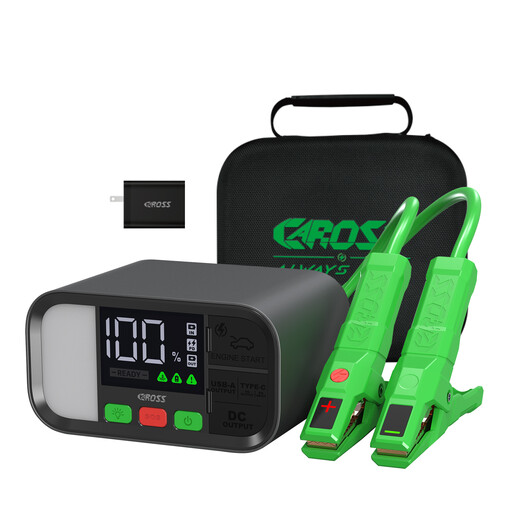
Why it suits this profile: A good choice if you value straightforward operation, a protective case and extra charging power on longer journeys.
The product information explicitly specifies 12V, a range covering petrol engines up to around 6.0 litres and diesel engines up to around 4.0 litres. This model is not designed for 24V systems.
16000mAh lithium-ion battery, 65W PD output, 3-inch screen and non-polarised clamps according to the product description.
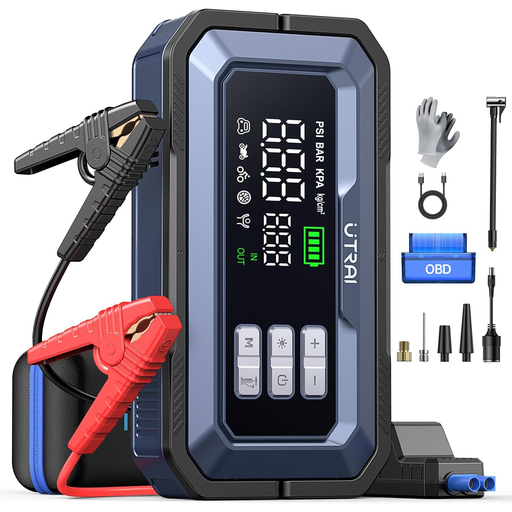
Why it suits this profile: A practical option for SUV and campervan drivers, outdoor enthusiasts and anyone who wants to inflate tyres or power 12V equipment as well as jump-start a vehicle.
The product description lists the functions separately: 7000A peak current, a compressor up to 150 PSI, pressure settings in four units and a 160W 12V output.
2000-lumen light, 18W USB-C charging, OBD2 adapter, five compressor modes and a stated suitability for diesel engines up to 14 litres.
We’ve put together a complete, up-to-date list of products that meet these strict selection criteria and the applicable European safety regulations.
Fully charge your jump starter before using it for the first time, and check its status before a long journey. Store it in a dry place, away from direct sunlight and not inside an extremely hot car. Lithium batteries lose capacity more quickly when exposed to prolonged heat.
Follow the instructions when jump-starting your vehicle, and avoid trying to start the engine repeatedly for long periods. Let the device cool down after use, then recharge it. Some manufacturers recommend topping up an emergency jump starter every three months; check the product-specific instructions for guidance.
No. Check the vehicle type, engine size and permitted battery voltage. A 12V jump starter is not suitable for 24V lorries. A booster may also fail to work if the battery is completely faulty or its voltage is below the minimum activation level.
Its lifespan depends on storage temperature, charging frequency and how it is used. Recharge the device regularly according to the manual, even if you haven’t used it. Don’t leave it permanently in a hot car, and check the battery status before setting off.
Charging the jump starter uses electricity, but this is normally only occasional. The compressor or USB function uses the device’s internal battery. A 12V inverter or additional device can put a strain on your car battery, so only use these accessories within their stated power limits and, ideally, with the engine running.
