
Vandaag of morgen in huis

Kwaliteit gegarandeerd

Welkomstaanbiedingen ontgrendelen: GRATIS bezorging | Tot 80% korting | Gratis 30 dagen JoyPlus-proefperiode
Download de app
A lukewarm drink on a hot day or spoiled food halfway through your holiday—these are the minor annoyances that can ruin a road trip or camping adventure. The market for portable cooling is vast, but it's filled with traps. Many models overpromise and underdeliver, leaving you with an expensive, power-hungry device that barely cools.
Before you invest in a new car fridge, it's crucial to see through the marketing hype. These are the three most common pitfalls:
35-litre cooler sounds spacious, but the motor compartment often eats up a significant portion of the internal space. Without a smart layout featuring baskets or a divider, you're left with an impractical, deep bin where everything gets jumbled together.To avoid these problems, there are a few technical specifications you must check. They mark the difference between a useful appliance and a source of frustration.
The most important factor is the cooling technology. A 12v compressor cooler works just like your refrigerator at home. It uses a refrigerant and a compressor to actively remove heat, allowing it to reach temperatures as low as -20°C, regardless of the outside temperature. This makes it a true portable fridge and even a portable car freezer. Thermoelectric models are only suitable for keeping already chilled items cool, not for actively cooling or freezing them.
A good camping fridge must be versatile. Look for models that operate on both 12V/24V (via the cigarette lighter socket in a car, RV, or boat) and 220V (via a standard wall outlet). This is often referred to as an electric cooler 12v and 220v. Equally important is the battery protection. A three-stage system (Low, Medium, High) is the standard. This allows you to set the voltage at which the cooler automatically shuts off, ensuring you always have enough power left to start your engine.
Look beyond the total litre capacity. An efficient layout with removable baskets or a divider makes it much easier to organise your items. For added convenience, some models feature a cooler with wheels and a retractable handle, which makes moving a full, heavy cooler significantly easier. Modern features like app-controlled coolers offer the ability to adjust the temperature remotely, which is useful when the cooler is in the back of the car.
Not everyone has the same needs. We've highlighted a popular model and matched it to different user scenarios.
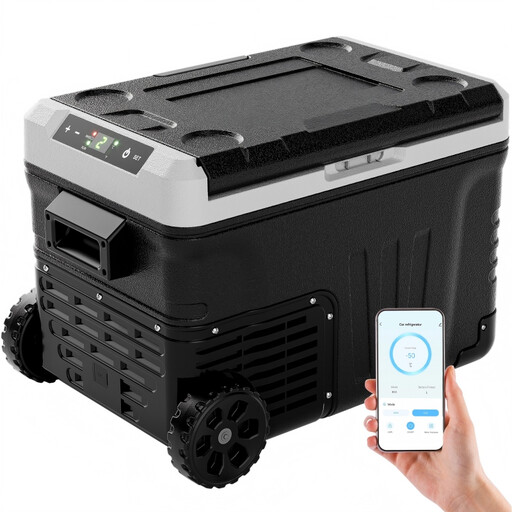
Why This Fits Their Persona: Ideal for RVers, truck drivers, or anyone on extended trips. The spacious 35L capacity and true freezing capability allow you to carry several days' worth of food, reducing reliance on supermarkets.
This model uses an efficient compressor that can freeze down to -20°C and features 3-stage battery protection to prevent a dead battery. The dual-zone with a divider ensures a practical layout.
Dual power supply (12V/24V & 220V) for use in the vehicle and at home. Stable operation on inclines up to 30 degrees, which is useful on uneven terrain.
Why This Fits Their Persona: For families heading to the campsite or the beach, ease of use is essential. The wheels and handles make it simple to move the cooler from the car to the campsite, even when it's fully loaded with drinks and snacks for the whole family.
The robust wheels and handles solve the problem of an unwieldy, heavy cooler. The removable baskets prevent the contents from becoming a jumbled mess, a common issue with deep coolers.
Easy to transport thanks to the off-road wheels and handles. Quiet operation (around 40 dB, according to the manufacturer), so it won't be disruptive in a tent or RV at night.
Why This Fits Their Persona: For those who love control and convenience. The app allows you to monitor and adjust the temperature, cooling mode, and voltage without having to touch the cooler. This is handy when it's in the back of the car or when you want to change settings from your camping chair.
The app functionality and clear LCD panel provide full transparency and control over performance, unlike 'black box' models where you have to guess the internal temperature.
Remote control via app for maximum convenience. Clear LCD control panel for direct adjustments and monitoring. Choice between MAX mode (fast cooling) and ECO mode (energy saving).
We have compiled a complete, real-time list of products that fully satisfy these strict selection criteria and UK safety regulations.
This depends heavily on the battery's capacity, the set temperature, the ambient temperature, and the cooler's insulation. An average car battery (approx. 60Ah) can typically power an efficient compressor cooler in ECO mode for 20 to 40 hours. However, it is crucial to use the battery protection feature (usually set to 'Medium' or 'High') to prevent the battery from becoming too deeply discharged.
A compressor cooler is a miniature fridge-freezer. It can cool and freeze independently of the outside temperature, often down to -20°C. A thermoelectric cooler can only cool to a certain differential from the ambient temperature (e.g., 20°C cooler). On a hot day, this is often insufficient to keep food safe. For serious on-the-go cooling and freezing, a compressor model is the only reliable option.
Modern compressor coolers have become significantly quieter. Many models produce a noise level of around 40-45 decibels when the compressor is running. This is comparable to the soft hum of a modern home refrigerator. While it is audible in a quiet environment, most users do not find it disruptive, especially not while driving.
