
Vandaag of morgen in huis

Kwaliteit gegarandeerd

Welkomstaanbiedingen ontgrendelen: GRATIS bezorging | Tot 80% korting | Gratis 30 dagen JoyPlus-proefperiode
Download de app
A flat car battery often happens at the worst possible time: on a cold morning, on the way to work or during a caravan holiday. A 12V car jump starter can help you get back on the road independently. However, not every model is suitable for every car, motorbike or van.
As a Joybuy Product Recommendation Officer, I focus primarily on verifiable specifications. Marketing terms such as “powerful”, “smart” or “safe” do not mean much on their own. So check the points below before buying a portable jump starter.
A peak current of 800, 1,500 or 4,000 A sounds impressive, but the figure does not tell you everything about starting performance. Manufacturers may present peak current in different ways. So also check which petrol and diesel engines the device is suitable for.
For example, an 800A model may be intended for smaller cars and motorbikes, while a heavier SUV or diesel van may need more capacity. The exact vehicle limits stated in the product manual remain the deciding factor.
A jump starter provides temporary power to start a vehicle. It does not charge a flat battery in the same way as a car battery charger or 12V battery charger. If you regularly keep a vehicle in storage, a mains charger with automatic charging control may be more useful.
Also pay attention to claims about pulse repair. According to EAFC’s product description, the function is intended to address certain issues affecting lead-acid batteries. This is a claim made by the brand and is not a guarantee that a worn or damaged battery will be restored.
A device with reverse-polarity protection and spark-free clamps reduces the risk of an incorrect connection, but correct use is still essential. A lithium jump starter should also be stored charged. Some models recommend recharging after use or every three months.
Also check whether the clamps are long enough, whether a sturdy storage case is included and whether the display clearly shows the charge status.
A 12V car jump starter is designed for vehicles with a 12V system. It is not suitable for 24V lorries or the high-voltage batteries used in electric cars. Next, check the stated engine size:
The capacity of a lithium jump starter is usually stated in mAh. A higher figure may provide more reserve power for USB devices, but it does not directly guarantee a more powerful start. Also pay attention to the charging standard. A model with USB-C, QC 18 W or PD output can charge a phone, tablet or laptop while you are on the move.
If you only need emergency starting power, you do not automatically need to choose the largest power bank. A compact device is easier to store in a motorbike or car boot.
Look for verifiable features such as:
When buying, also check the CE marking, safety information and manual. A CE marking is not proof that every marketing claim is accurate, but it is an important part of European product information.
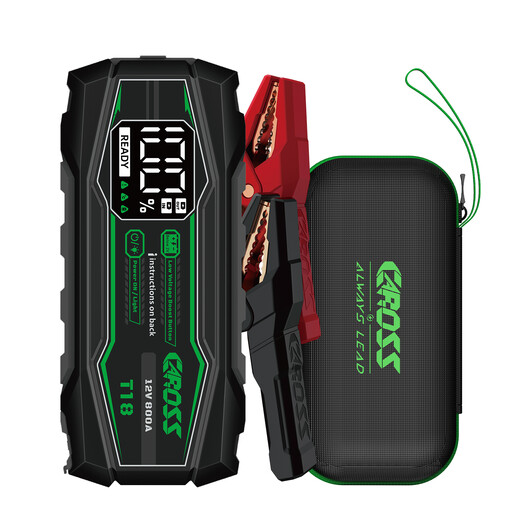
Why it suits this profile: This compact model is aimed at owners of 12V cars, motorbikes and smaller vehicles who want an emergency starter for use on the go without extra charging functions.
The product description states that it has a 10,000mAh lithium battery, boost function, spark reduction and reverse-polarity protection. However, check the exact engine limit in the manual.
800A peak current, 18W fast charging, digital display and protective case.
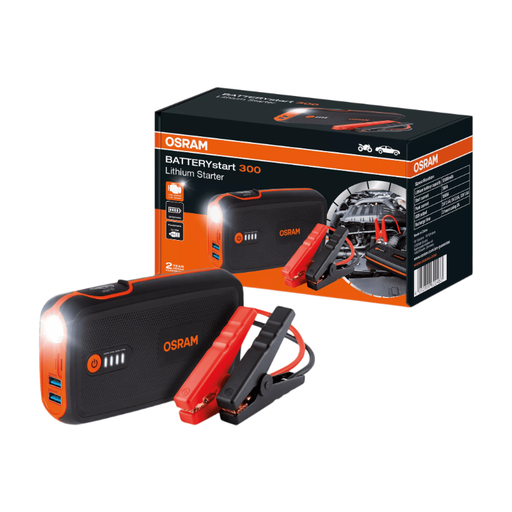
Why it suits this profile: A practical choice for drivers who want to carry a recognisable, compact device in a car or light commercial van and also charge USB devices.
The stated limits are specific: up to 6L petrol and 3L diesel. The product information also mentions correct connection and regular charging.
1,500A peak power, 13,000mAh capacity, dual USB output and integrated LED light.

Why it suits this profile: Designed for SUVs, boats, motorhomes and vehicles with larger petrol or diesel engines. According to the product description, the model is intended for engines of up to 9L petrol or 7L diesel.
Alongside 3,000A peak power, the product information lists several safety features, a boost mode and a protective casing. Check the manual for your vehicle.
3,000A peak current, USB-C, power bank function, LED light and support for 12V vehicles.
A 12V battery charger makes more sense when the car is often left unused, for example a classic car, motorbike or motorhome. According to the product description, the EAFC 12V 15A charger is suitable for AGM, EFB, GEL and standard lead-acid batteries, among others. The model has a display, automatic shut-off function and winter and summer modes.
View the EAFC 12V 15A Car Battery Charger if your main priority is charging and maintenance rather than starting a vehicle immediately.
We have put together a complete, up-to-date list of products that fully meet these strict selection criteria and the applicable European safety regulations.
Switch off the vehicle and first check that the device has sufficient charge. Connect the red clamp to the positive terminal and the black clamp to the negative terminal or a suitable earth point, as instructed in the manual. Try starting the vehicle briefly, usually for a few seconds per attempt. Remove the clamps as soon as the engine is running.
This varies depending on the model, temperature, storage conditions and charging habits. Store the jump starter in a dry place and away from extreme heat. Check the charge status regularly and charge it according to the instructions, for example every three months or after use.
Usually not completely. A jump starter is designed to provide a temporary starting boost. To charge or maintain a battery, you need a suitable car battery charger, trickle charger or battery charger with pulse repair. Always check that the charging type matches your battery.
